
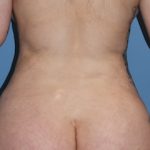
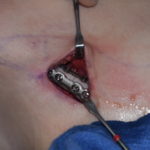
While rarely talked about or usedI have found that soft-tissue jaw angle implants are one of the most effective reconstruction option for patients with chronic masseteric muscle dehiscence when the primary problem is loss of soft-tissue contour and inadequate implant coverage rather than a deficiency of the bony jaw angle itself.
Concept
Instead of augmenting the mandible, the implant is designed to augment the soft-tissue envelope over the mandibular angle. It functions as a permanent volume replacement below the detached masseter muscle edge to correct the contour deformity over the jaw angle.
Indications
- Chronic masseter detachment with persistent hollowing
- Skeletonized jaw angle implant
- Thin soft-tissue coverage over the mandibular angle
- Failed traditional soft tissue augmentation treatments with recurrent hollowing
- Patients who do not require additional skeletal projection
Implant Design
Typical characteristics include:
- Equilateral triangle implant shape
- Implant thicknesses in the 3 to 6mm range
- Feathered edges to avoid visibility
Materials may include:
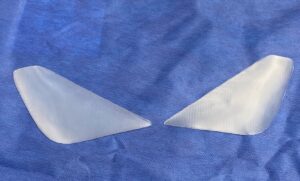
- Solid silicone elastomer
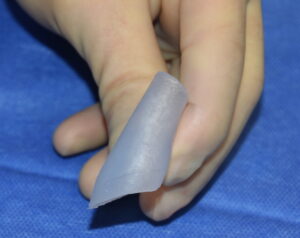
Advantages: soft and flexible, easy to insert/remove
Off the shelf options = 1.5 to 2mm silicone sheeting
Custom implant design – made in any configuration and
thicknesses, preferred method of implant fabrication
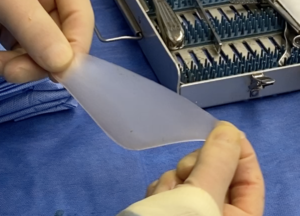
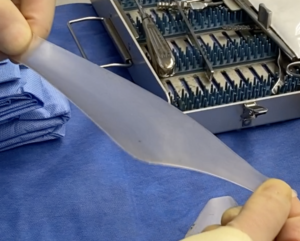
Disadvantages: While soft, it never feels exactly the same
as soft tissue muscle or fat
- ePTFE (Gore-Tex)
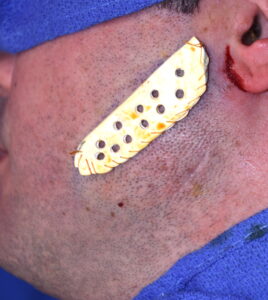
Advantages: off the shelf, easily hand shaped
sheets can be stacked for increased thickness
holes can be placed in the implant to allow for tissue ingrowth
Disadvantages: limited to 2mm thickness
firmer/stiffer than silicone
harder to remove
Surgical Placement
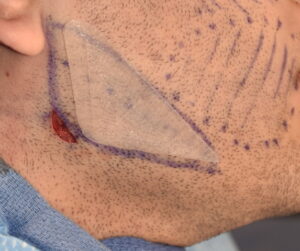
Regardless of the implant material it is placed:
- Under the skin over the contour deficient area
- Placed as deep into the tissues as possible
- In rare cases with very thin tissues it may be able to be placed right over the implant
- Small skin incision at or just behind the jaw angle
- Can be done under local anesthesia
Advantages
- Permanent volume restoration
- More predictable than fat grafting alone
- Immediate correction of contour deficiency
- Can enhance the appearance of a more defined jaw angle
Limitations
- Does not restore muscle function
- Requires adequate soft-tissue coverage
- Risk of displacement if pocket control is poor
- No method for fixation, relies in encapsulation for position control
The ideal design is usually a custom soft-tissue implant that occupies the space normally filled by the lateral masseter muscle, recreating the jaw angle contour. This is particularly effective in patients who already have a properly positioned jaw angle implant but have developed chronic muscle detachment and soft-tissue thinning.
Dr. Barry Eppley
Plastic Surgeon