
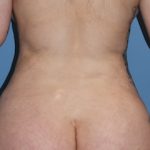
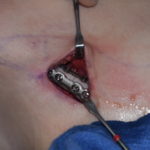
For masseteric muscle dehiscence after jaw angle implant surgery, soft-tissue augmentation can be useful when direct muscle reattachment is not possible, when there is persistent contour deficiency, or when implant coverage is inadequate. The goal is to recreate a soft-tissue envelope between the implant and overlying tissues and reduce visibility or palpability of the implant.
Fat Grafting
The simplest and most commonly considered option.
Advantages
- Adds volume to hollowed mandibular angle regions.
- Improves contour asymmetry.
- Scarless
- May improve scarred soft tissues through regenerative effects.
Limitations
- Variable long-term graft survival.
- Often requires more than one injection treatment
- Cannot create jaw angle definition
Best for:
- Mild hollowing.
- Not for thin jaw angle tissue coverage with implant skeletonization
Injectable Fillers
Generally a temporary solution.
Useful for:
- Diagnostic contour correction.
- Patients unwilling to any surgical approach
- Good immediate improvement with no recovery
Not ideal because:
- Repeated treatments are necessary.
Acellular Dermal Matrix (ADM)
Examples include AlloDerm and similar products.
Advantages
- Creates a biologic soft-tissue layer over the implant and thickens the subcutaneous tissue layer.
- Reduces soft tissue hollowing.
Technique
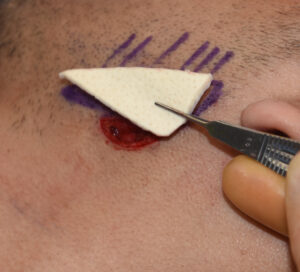
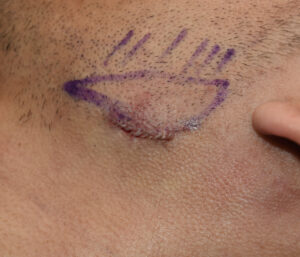
- ADM is inserted in the deep subcutaneous tissue over the lateral aspect of the implant through a small external skin incision
- Could be done intraorally but the closer the graft is to the skin the more improvement is seen.
- The graft shape should match the geometry of the hollowing
- Thick grafts (1.5 to 2mms ), can be layered/stacked.
Best for:
- Small soft tissue contour deformities.
- Partial muscle loss.
- First line approach if fat grafting is not desired
Soft Tissue Implants
Examples include ePTFE and solid silicone materials
Advantages
- Provides permanent volume
- Reduces soft tissue hollowing without making it look bloated or round.
Technique
- The implants materials are inserted through a small angle skin incision under local anesthesia.
- The implant shape should match the geometry of the hollowing which is always various forms of a equilateral triangle
- Larger implant thickness can be used
Best for:
- More significant/larger soft tissue contour deformities.
- Patients with naturally thicker soft tissue for better implant camouflage
My Preferred Hierarchy
For a stable jaw angle implant with chronic masseter dehiscence and lateral hollowing:
- Add structural fat grafting over the angle region.
- Add ADM if implant coverage need is thin or after fat graft failure
- Soft tissue implant options
The critical concept is that volume restoration alone does not correct a detached masseter, it camouflages it. Fat grafting and fillers are immediately effective but their long term effects are often inadequate. ADM is a good soft tissue augmentation method but its thicknesses are often not enough for complete contour correction. Implant options are the most effective but risk edge show in thin tissues.
Dr. Barry Eppley
Plastic Surgeon