

Small custom skull implants are a niche application of cranial augmentation used to correct localized contour irregularities rather than significantly enlarge the skull. They are ideal for patients who have subtle asymmetries, depressions, or flat spots that are noticeable in certain lighting or with short hair but do not require a large implant.
Common indications
- Small post-traumatic skull depressions
- Mild congenital contour irregularities
- Residual contour defects after previous skull surgery
- Minor flat spots or localized asymmetry
- Filling a visible indentation adjacent to a larger implant
- Smoothing transitions between normal skull and a previously placed implant
Typical implant dimensions
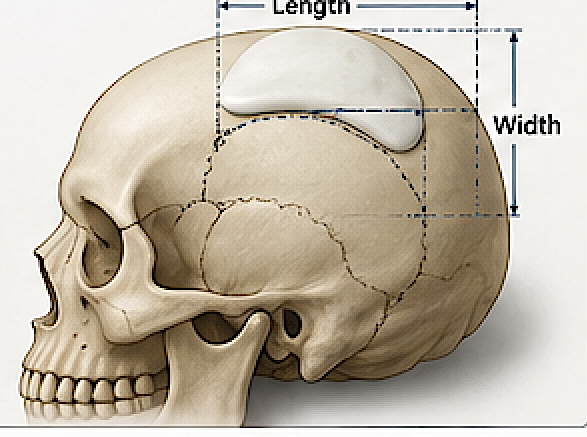
These implants are considerably smaller than full occipital or forehead implants.
|
Parameter |
Typical Range |
|
Length |
3–8 cm |
|
Width |
2–6 cm |
|
Maximum thickness |
2–8 mm |
|
Volume |
2–20 cc |
Most are only 3–5 mm thick at their greatest point, tapering smoothly to essentially zero at the edges so they become imperceptible.
Design process
A high-resolution (?1 mm slice thickness) CT scan is used to create a 3D model of the skull. The implant is then designed digitally to:
- Restore normal curvature
- Blend smoothly into surrounding bone
- Avoid palpable edges
- Preserve symmetry with the opposite side whenever possible
Because the implant is custom designed, no intraoperative carving is usually required.
Materials
The most common material is solid medical-grade silicone because it:
- Is easily customized
- Has a very smooth edge transition
- Is simple to insert through a relatively small incision
- Can be removed or modified if necessary
PEEK and porous polyethylene are generally reserved for larger reconstructive defects rather than small cosmetic contour corrections.
Surgical technique
The incision is usually placed within the hair-bearing scalp.
For many small implants:
- Incision length: 3 to 4 cm
- Subperiosteal pocket created only slightly larger than the implant
- Implant positioned directly on bone
- Microcrew fixation
- Closure in multiple layers
Because the dissection is limited, operative time is often 30–60 minutes.
Recovery
Compared with larger skull augmentations, recovery is relatively straightforward:
- Mild swelling for several days
- Minimal bruising
- Temporary scalp numbness around the incision
- Return to office work in about a week
- Exercise in 2–3 weeks
- Final contour visible after swelling resolves over several months
Advantages over fat grafting
Small skull contour defects are poorly suited to fat grafting because:
- Fat survival is unpredictable over the scalp.
- The scalp is relatively tight and not very expandable.
- Fat may produce irregular contours or partial resorption.
A custom implant provides:
- Permanent correction
- Precise restoration of the intended contour
- Stable long-term volume
Case Study
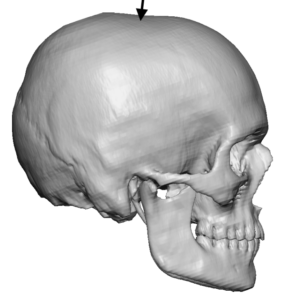
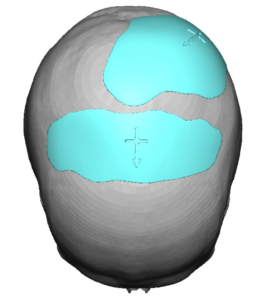
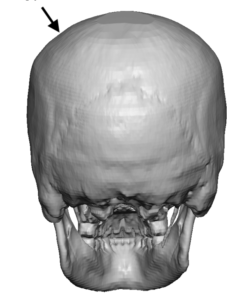 This young male was bothered by two area of skull contour defects. The first was a classic horizontal indentation along the coronal suture line (coronal dip) across the top of the head between the bony temporal lines. The second was a small flat spot at the left upper occipital-parietal area on the back of the head.
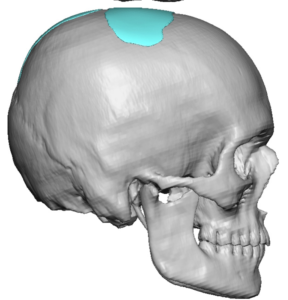
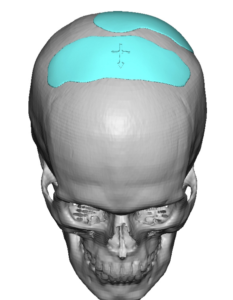 To address these contour defects two small custom skull implants were designed. The coronal dip implant had a maximum thickness of 3mms with a volume of 7.5ccs.
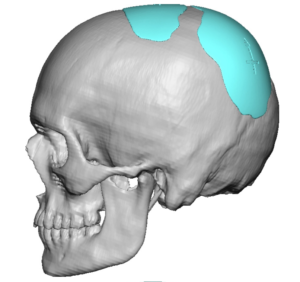
 The occipital-pariental implant had a maximal thickness 2.5mms with a volume of 10.3ccs.
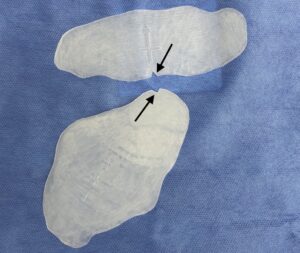 To prepare the implants for place small wedge markers made in the midline at the back edge of the coronal dip and from edge of the occipital implant. This was done knowing that once the implants were inside the suboeriosteal pockets only this area of the implant could be seen. The midline wedges served as orientation markers for the two implants.
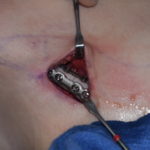
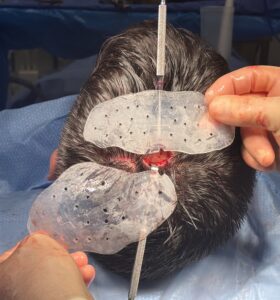 The custom implants werr inserted throigh a 3.5cm scalp incisions and oriented per the hand cut wedge markers.
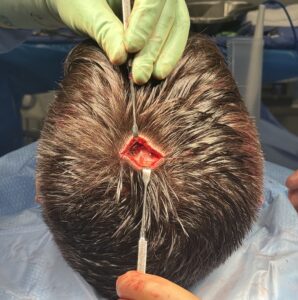
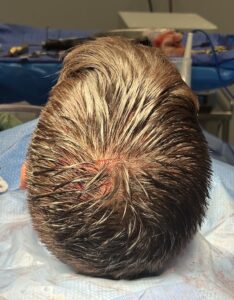 Double microsrew fixation was used to secuer them in position and two layer resorbable suture scalp closure done.
Discussion
Small custom skull implants are best suited for localized contour defects where the objective is to restore a normal skull shape rather than enlarge an entire cranial region. They are often overlooked because most discussions focus on larger skull augmentation implants, but in experienced hands they can provide excellent correction with relatively limited surgery.
The most suitable contour defects include:
1. Localized Skull Depressions
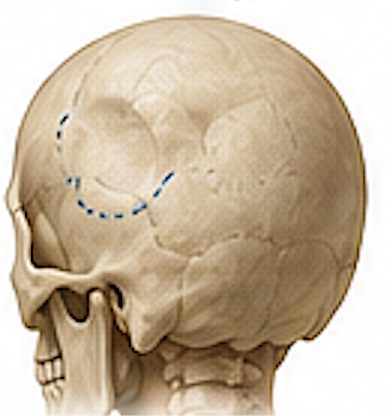
The most common indication.
Examples include:
- Small congenital depressions
- Minor developmental irregularities
- Focal flattening
- Asymmetric contour defects
Typical implant:
- 3–6 cm diameter
- 3–6 mm maximum thickness
2. Post-Traumatic Indentations
After blunt trauma, the skull may heal with a subtle depression that is cosmetically noticeable despite being structurally sound.
Ideal when:
- No fracture instability exists
- Depression is shallow
- CT demonstrates a localized contour deficiency
3. Residual Defects After Craniotomy
Following neurosurgical procedures, patients may have:
- Burr hole depressions
- Small bone contour irregularities
- Minor edge step-offs
Small custom implants can restore a smooth cranial surface without requiring revision of the original reconstruction.
4. Burr Hole Defects
Following placement of:
- Ventricular shunts
- Craniotomies
- Cranial monitoring devices
Small implants can camouflage the palpable depressions.
5. Implant Transition Zones
Patients with previous large skull implants occasionally have:
- Palpable implant edges
- Abrupt contour transitions
- Small adjacent depressions
A secondary custom implant can blend these areas into the surrounding skull.
6. Mild Plagiocephaly Residuals
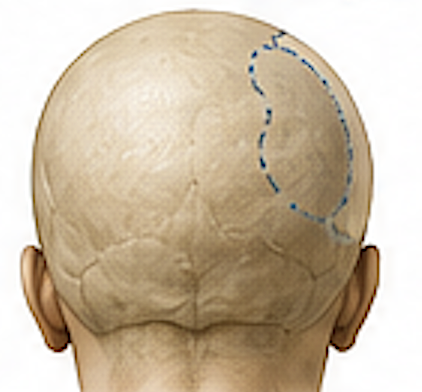
Some adults have only a small residual contour deficiency after childhood positional plagiocephaly.
Instead of augmenting an entire side of the skull, a localized implant may restore symmetry.
7. Focal Occipital Irregularities
Examples include:
- Small flat spot
- Localized indentation
- Asymmetric occipital prominence
These often require only 3–5 mm of augmentation.
8. Temporal-Parietal Junction Defects
These occur:
- Congenitally
- Following surgery
- After trauma
Because the surrounding skull curvature changes rapidly, a custom implant is much more precise than an off-the-shelf implant.
9. Small Forehead Contour Defects
Examples include:
- Localized forehead depression
- Contour asymmetry after osteoma removal
- Small post-traumatic defects
These should be distinguished from generalized forehead augmentation, which typically requires a larger implant.
10. Small Skull Asymmetries
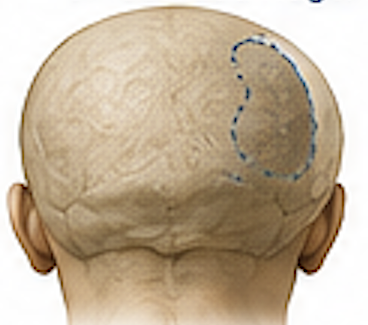
Patients sometimes notice:
- One side of the skull projects slightly less
- A subtle ridge on one side
- A localized flattening visible with a shaved head
A carefully designed implant can restore symmetry while leaving the overall head size unchanged.
Defects that are not ideal for small implants
Small implants are generally not the best solution for:
- Significant occipital flattening (requires a larger occipital implant)
- Major plagiocephaly
- Diffuse brachycephaly
- Large bilateral temporal deficiencies
- Global forehead retrusion
- Extensive post-craniectomy defects
- Cosmetic head widening involving broad regions
These situations usually require larger custom implants that address the entire deficient area rather than a focal defect.
Why custom implants are particularly effective
The skull has complex three-dimensional curvature. Even a seemingly minor 3–5 mm depression can create a visible shadow or highlight under certain lighting conditions. Because a custom implant is designed directly from a patient’s CT scan, it precisely matches the surrounding curvature and tapers to feather-thin edges, making the correction virtually imperceptible to touch or sight.
For small, localized contour defects, custom implants are often more predictable than fat grafting or bone cement because they provide a permanent, accurately shaped correction with a low risk of volume loss or contour irregularity.
Key Points
1) Limited skull contour defects are ideal for small size skull implants due to their precise contouring effects.
2) Placement of limited skull implants can be done through remarkably small scalp incisions
3) Placement with correct orientation of small skull implants =is the challenge due to lack of visibility once inside the subperiosteal pocket,
Barry Eppley, MD, DMD
World-Renowned Plastic Surgeon