
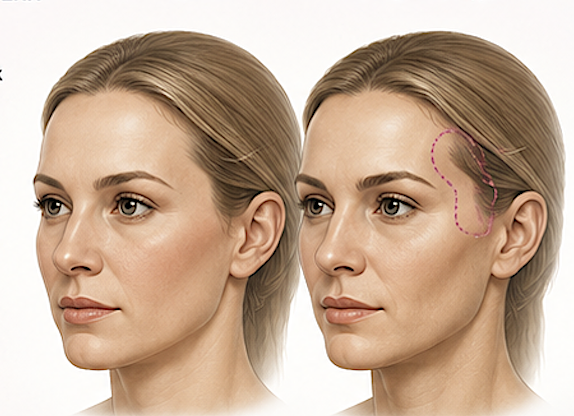
 Temporal implants are an effective option for women or men with moderate to severe temporal hollowing, particularly when the deficiency is due to age-related fat loss or muscle atrophy. Compared with fat grafting, implants provide a permanent, precisely controlled restoration of the temporal contour.
Ideal candidates
Patients who have:
- Congenital temporal hollowing
- Hollowing after significant weight loss or medication use
- Volume loss that has not responded well to fat grafting
- Asymmetry between the two temples
- Temporal hollowing following previous facial surgery
Implants:
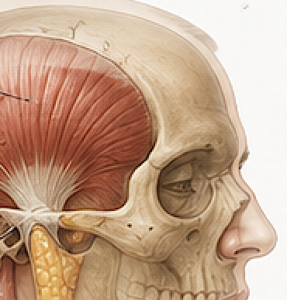
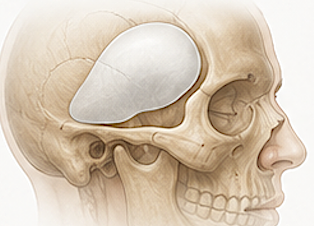
Standard temporal implants have been around now for almost a decade and they have two basic designs. Style I temporal implant is the original design used to fill small hollows isolated to the side of the lateral orbital rim or eye. Style 2 is the more extended design that augments the hollow from the bony temporal line of the forehead down to the zygomatic arch. For most patients style 2is usually the implant of choice because of its greater surface area coverage.
Custom temporal implants are also an option if the narrowness on the side of the head extends more posterity, the temporal hollering requires that the augmentation cross onto the lateral bony forehead or if the patient prefers a patient-specific implant approach.
Surgical approach
The implant is usually inserted through:
- A 2–3 cm incision hidden within the hair-bearing scalp, or
- Occasionally through another incision if combined with forehead or brow surgery.
The implant is positioned beneath the temporalis fascia but io top of the temporal muscle.
Advantages over fat grafting
|
Fat grafting |
Custom temporal implant |
|
Variable survival |
Permanent volume |
|
May require multiple sessions |
Usually one procedure |
|
Limited ability to correct contour precisely |
Exact CAD-designed contour restoration |
|
Can resorb over time |
Stable long-term shape |
Recovery
- Mild to moderate swelling for 1–3 weeks
- Bruising is usually minimal
- Most patients return to desk work within about one week
- Final contour becomes apparent over 6–12 weeks as swelling resolves
Aesthetic goals in women
Unlike male temporal augmentation, which may intentionally increase upper facial width, female temporal implants are typically designed to:
- Produce a soft, convex temporal contour
- Blend smoothly into the forehead and cheek
- Maintain an elegant oval facial shape
- Avoid an overfilled or overly broad appearance
When carefully designed, the implants should not be visible or palpable, and the result is a subtle restoration of youthful upper facial fullness rather than an obviously augmented appearance.
Case Study
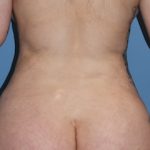
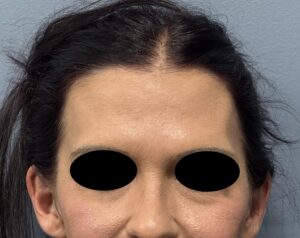 This thin petite female developed temporal hollowing for no known medical reason The left was more significant than the right with greater visibility of the three bony temporal borders (lateral forehead and orbital rim and zygomatic arch and increased depth to the hollowing.
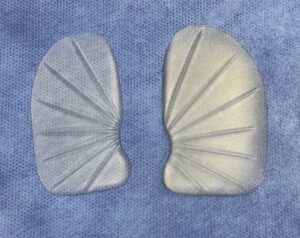 Under anesthesia differential size style 2 standard temporal implants were chosen with a 4mm size on the right and a 6mm size on the left.
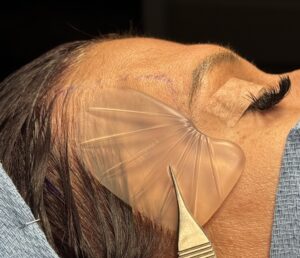
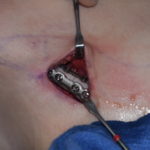
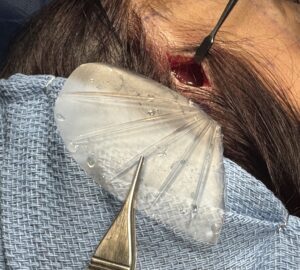 On the right side through a high retro temporal hairline incision the implant was vertically shortened as is often needed and placed in the subfascial pocket location.
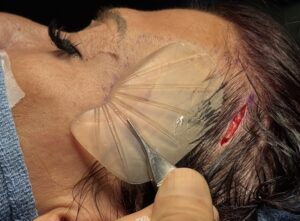
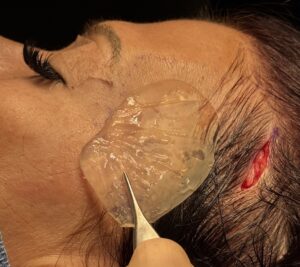 On the left side the implant was vertically shortened and also thinned down to 5mm thickness. It was similarly placed through a small high retro hairline incision.
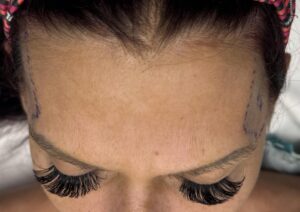
 he goal was to lessen the depth of the hollowing but not to make it overcorrected or create a temporal convexity.
Discussion
Women are treated with temporal implants more frequently than men, although the reasons differ between the sexes.
Women
Temporal hollowing is one of the most common upper-face contour concerns in women because:
- Women generally have less temporal muscle bulk and thinner soft tissues.
- Aging leads to loss of subcutaneous fat, making the temporal hollow more apparent.
- Cosmetic procedures such as facelifts, browlifts, or fat loss after weight reduction can accentuate the hollow.
- Hairstyles that expose the temples often make even mild hollowing noticeable.
For these reasons, temporal augmentation is a common aesthetic procedure in women. Many women with mild-to-moderate hollowing are treated with fat grafting, while those seeking a permanent correction or who have severe bony deficiency may be candidates for custom temporal implants.
Men
Men undergo temporal implants less often overall, but when they do, the goals are often different:
- Correction of congenital temporal hollowing.
- Restoration after excessive temporal muscle atrophy or surgery.
- Creation of a broader, stronger upper facial frame as part of facial masculinization.
- Balancing augmentation after jawline, chin, or cheek implants.
Men generally have:
- Larger temporalis muscles.
- Thicker skin and soft tissue.
- A naturally wider bitemporal dimension.
These characteristics tend to camouflage mild temporal hollowing better than in women.
Why custom temporal implants are more common in men than fat grafting
Although women account for more patients with temporal hollowing overall, men are proportionally more likely to choose custom silicone temporal implants because:
- They often desire a larger increase in head width beyond what fat grafting can reliably achieve.
- Permanent, precisely shaped augmentation is usually preferred.
- Implant placement beneath the temporalis fascia provides a stable, well-defined contour that complements other skeletal enhancement procedures.
Typical distribution for standard temporal implants
Based on my extensive experience, the approximate distribution is:
- Women: 70%–80%
- Men: 20%–30%
By contrast, for fat grafting to the temples, women may account for 75–90% of the patients.
The distinction reflects the different aesthetic goals: women usually want to restore lost volume and achieve a smooth transition between the forehead and cheek, whereas men more often aim to increase upper facial width and create a stronger, more masculine craniofacial frame.
Key Points
1) Standard temporal implants can be an effective option for age related temporal Halloween for many women.
2) In temporal hollowing with asymmetry, a larger standard implant can be used on the more affected side, although some modification of the implant is usually necessary
3) a high small incision behind the upper temple hairline is a good approach for the vertically long style two standard temporal implant,
Barry Eppley, MD, DMD
Plastic Surgeon