


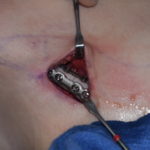
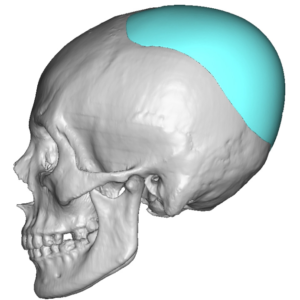
 For aesthetic skull augmentation, custom solid silicone implants are generally the preferred material because they best satisfy the requirements of cosmetic cranial contouring: precise shape, smooth contours, long-term stability, and the ability to be safely revised if necessary. While materials such as PEEK, porous polyethylene (Medpor), PMMA, and titanium all have specific reconstructive indications, they offer few advantages—and several disadvantages—for purely aesthetic skull reshaping.
Here are the reasons why.
1. Custom Design Accuracy
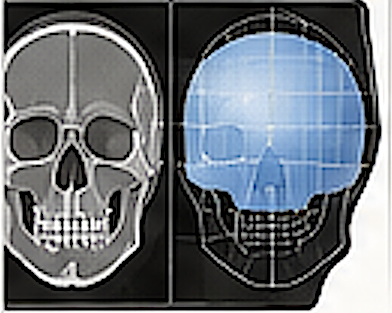
Every skull has a unique contour deficiency. A custom implant is designed directly from a patient’s high-resolution CT scan using CAD software, allowing:
- Exact correction of flat areas
- Restoration of symmetry
- Smooth transitions into the surrounding skull
- Precise control of projection in millimeters
Silicone can be manufactured with excellent dimensional accuracy, faithfully reproducing even complex curved surfaces.
2. Soft Tissue Compatibility
Unlike facial implants, the scalp is:
- Thick
- Well vascularized
- Relatively immobile
- Under constant tension
Solid silicone performs exceptionally well beneath the scalp because:
- It does not stimulate significant inflammation.
- It becomes surrounded by a thin fibrous capsule that stabilizes the implant.
- The capsule allows slight physiologic movement without compromising position.
After healing, patients generally cannot feel that an implant is present other than the improved skull shape.
3. Smooth Surface Creates Better Cosmetic Contours
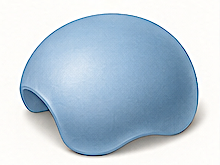
Aesthetic skull implants require long flowing curves.
Silicone is manufactured with:
- perfectly smooth surfaces
- continuous radii
- no sharp transitions
This produces the most natural external contour.
4. Large Volume Augmentation
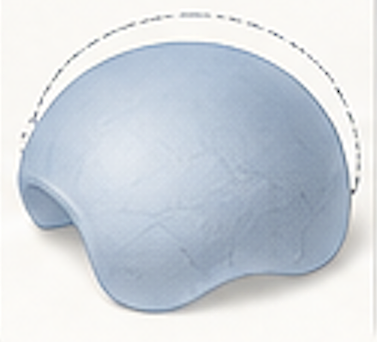
Many skull augmentations require:
- 8–20 mm projection
- 80–300 cc of added volume
- correction across a large surface area
Silicone can safely provide these large-volume augmentations while remaining relatively lightweight and maintaining excellent contour accuracy.
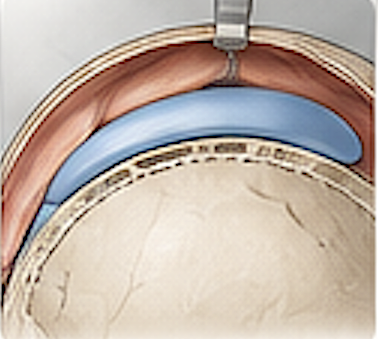
5. Slight Elasticity Improves Insertion
One of silicone’s greatest advantages is its flexibility.
The implant can:
- flex
- roll
- fold slightly
during insertion through a relatively limited scalp incision.
Once inside, it immediately returns to its exact designed shape.
Rigid materials like PEEK or titanium cannot do this and often require substantially larger incisions.
6. Easier Revision Surgery
One of the realities of cosmetic surgery is that revisions occasionally become necessary.
Patients may later desire:
- additional projection
- reduction
- asymmetry correction
- edge modification
- extension of the implant
Silicone is the easiest cranial implant material to revise because it does not bond directly to bone. The implant can typically be removed cleanly, modified, or replaced with minimal disruption to the surrounding tissues.
7. Excellent Long-Term Stability
Silicone does not:
- degrade
- dissolve
- corrode
- fatigue
- resorb
- shrink
Patients commonly retain silicone implants for decades without material failure.
8. Minimal Bone Reaction
Silicone rests directly on the skull beneath a thin fibrous capsule.
The underlying bone generally remains stable, with little clinically significant remodeling or resorption in aesthetic applications because the skull is a non–load-bearing surface.
9. Lower Cost
Compared with PEEK or titanium, custom silicone implants are generally:
- less expensive to manufacture
- easier to produce
- less expensive to revise if needed
This provides a meaningful economic advantage without sacrificing cosmetic outcomes.
Comparison with Other Materials
|
Property |
Solid Silicone |
PEEK |
Porous Polyethylene (Medpor) |
Titanium |
|
Custom contour accuracy |
Excellent |
Excellent |
Good |
Excellent |
|
Flexibility for insertion |
Excellent |
None |
Minimal |
None |
|
Revision surgery |
Excellent |
Moderate |
Difficult |
Moderate |
|
Tissue ingrowth |
No |
Minimal |
Extensive |
None |
|
Cosmetic contour |
Excellent |
Excellent |
Good |
Good |
|
Large-volume augmentation |
Excellent |
Good |
Limited |
Limited |
|
Cost |
Lowest |
High |
High |
Highest |
|
Best for aesthetic skull augmentation |
Yes |
Sometimes |
Rarely |
Rarely |
Why Not PEEK?
PEEK is an outstanding reconstructive cranial implant material, particularly for replacing bone after trauma, tumor resection, or decompressive craniectomy. However, for cosmetic augmentation it offers little advantage over silicone while introducing several drawbacks:
- Completely rigid, requiring larger incisions for placement.
- More difficult to revise or exchange.
- Significantly higher manufacturing cost.
- No proven aesthetic advantage in contour or long-term outcome.
Why Not Porous Polyethylene?
Porous polyethylene is designed to encourage tissue ingrowth. While this can provide fixation, it is usually unnecessary in aesthetic skull augmentation because:
- Large skull implants are inherently stable beneath the scalp.
- Tissue ingrowth makes revision surgery substantially more difficult.
- Removal often requires sacrificing incorporated tissue or thinning the implant.
For procedures where revisions or adjustments may be desired, these characteristics are disadvantages rather than benefits.
Why Not Titanium?
Titanium is exceptionally strong and biocompatible, making it ideal for structural craniofacial reconstruction. However, it is not well suited for aesthetic skull augmentation because it is:
- Rigid and unforgiving during insertion.
- Less adaptable for creating broad, smooth cosmetic contours.
- More expensive.
- Difficult to modify once manufactured.
- More likely to be palpable at edges if not perfectly contoured.
Its strength far exceeds what is required for cosmetic skull contour enhancement.
Conclusion
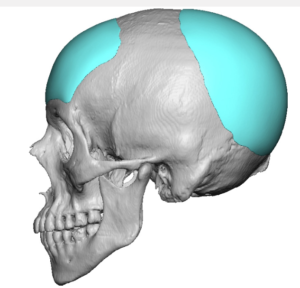
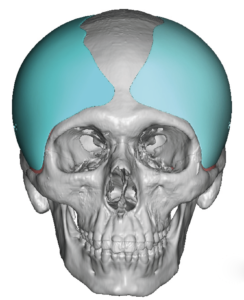 For aesthetic skull augmentation, the ideal implant material should combine precise custom shaping, smooth contours, ease of placement through limited incisions, long-term stability, and straightforward revision if future changes are desired. Custom solid silicone best meets all of these requirements. While PEEK, porous polyethylene, and titanium each have important roles in reconstructive craniofacial surgery, they offer no demonstrated cosmetic advantage over silicone for elective skull contouring and often introduce additional complexity, cost, and revision challenges. For these reasons, custom solid silicone has become the material of choice for most aesthetic skull augmentation procedures.
Dr. Barry Eppley
Plastic Surgeon