

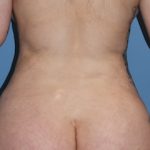
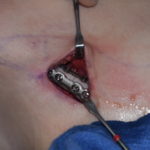
Custom pectoral implants are patient-specific chest implants designed to augment or reconstruct the pectoral region when standard implant sizes and shapes are inadequate.
Common Indications
- Congenital chest asymmetry
- Poland syndrome
- Pectus excavatum contour deformities
- Post-traumatic chest wall defects
- Body-contouring augmentation in men seeking greater pectoral definition
- Revision of unsatisfactory results from standard pectoral implants
Design Process
- CT scan or 3D imaging of the chest.
- Computer-aided design (CAD) to create an implant matching the patient’s anatomy and desired contour.
- Manufacturing of a custom solid silicone elastomer implant.
- Preoperative review of the design and dimensions.
Advantages Over Standard Implants
- Better correction of asymmetry.
- Ability to address complex contour deficiencies.
- More precise fit to the chest wall.
- Reduced need for intraoperative modification.
- Can create augmentation in areas not covered by stock implants.
Surgical Placement
- Usually inserted through an axillary (armpit) incision.
- Positioned in a submuscular pocket.
- :Pocket control is the mechanism for implant positional stability.
Limitations
- Higher cost than stock implants.
- Manufacturing lead time (often several weeks).
- Requires high-quality imaging and careful preoperative planning.
- Revisions can be more complex if major design changes are needed.
Materials
Most custom pectoral implants are made from:
- Solid silicone elastomer (only material option))
For reconstructive cases such as Poland syndrome or severe chest asymmetry, custom implants are the primary implant to use.. In aesthetic cases, however, custom implants are generally used when standard off-the-shelf pectoral implants are inadequate.
Case Example
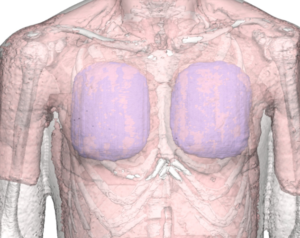
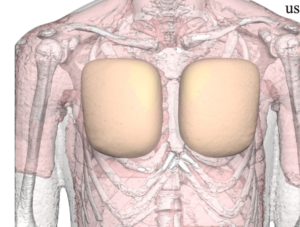
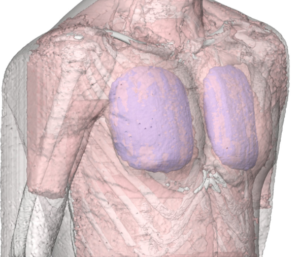
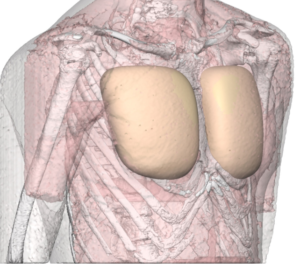 This patient already had excellent pectoral implant results but wanted even greater upper chest fullness and projection. Using 3D CT imaging, custom-designed implants were created with double the volume of his original implants and a tailored shape to enhance upper chest contour.
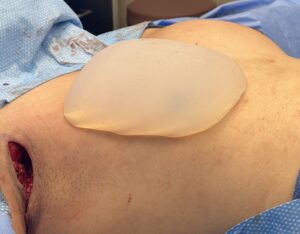
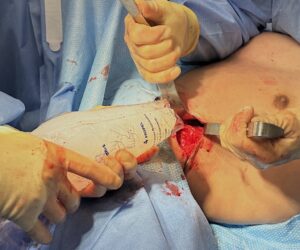 Inserted through the existing underarm incisions using a specialized funnel technique, the new implants delivered a more powerful, customized chest enhancement without additional scars.
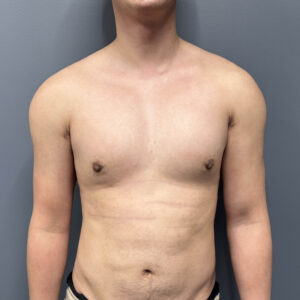
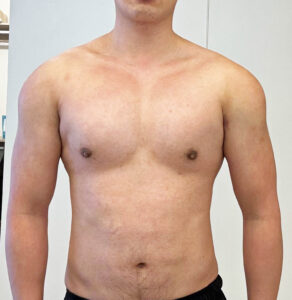 His six month post appearance showed the improvement in upper pole fullness. It illustrates how much volume increase it takes to make a visible external change in chest shape.
Discussion
While there are numerous reasons for why pectoral implant patients opt for a custom implant design but the most common one is an enhanced effect. The patient has an adequate result from their current standard pectoral implants but is seeking greater definition and a specific shape from the custom implant.
There are several specific changes that many of these patients seek:
- Increased upper pole fullness (often the most important)
- Enhanced definition along the inner sternal border
- Greater overall projection
- More of a vertical rectangular shape rather than an oblong or rounder shape
- Improved symmetry
While there are common male chest shape goals the initial implant has created a footprint which is now encapsulated with scar. Unlike breast implants in which modification of the encapsulated is more easily done, in pectoral implants that can be more challenging due to the limitations of incisional access. As a result the most straightforward custom implant replacements are those in which the implant footprint remains the same as the first implant but the shape is changed and the projection increased (as this case demonstrates).
The key question is how much more implant volume is needed to make an effective change as well as how more volume can the implant pocket accommodate.As a general rule most inplant volumes can be increased by 100% but no more. And as another general guideline most implant volumes need to be increased by at least 50% to be seen externally.
Dr. Barry Eppley
Plastic Surgeon