

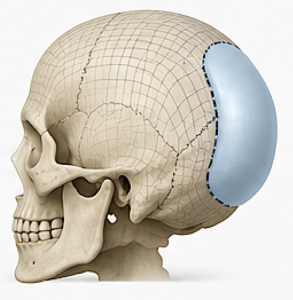
 A custom skull implant for back-of-head augmentation (occipital augmentation) is designed to increase the projection, width, or overall contour of the posterior skull. This is one of the most predictable forms of skull reshaping because the implant is placed directly on the bone and can be manufactured to precise dimensions from a CT scan.
Implant Design Process
- 3D CT Scan
- A thin-cut (1 mm) craniofacial CT scan is obtained.
- The skull is converted into a 3D digital model.
- Custom Implant Design
-
- The desired increase in projection (typically 5–20 mm or more) is digitally added.
- The implant can address:
- Flat back of head
- Asymmetry
- Narrow occipital width
- Combined projection and width deficiencies
- Manufacturing
-
- Usually fabricated from:
- Solid silicone elastomer (most common)
- PEEK (less common for aesthetic augmentation)
- Produced as a patient-specific implant.
- Usually fabricated from:
Surgical Procedure
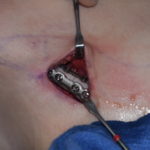
- Incision placed low in the scalp behind the head.
- Subperiosteal pocket developed over the occipital bone.
- Implant inserted and secured if necessary.
- Procedure typically takes 1–2 hours.
- Usually outpatient surgery.
Amount of Augmentation
Typical increases:
- Mild: 5–8 mm
- Moderate: 10–15 mm
- Large: 15–25 mm+
Unlike bone cement techniques, a custom implant can create substantial projection without limitations from material handling during surgery.
Advantages of a Custom Implant
- Exact shape and thickness predetermined before surgery.
- Smooth transitions into surrounding skull.
- Greater augmentation than injectable or fat graft methods.
- Reversible if necessary.
Limitations/Risks
- Scalp tightness limits maximum enlargement.
- Seroma (fluid collection) is the most common postoperative issue.
- Infection risk is low but can require implant removal.
- Temporary scalp numbness is common.
- Hair usually grows through the scar, making it difficult to see.
Determining What Is Possible
The key factor is the soft tissue stretch capacity of the scalp, not the skull bone itself. Most patients can accommodate 10–15 mm of projection easily, while larger augmentations require individual evaluation.
Case Example
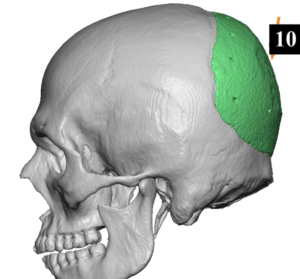
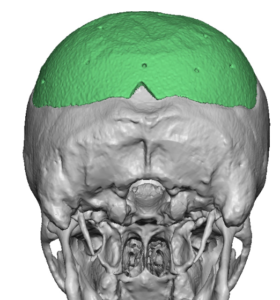
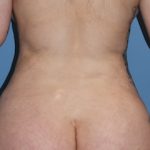
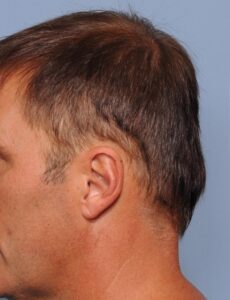
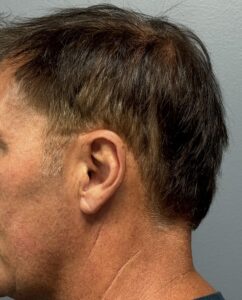
This middle aged male desire a correction of the flat back of his head. A custom skull implant was designed and placed though a low horizontal scalp incision. He went to heal and was not seen again form 12 years A 3D CT scan showed a well positioned back of the head skull implant. Some implant settling could be seen around the upper perimeter of the implant,
 .
.
His result in side profile showed good contour improvement.
Discussion
Long-term results from custom occipital skull implants are generally very stable because the implant is placed directly on the skull and neither the skull shape nor the implant material changes significantly over time.
What Happens 5–20+ Years Later?
Implant Shape and Volume
- A solid silicone custom implant maintains its original dimensions indefinitely.
- There is no resorption as occurs with fat grafting or some bone substitutes.
- The augmented contour seen after healing is usually the contour maintained long-term.
Bone Beneath the Implant
- Minor pressure remodeling of the outer skull surface can occur over many years.
- This is usually only a few millimeters and is rarely clinically significant.
- It does not typically affect appearance or implant stability.
Scalp and Soft Tissue
- The scalp stretches to accommodate the implant during healing.
- Once healed, the soft tissues generally remain stable.
- Normal aging can lead to scalp thinning, but this is usually not enough to make a properly designed occipital implant visible.
Implant Visibility and Palpability
- The back of the head is one of the most forgiving locations because:
- The scalp is relatively thick.
- The implant is broad and smooth.
- Hair often provides additional camouflage.
- A well-designed custom implant typically remains undetectable to casual observation.
Potential Long-Term Issues
Seroma
- Almost always an early postoperative issue.
- Rarely becomes a late problem once healing is complete.
Infection
- Most infections occur within weeks to months after surgery.
- Very late infections are uncommon but can occur after:
- Trauma
- Scalp surgery
- Significant bacteremia
Edge Visibility
- More likely if:
- Implant edges are abrupt.
- Implant is excessively thick.
- Patient has a very thin scalp.
- Modern custom designs with feathered edges have largely minimized this risk.
Implant Mobility
- Rare with a properly fitting custom implant.
- Large occipital implants generally become stabilized by the surrounding tissue pocket.
Patient Satisfaction Over Time
Among craniofacial implant procedures, occipital augmentation tends to have:
- High long-term satisfaction.
- Low revision rates.
- Stable aesthetic results.
The most common reason for revision is not a complication but a patient deciding they would like more augmentation after living with the implant and becoming accustomed to the change.
Comparison to Bone Cement Augmentation
|
Feature |
Custom Implant |
Bone Cement |
|
Precise shape |
Excellent |
Surgeon-dependent |
|
Reversible |
Yes |
Difficult |
|
Large augmentations |
Excellent |
Limited |
|
Long-term stability |
Excellent |
Excellent |
|
Revision capability |
Easier |
More difficult |
Typical Appearance After 10+ Years
A properly designed custom occipital implant generally:
- Looks the same as it did after the initial swelling resolved.
- Maintains projection and contour.
- Is not visible through the scalp.
- Does not require replacement simply because of age.
From my experience with custom skull implants, the occipital region is one of the most reliable locations for long-term craniofacial implant augmentation because it is subjected to relatively little motion and has thick soft-tissue coverage compared with areas such as the forehead or jaw angle.
Dr. Barry Eppley
Plastic Surgeon