
While jaw implant augmentation can be done at any age if a structural deficiency exists management of loose or sagging overlying soft tissues is usually more age dependent. But in contemporary facial surgery we are seeing much younger patients seeking face/necklift surgery. Weight loss, early onset aging in structurally weaker faces and the desire for more aggressive facial definition changes has created an interface of structural jaw augmentation with soft tissue tightening procedures.
As a result this has created the question of what is the order of the two procedures, if they are done sepatrately, or should they be done together.
In most patients considering a custom jawline implant, I would generally recommend:
If you’re under 45–50 and have good neck/jawline soft tissues
Jawline implant first.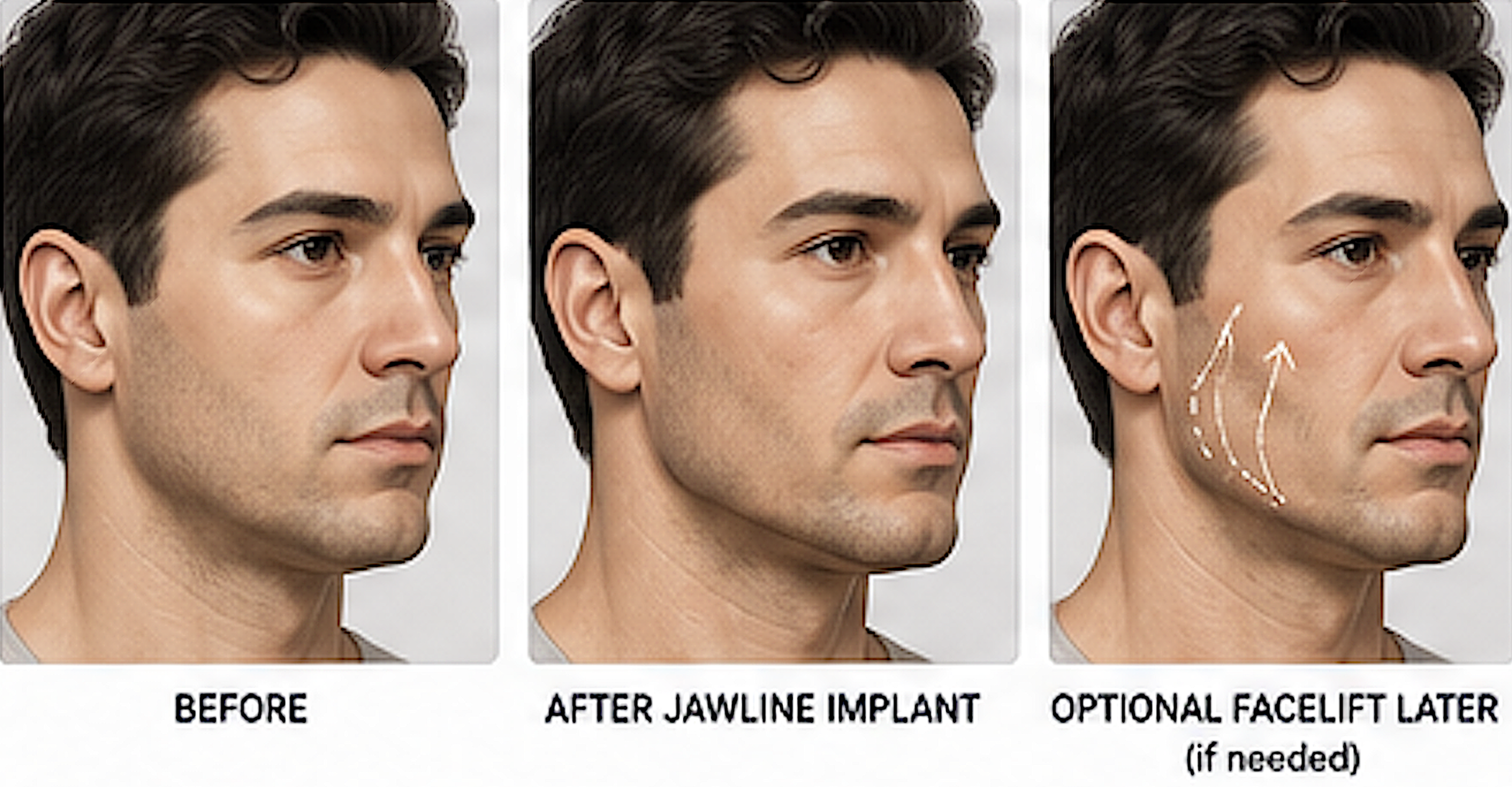
A custom jawline implant creates the skeletal foundation. Once the bone framework is enlarged, the overlying soft tissue often redrapes surprisingly well. Many patients discover they don’t need a facelift afterward.
If you’re older or have significant jowls/neck laxity
Combine them do the facelift at the same operation.
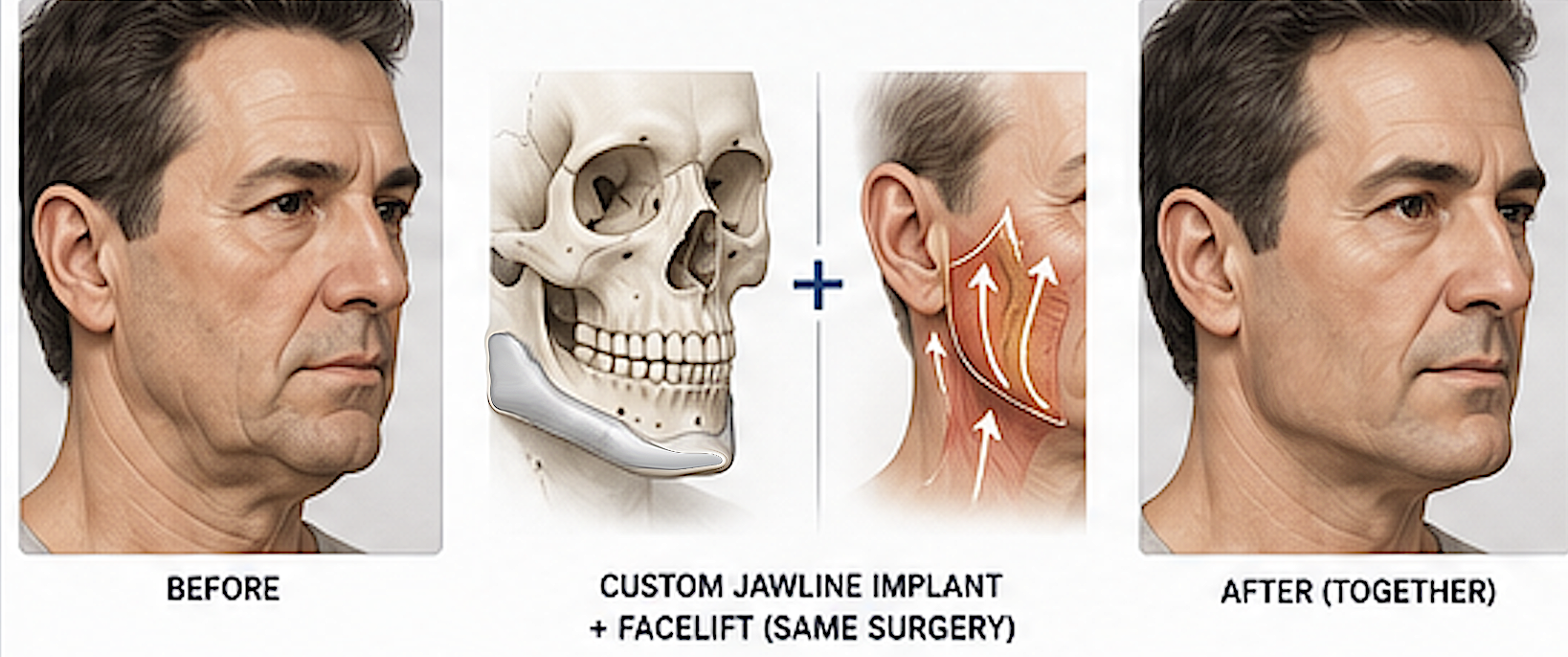
A large custom jawline implant pushes the skeletal framework outward, but it does not reposition descended soft tissues. If the jawline is obscured by:
- jowls,
- loose neck skin,
- platysmal banding,
- heavy submandibular tissues,
then the implant may be partially hidden unless the soft tissue is simultaneously tightened.
Why doing the facelift later can be less ideal
Suppose you place a substantial custom jawline implant and then perform a facelift 1–2 years later:
- The facelift surgeon is working over an altered skeletal framework.
- Scar tissue from the implant surgery may make dissection slightly more challenging.
- The soft-tissue redraping is often more predictable when the final skeletal shape is already present.
For that reason, if you know you will eventually want both procedures, I usually favor:
implant first and facelift simultaneously, rather than implant now and facelift later.
When I would stage them
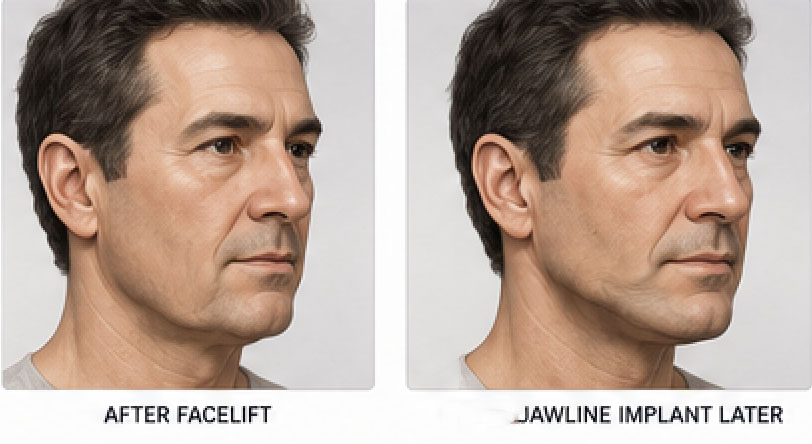
I would stage them if:
- You’re unsure about the amount of jaw augmentation desired.
- You’re relatively young and may not need a facelift.
- Your primary issue is skeletal deficiency rather than soft-tissue descent.
In those patients:
- Custom jawline implant.
- Allow 6–12 months for healing and tissue adaptation.
- Reassess whether a facelift is actually needed.
Simple Rule
- Strong bone deficiency, minimal sagging : Jawline implant alone first.
- Strong bone deficiency plus visible jowls/neck laxity : Jawline implant + facelift together.
- Borderline soft-tissue laxity : Jawline implant first, then reassess after healing.
Dr. Barry Eppley
Plastic Surgeon