

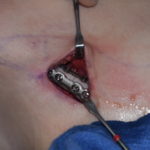
One of the more contemporary and increasingly popular facial reshaping changes that has grown in demand due to custom implant designs is that of the periorbital region, specifically the upper midface along the infraorbital rims and cheekbones. Structural deficiencies in this area even in young people cause undesired effects of undereye hollowing and weak cheekbones.
While injectable fillers and fat are commonly used to try to correct these issues they often are either ineffective or have very short term effects and do not add long-term structural support. Adding implants to do so offers a more effective and sustained solution and the complex shape of the area requires a custom design approach for optimal structural enhancement.
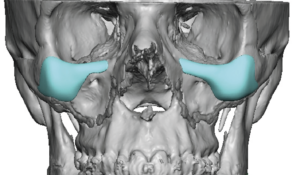
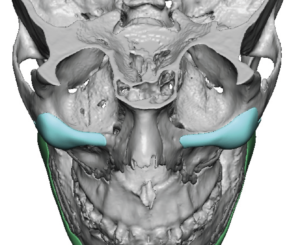
Because of the anatomic proximity of the infraorbital rims to the cheek (malar) region the question in custom facial implant designs is whether not should be infraorbital only or a combined infraorbital-malar implant design That decision really comes down to whether your deficiency is limited to the orbital rim or whether it extends into the cheekbone/midface.
A useful way to think about it:
Custom Infraorbital Implant
This is best when your main concern is:
- Under-eye hollowing
- Weak infraorbital rim definition
- Mild negative orbital vector
- You like your current cheekbone width and projection
- You want a more subtle change
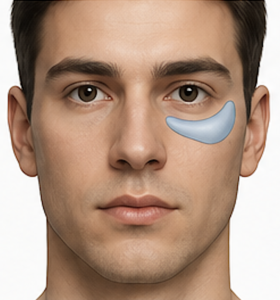
The implant primarily builds out the lower eye socket rim and tear-trough region. It is an under-eye correction rather than a full midface augmentation.
Custom Infraorbital-Malar (IOM) Implant
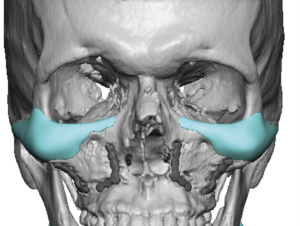
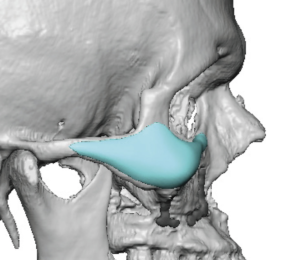
This is usually the better choice when you have:
- Under-eye hollowing plus flat cheeks
- A noticeable negative orbital vector
- Eyes that appear prominent because the midface lacks support
- Desire for a stronger, more mature upper-midface structure
- Interest in a “high cheekbone” effect
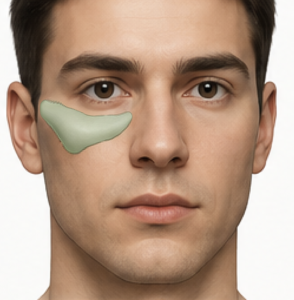
An IOM implant augments the infraorbital rim and continues around onto the cheekbone and often along the zygomatic arch, creating a continuous upper-midface structure rather than just filling the rim.
The Most Important Question
When you push up under your eyes with your fingers and like the result:
What is actually improving?
If the improvement comes purely from more support directly under the eye, an infraorbital implant may be enough.
If the improvement comes from:
- a smoother lid-cheek transition,
- stronger cheekbones,
- a wider/more horizontal upper face,
- looking older and more structurally developed,
then an infraorbital-malar implant is often the better match.
For Most Male Patients Seeking a More Mature Look
In my experience, many men who say:
“I want to look older, more masculine, less baby-faced”
are often describing an upper midface deficiency, not just an infraorbital rim deficiency. That’s why custom IOM implants are frequently favored—they create a horizontal skeletal line from beneath the eye toward the cheekbone rather than just adding volume under the eye.
A Practical Test
Ask yourself:
- Are your cheeks already projected enough?
- From a 45° angle, does the midface look flat?
- Do you want more of a “high cheekbone” appearance?
- Is your goal primarily structural masculinization rather than tear-trough correction?
If you answer yes to 2–4, I would lean toward an infraorbital-malar design. If the answer is mostly no, a custom infraorbital-only implant may be more appropriate.
Dr. Barry Eppley
Plastic Surgeon