 Silicone sheeting is most commonly used as an external scar treatment but its less known as an implant material for facial soft tissue augmentation. This is a concept that has been explored historically but is rarely used today in a pure sheet form.
Silicone Sheeting as an Implant
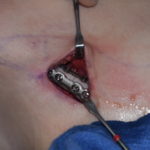
Thin sheets of medical-grade silicone can be surgically inserted into soft tissue pockets to provide volume enhancement. Potential applications include:
- Temporal hollowing
- Facial contour deficiencies
- Correction of localized soft tissue atrophy
Advantages

- Soft and flexible compared to solid carved implants.
- Can be stacked in layers to achieve varying amounts of augmentation.
- Easily trimmed intraoperatively.
- Relatively inexpensive.
Disadvantages
- Difficult to secure adequately.
- Potential for folding, wrinkling, or migration.
- May develop implant edging over time
- May be palpable in areas with thin soft tissue coverage.
- Becomes encapsulated with no tissue integration
Historical Use
Prior to the availability of modern facial implant systems and widespread fat grafting, surgeons occasionally used:
- Stacked silicone sheets
- Rolled silicone sheets
- Silicone sponge blocks
for correction of contour deficiencies. Most of these applications have largely been replaced by:
- Preformed and custom.facial implants
- Fat grafting
- Acellular dermal matrices
Current Niche Applications
For a surgeon experienced with implant fabrication, silicone sheeting can still be useful for:
- Small soft tissue contour defects
- Camouflage of implant edges
- Secondary revisions
Comparison with Fat Grafting
For pure soft tissue augmentation, especially in the face:
- Fat grafting generally provides a more natural feel and appearance and is the preferred technique
- Silicone sheeting offers permanent volume with no resorption but may be more palpable and less adaptable to facial movement.
For facial areas such as the temporal region and soft tissue areas outside bony borders silicone sheet implants can work well in selected patients. In contrast, for dynamic regions such as the lips, nasolabial area, and perioral tissues, fat grafting is usually superior.
From a reconstructive standpoint, silicone sheeting functions somewhat like a permanent “volume spacer” and can be a useful option when a patient desires permanent augmentation but either lacks donor fat or wants to avoid the variability of fat graft survival.
 Implantech AlliedSil™ Silicone Sheeting is one of the few commercially available implant-grade silicone sheet materials intended for surgical implantation and custom contour augmentation. It is supplied as a sterile, non-reinforced silicone sheet that can be cut, stacked, carved, or layered to create custom implants or contour corrections.
Key Characteristics
- Medical-grade solid silicone elastomer
- Sterile packaging
- Long-term implantable (>30 days)
- Non-reinforced construction
- Can be layered to increase thickness and volume
Facial Applications
For facial surgery, silicone sheeting is typically used as a surgeon-fabricated implant material rather than a stock implant. Potential uses include:
- Temporal hollowing augmentation
- Submalar/midface soft tissue augmentation
- Prejowl contour correction
- Camouflage of implant edges
- Correction of localized contour defects
- Secondary revision procedures
Advantages
- Easily trimmed with scissors or scalpel
- Allows custom thickness by stacking layers
- Softer and more adaptable than many preformed implants
- Permanent volume with no resorption
- Useful when stock implants do not fit the defect
Case Example
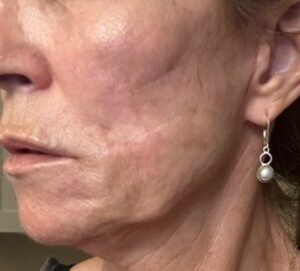
 This older female developed facial lipoatrophy with ther most significant change occurring in the soft tissue ‘trampoline’ area between the zygomatic arch and the jawline. She had tried fat injection grafting which completely resorbed and she did not want any further efforts with that approach. The cost of Alloderm sheets and cadaveric fat tissue (e.g., Alloclae) were prohibitive. This left the option of thin silicone sheeting.for the soft tissue augmentation technique.
For facial soft tissue augmentation silicone sheeting is best thought of as a customizable permanent spacer material that can bridge the gap between fat grafting and traditional preformed facial implants. It is particularly useful for soft tissue facial areas where traditional bone=based implants can not be used and where subtle volume enhancement is desired. It’s use for these indications is rare but it offers the benefits of permanent volume, easy reversibility and low cost. It is far from a first line treatment but can be useful in the properly selected patient.
Dr Barry Eppley
Plastic Surgeon