
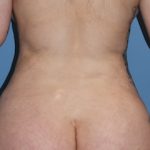
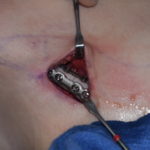
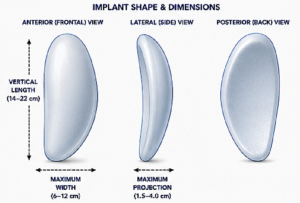
For custom aesthetic hip implants, the dimensions are driven more by the patient’s pelvic width, soft-tissue thickness, and desired silhouette than by a standard size. Typical design ranges I have used are:
|
Parameter |
Typical Range |
|
Vertical length |
14–22 cm |
|
Maximum width |
10–14 cm |
|
Maximum projection |
1.5 – 4.0 cm |
|
Edge thickness |
Feathered to near zero |
|
Superior pole thickness |
20–50% greater than inferior pole |
Small Hip Augmentation
- Length: 14–16 cm
- Width: 6–8 cm
- Projection: 1.0- 1.5 cm
- Goal: soften hip dip
Moderate Hip Augmentation
- Length: 16–19 cm
- Width: 8–10 cm
- Projection: 1.5–2.5 cm
- Goal: athletic hourglass shape
Large Hip Augmentation
- Length: 18–22 cm
- Width: 10–12 cm
- Projection: 3.0 cm or greater
- Goal: dramatic lateral pelvic widening
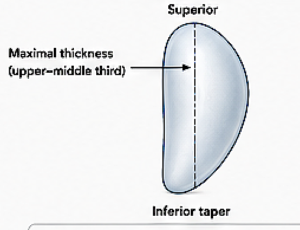
Preferred Cross-Section
Rather than a hemispheric profile, a crescent/teardrop cross-section usually looks more natural:
Design Ratios
A useful starting point:
- Length : Width 2:1
- Projection : 20–30% of width
- Superior thickness : 1.3–1.5 × inferior thickness
For example, a common female aesthetic implant for moderate augmentation
- Length = 18 cm
- Width = 9 cm
- Maximum projection = 2.5 cm
- Superior projection = 2.5 cm
- Inferior projection = 1.5 cm
CAD Design Rule
The implant should:
- Begin just below the iliac crest.
- End above or at the greater trochanter.
- Have its point of maximum projection centered in the upper-middle third.
- Taper smoothly into the lateral thigh.
For a truly custom design from CT, I typically start by measuring:
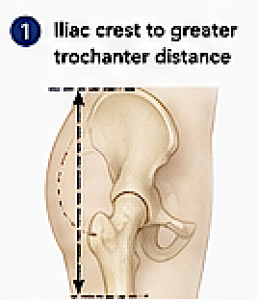
Iliac crest to greater trochanter distance which is the vertical height of the implant.
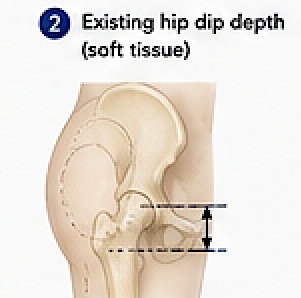
Determine hip dip depth. Lay a ruler over the iliac crest down to the greater trochanter and measure the depth of the concavity…and then add 1 cm.
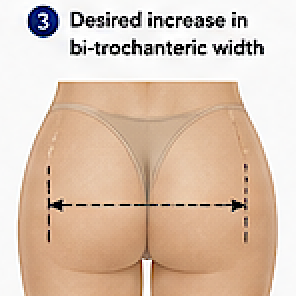
Desired increase in bi-trochanteric width, how much curve is needed.
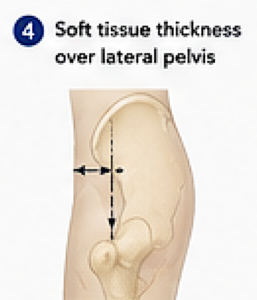
Soft tissue thickness over the lateral pelvis. This thickness will influence hoe much implant projection can be tolerated. The thinner the tissue thickness the less implant projection should be done. Thicker soft tissues can tolerate increaed implant projection/volumes.
Those four measurements usually determine about 90% of the final implant dimensions.
Dr. Barry Eppley
Plastic Surgeon