

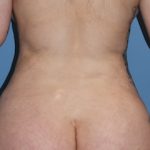
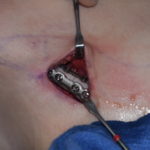
Aesthetic hip implants are usually custom solid silicone designs because there are no widely available true “standard” hip implants, and the hip has a complex, curved, vertically oriented contour.
Key Hip Implant Augmentation Design Concepts
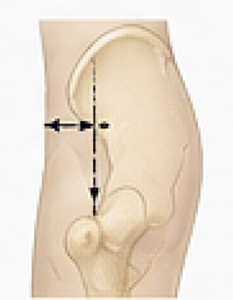
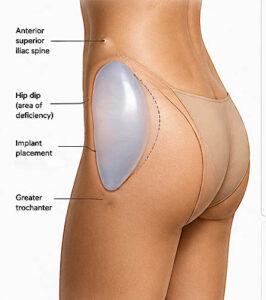
Intended to fill the hip dip zone between the iliac crest and the greater trochanter of the femur.
Avoid going below the greater trochanter as this increases the risk of implant show with decreased soft tissue thickness
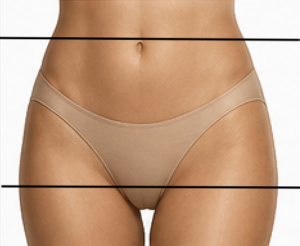
Vertical > horizontal shape
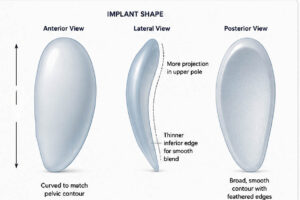
Hip implants are typically longer vertically than wide, unlike buttock implants.
Superior fullness, inferior taper
Most designs need more bulk in the upper half/superior pole and a thinner lower half inferior edge to blend into the lateral thigh.
Broad feathered edges
The implant must disappear into the flank, buttock, and upper thigh contours. Blunt rounded edges risk implant show.
Avoid excessive projection
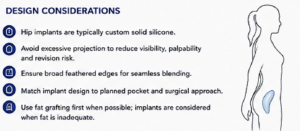
Hip soft tissue coverage is thinner and more superficial than buttock coverage, so overprojection increases visibility, palpability, and revision risk.
Account for bending forces
Hip implants experience movement-related bending stresses from leg motion, so softness/durometer, flexibility, and edge taper matter. This is another reason why havung the implant extend further below the greater trochanter increases motion visibility.
Use fat grafting first when possible
Fat transfer is usually preferred first; implants are more useful when the patient lacks adequate fat or prior fat grafting was inadequate.
Pocket planning is part of design
The implant shape must match the surgically achievable pocket. Poor pocket-design mismatch is a major cause of implant show, malposition, or bending and a need for revision. This is why preoperative measurements of the patient are essential with an implant design that matches the measurements (custom implant design).
Best aesthetic shape: a tall, curved, teardrop/oval custom silicone implant with maximal upper-mid hip fullness, broad feathered margins, low-profile projection, and a long inferior taper.
Dr. Barry Eppley
Plastic Surgeon