
An upper-ear setback otoplasty is a targeted form of otoplasty designed to bring the upper third of a prominent ear closer to the head, rather than repositioning the entire ear.
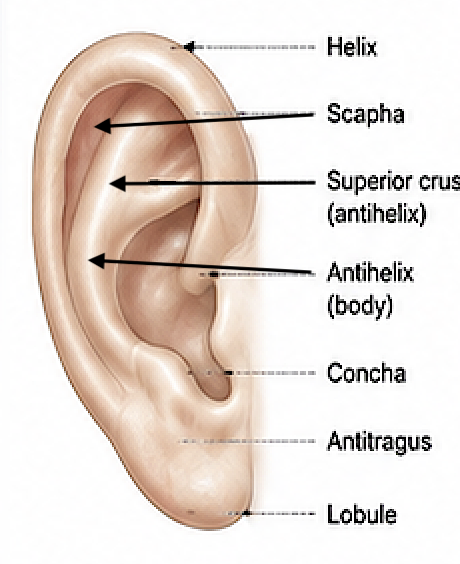
 It is commonly considered when the upper ear projects at a noticeable angle from the side of the head because of an underdeveloped upper antihelical fold, excess upper-ear cartilage projection, or residual upper pole prominence after a previous otoplasty. Unlike a traditional setback otoplasty, which involves cartilage-shaping sutures (such as Mustardé-type sutures) to reshape the antihelical fold with limited cartilage modification, this technique is not usually effective to correct an upper ear excessive projection. This is due to the differences in anatomy of the ear cartilage in which there is no defined single antihelical fold in the upper third of the ear. In the upper third of the year, the antihelical fold becomes a Y configuration with the development of a superior and inferior crus. Such crus formation is not usually amenable to a setback suture technique without causing a crimping effect.
In upper ear setback otoplasty the goal is a natural reduction in upper-pole projection while preserving the normal contours and avoiding an “over-pinned” appearance. Important considerations include symmetry, postauricular sulcus depth and avoiding distortion of the helix or excessive narrowing of the ear.
If the upper pole remains prominent despite an adequate antihelical fold, the residual prominence is coming from the superior concha/root of the helix rather than inadequate antihelical folding. Simply doing superior Mustardé sutures is unlikely to correct the problem.
For a residual upper pole, I would think about it anatomically:
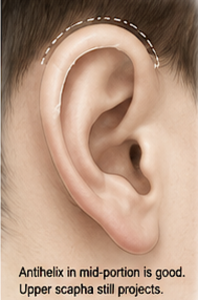
Antihelix looks good, but the whole upper third stands away from the scalp with an increased helix-temporal angulation. Consider a high/superior scapha-to-temporal fascia fixation. This extends the setback vector superiorly rather than further folding the antihelix.
A useful intraoperative diagnostic is to manually push the upper ear at the helical root toward the side of the head while leaving the established antihelix alone. If that produces the desired contour, the missing vector is usually posterior/superior fixation rather than additional antihelical folding. Conversely, if manually creating a stronger superior crus corrects the prominence, Mustardé sutures are more logical.
The endpoint is driven by the patient, which for some may be a modest upper ear inward positioning, and for others it may be a maximal setback. Regardless of the amount of setback you still want a visible, smooth helical rim and a gradual transition from the corrected upper pole into the middle third.
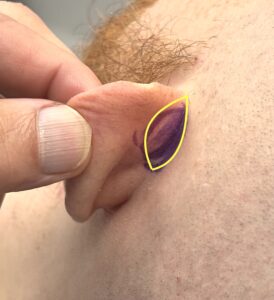
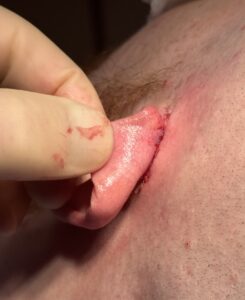
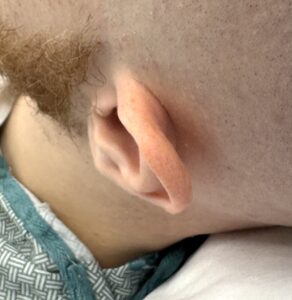
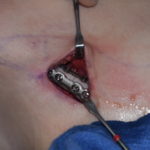
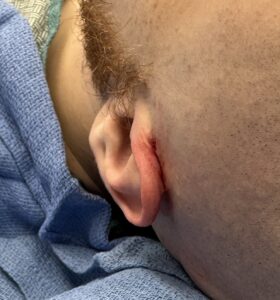 But the key is the management of the postauricular sulcus. Suturing the helical root to the temporalis fascia requires direct linear access, which is not usually possible with the existing depth of the postauricular sulcus. As a result, the depth of the sulcus must be opened by skin excision, extending onto both the ear and the side of the head to some degree. This then allows cartilage to fascia sutures to be placed.This will shorten the depth of the sulcus with closure but still not completely eliminating it. This also provides an additional method of maintenance of the long-term result that does not rely on the suture fixation alone
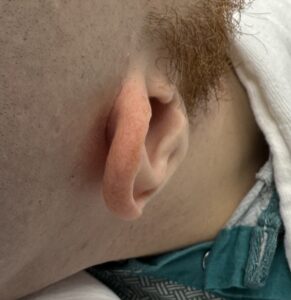
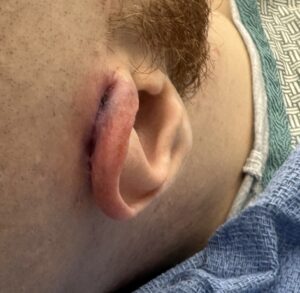
In correction of the protruding upper ear the corrective principle is not to extend the antihelical fold superiorly. Rather it requires bringing the helical root closer to the side of the head by suturing the cartilage to the temporalis fascia. To do so the depth of the upper ear postauricular sulcus must be shortened through skin excision.
Dr Barry Eppley
Plastic Surgeon