

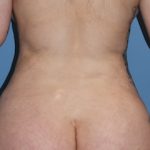
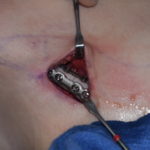
Custom temporal widening skull implants are patient-specific implants designed to increase the width of the sides of the head and create a broader cranial shape. They can be used to create overall head widening (bitemporal implants) or can be okayed on just one side for asymmetry correction. In either case they are distinct from implants used to repair skull defects after trauma. They ae also unique because of the temporal muscle on the side of the head and the unique shape of the temporal bone.
How they work
- A high-resolution CT scan of the skull is obtained.
- A 3D custom implant is designed to match the patient’s anatomy for asymmetry or achieve a bitemporal widening.
- The implant is manufactured (most commonly from solid medical-grade solid silicone.
Implant placement
Unlike traditional cranioplasty materials such as PMMA (bone cement), custom silicone implants can extend beyond the superior temporal line and rest over the temporalis fascia/muscle with a thin, feathered edge. This allows a smooth transition and greater head widening.
They can be placed submuscular, subfascial or on top of the muscle fascia depending on implant size and footprint.
What can be achieved?
Custom temporal widening implants can:
- Increase bitemporal width (side-to-side head width).
- Increase biparietal width when the implant extends farther superiorly.
- Blend into the forehead or posterior skull if more comprehensive widening is desired.
- Correct congenital asymmetry
- Correct loss of muscle volume due to prior surgery
Typical aesthetic augmentation is approximately:
- 5–10 mm per side for noticeable but natural widening.
- Larger augmentations (up to 15–20 mm total increase in head width) may be possible depending on scalp elasticity and anatomy.
Surgical approach
The implants are commonly inserted through:
- A hidden incision behind the ear (postauricular incision).
- Occasionally one or two very small scalp incisions for positioning and fixation.
Advantages of custom implants
- Precise symmetry using CT-based design.
- Smooth contour over a large surface area.
- Permanent result.
- No effect on hair growth when properly performed.
Risks
As with any craniofacial implant procedure, potential risks include:
- Infection
- Fluid collection (seroma)
- Implant malposition or asymmetry
- Need for revision surgery
- Temporary scalp numbness
- Scar-related issues (usually concealed)
Case Example:
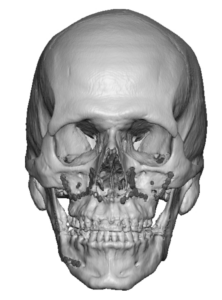
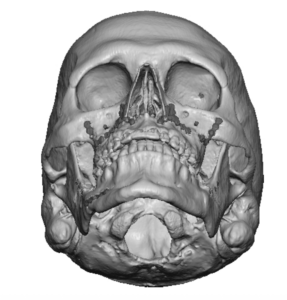 This young male had long been bothered by a congenital skull asymmetry with the right side of his head more narrow than the left side. This asymmetry was part of an overall right craniofacial asymmetry which had been previously addressed by a PMMA bone cement augmentation on the back of his head. A 3D CT scan showed a right temporal bone deficiency of 5mms.
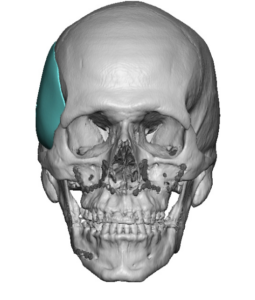
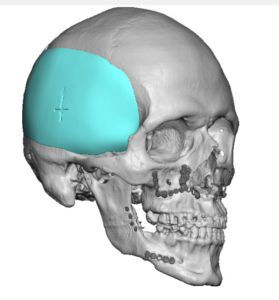 A custom right temporal implant was designed for the entire right temporal bone without full extension into the depths of the anterior temporal fossa. The implant design connected to the bone cement on the occiput posteriorly.
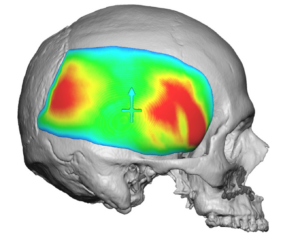 The thickness of the implant was greatest where it connected to the bone cement posteriorly and in the temporal fossa.
I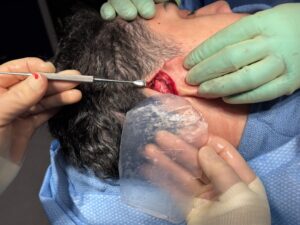 mplant placement was done through a postauricular incision in the submuscular location.
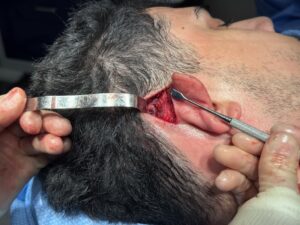
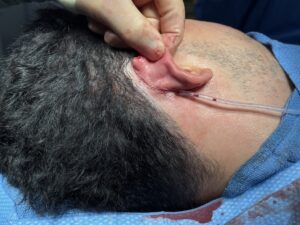 Single screw fixation was used with closure over a drain.
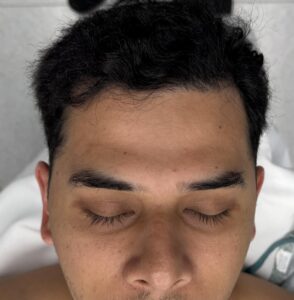
 The immediate intraoperative result showed improved temporal width symmetry.
Discussion
Key Points:
- Temporal width asymmetrical be effectively treated by a custom implant design.
- It can be placed in a favorable submuscular position as long as it is not necessary to extend to or over the bony temporal line of the forehead,
- It can be placed in a near scarless technique from an incision in the crease of the back of the ear.
Dr. Barry Eppley
World-Renowned Plastic Surgeon