
Testicular enhancement by implant displacement mean enlarging the apparent size of the testicles by placing implants that visually overshadow or displace the natural testes, a concept that is both anatomically plausible and effective under the right circumstances..
In such a configuration:
- The native testes remain in the scrotum and continue to function.
- The implants contribute most of the visible bulk and projection.
- The natural testes may become relatively inconspicuous externally if the implants are substantially larger.
- The final appearance depends on implant size, shape, position, and scrotal tissue capacity.
For someone with testes measuring approximately 3.5 × 2.7 cm (~13–15 mL), implants that add significantly more volume than the native testes would become the dominant determinant of scrotal size and contour. The native testes would still be present but could contribute relatively little to the visible appearance.
From a surgical standpoint, important considerations include:
- Adequate scrotal volume and tissue expansion.
- Implant mobility and stability.
- Preservation of blood supply to the testes.
- Ability to examine the testes for future health surveillance.
- Avoidance of excessive tension, discomfort, or an unnatural appearance.
In terms of cosmetic outcome, I think in terms of the ratio of implant volume to native testicular volume. Once implant volume substantially exceeds native testicular volume, the visual appearance is increasingly driven by the implants rather than the natural testes.
Case Example
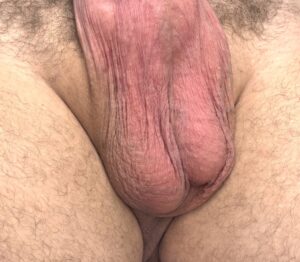 This male had a large scrotal skin sac which by comparison made his testicles appeared small even though they were of normal size (3.75cm) He desired a larger testicular appearance by implant displacement.
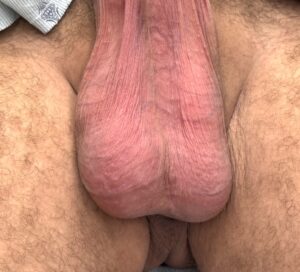 A 6.75cc implant size was chosen which was 80% bigger by length but 4x the volume (18cc vs 72cc). The custom testicle implants were implanted and his 6 month result showed improvement in the appearance of the size of the testicles but had some residual native testicular show.
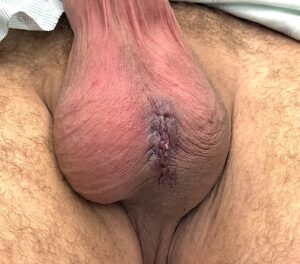 In a subsequent implant surgery 8.25cm size (130ccs volume) replacements were used with improved native testicular camouflage.
Discussion
If custom implants are substantially larger than the native testes, the implants will tend to dominate the external appearance and make the natural testes much less noticeable or hide them from the outside.
However, “hide” can mean two different things:
- Visually hide externally
-
- Larger implants can create most of the visible scrotal contour and fullness.
- With sufficiently large implants, observers typically cannot distinguish the native testes from the implants by appearance alone.
- Physically obscure or prevent palpation
-
- Usually no. The natural testes remain present and may still be palpable depending on implant placement, implant firmness, and scrotal anatomy.
- A skilled examiner may still be able to identify the native testes separately from the implants.
With native testes around 3.5 × 2.7 cm (~13–15 mL each), implants that are considerably larger than that volume would be expected to become the dominant visual feature of the scrotum. The larger the difference between implant volume and native testicular volume, the more the implants will determine the overall size and shape.
The practical limitation is not the native testis size but:
- Available scrotal space.
- Skin laxity.
- Comfort.
- Risk of implant migration, visibility, thinning of tissues, or an unnatural appearance.
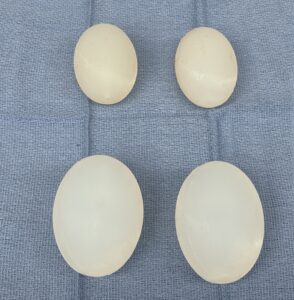
The key question is what implant size is big enough to obscure the native testes. As a general guideline I use implant size as defined by length with at least a 70%, and more ideally a 100% increase, needed to be completely successful.Factoring in size by volume it is far closer to 2X to 3X volume increase needed.
While implant size is a visible metric the other important variable is scrotal capacity. As was seen in this patient when there is a lot of loose scrotal skin (large scrotal capacity) the implant size and volume needs to be even bigger to adequately hide/displace the native testes. The influence of the implants is diminished as the loose skin allows them to ultimately hang lower than in scrotums with tighter skin. Loose scrotal skin is also more elastic which means more implant volume is needed.
Key Points
1) Testicular enhancement by displacement is effective if implant size and volume is large enough.
2) Increased implant volumes are needed when a large scrotal capacity exists .
3) A good guideline to follow is to place the largest implants that will fit.
Barry Eppley, MD, DMD
Plastic Surgeon