
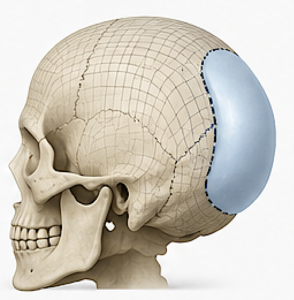
 A custom back-of-the-head skull implant (occipital skull implant) is a patient-specific implant designed to increase the projection, width, or symmetry of the posterior skull. It is commonly used for:
- Flat back of the head (occipital flattening)
- Congenital skull shape deficiencies
- Asymmetric occipital skull contours
- Secondary correction after previous cranioplasty procedures
Design Process
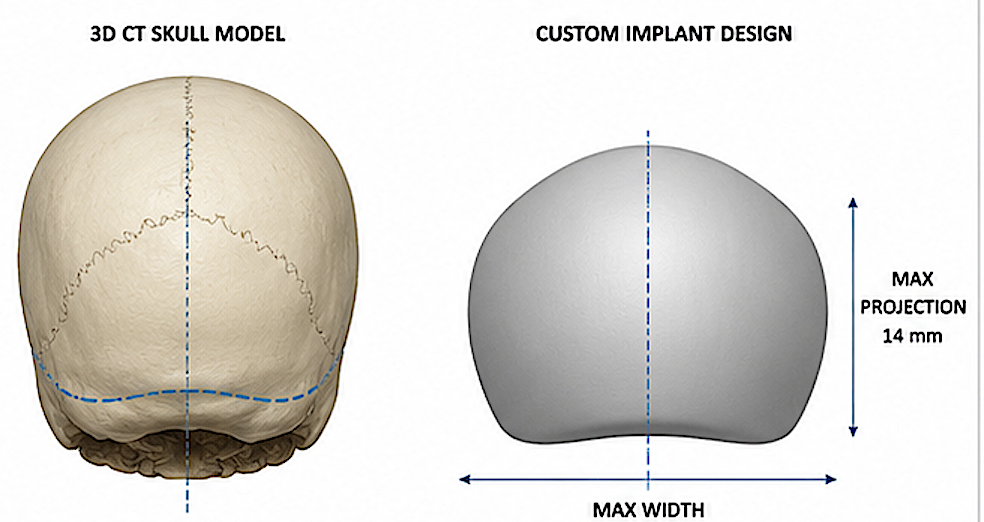
- Obtain a high-resolution craniofacial CT scan (typically 1 mm cuts).
- Convert the CT data into a 3D skull model.
- Digitally design the desired augmentation, often increasing occipital projection by 5–15 mm or more depending on the patient’s goals and scalp characteristics.
- Manufacture a patient-specific implant.
Implant Materials
For aesthetic occipital augmentation, the most common materials include:
- Custom silicone elastomer – widely used for cosmetic skull augmentation.
- PEEK (polyetheretherketone) – used more commonly in cranial reconstruction for craniotomy bone flap loss..
- Titanium – used primarily for reconstructive cranial defects rather than cosmetic augmentation.
Surgical Placement
- Usually inserted through a posterior scalp incision.
- Placed directly on top of the occipital bone beneath the scalp.
- Secured when necessary with small titanium screws.
- Typical operative time: 1–2 hours for cosmetic augmentation cases.
Advantages of a Custom Implant
- Exact fit to the skull anatomy.
- Precise control of projection and width.
- More predictable than injectable fillers or bone cement contouring.
- Can simultaneously correct asymmetry and flatness.
Design Considerations
For a posterior skull implant, I typically evaluate:
- Maximum central projection increase (mm)
- Lateral width expansion
- Transition into the parietal regions
- Existing asymmetry
- Scalp thickness and tissue stretch capacity
Case Study
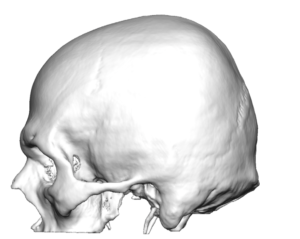
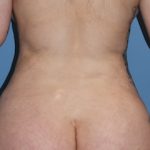
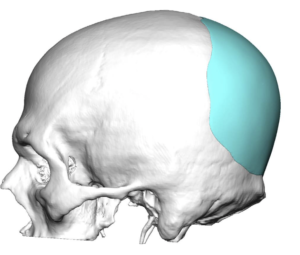 This older male had a flat back of the head that was treated by a custom occipital skull implant 14 years previously. With a 14mm projection it was too tight during placement and it was reduced to a 10mm projection. Regardless of the reduced projection he liked the result but wanted it to extend more inferiorly the whole down to the bottom of the visible occipital bone (nuchal ridge).
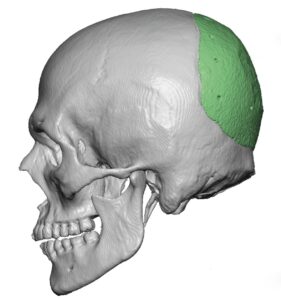
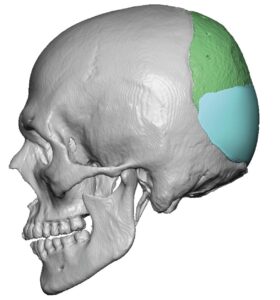
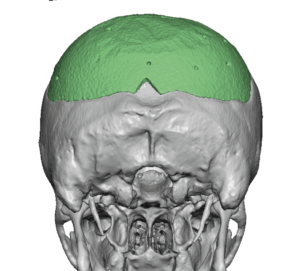
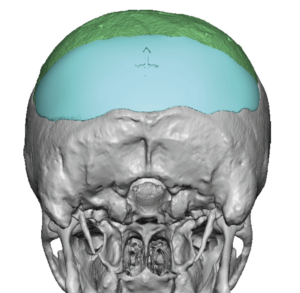 A 3D CT scan showed the depression in the shape of the back of the head between the bottom of the implant and the nuchal ridge. A custom skull implant extension was designed to fill in the depression.
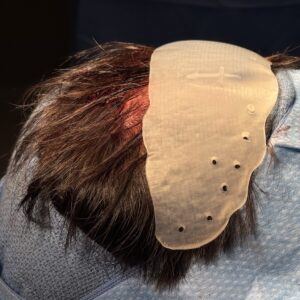 Under general anesthesia and in the prone position the custom extension implant was prepared by placing multiple 4mm perfusion holes.
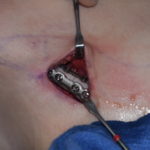
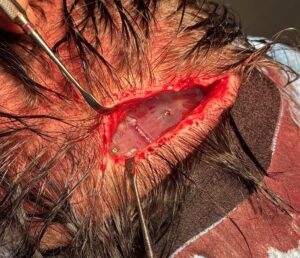 Through a part of the same incision used from the initial implant the extension implant was placed and secured with two drilled screws that passed through both implants to the bone.

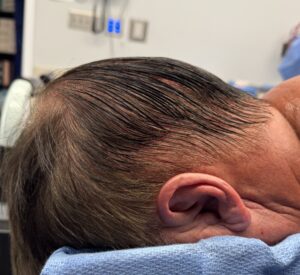 The extension of the original implant’s contour could be seen immediately
Discussion
A secondary onlay extension can be added to an existing custom skull implant, but the key issue is how accurately the in-place implant surface can be captured.
The usual approach:
- Obtain a new thin-cut 3D CT scan with the current implant in place.
- Segment both the skull and visible implant contours.
- Design the extension as a custom add-on piece that overlaps or keys onto the existing implant margin.
- Use a feathered edge transition so the extension blends into both the native skull and the prior implant.
- Fixation is typically by small screws into bone where accessible; fixation into the existing implant depends on its material and thickness.
Important design considerations:
- The extension should ideally have a buttress/overlap interface, not just a thin edge-to-edge contact.
- If the existing implant is silicone, direct rigid fixation to it is limited; the extension usually needs bony fixation.
- A secondary extension is easier when the desired augmentation is along an exposed implant border, such as seen in this case at the occipital implant edge.
- If the needed change is broad, central, or requires major reshaping, replacement with a new one-piece implant may be better than adding an extension.
Key Points
1) A custom skull implant can have its coverage area secondarily increased by a custom implant extension design.
2) A custom skull implant extension partially sits on the existing implant and requires screw fixation through both implants for optimal stable long term positioning.
3) An implant extension provides an additional augmentation effect for an improved skull contour/shape.
Dr Barry Eppley
Plastic Surgeon