
The success of any jawline implant is a combination of design and placement. It doesn’t matter how well an implant is designed if its placement on the bone doses not correlate closely to the design file. Accurate placement is a combination of surgical skill and various design features. An implant’s design can help or work against intraoperative placement
For a custom PEEK jawline implant, optimal intraoperative placement starts with designing the implant so that there is essentially one correct place for it to sit. The aesthetic shape matters, but the undersurface geometry, connectivity and fixation strategy are what make placement reproducible.
The most useful design principles are:
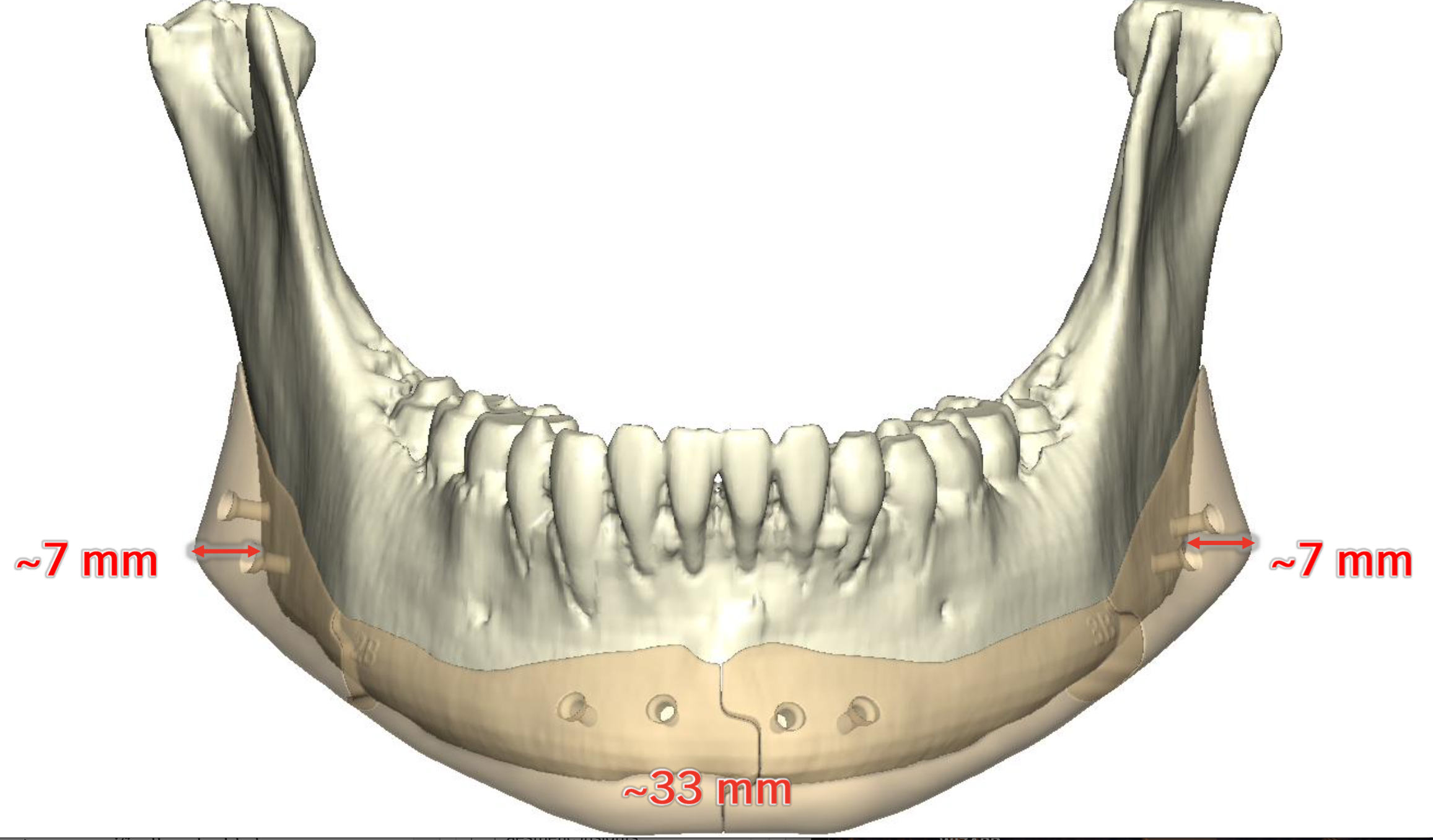
- Maximize unique bony registration. The internal surface should closely reproduce recognizable, non-flat mandibular anatomy. Broad conformity along the inferior border, parasymphysis/body, or angle reduces the ability of the implant to slide anteriorly, posteriorly, or rotate. Patient-specific PEEK implants are specifically valuable because CAD/CAM can reproduce the patient’s skeletal morphology with high conformity.
- Avoid designing a large implant that rests on a featureless plane. If the implant contacts mainly a relatively smooth lateral mandibular surface, several positions may appear to “fit.” Extending registration strategically onto distinctive contours can create a more positive seat without unnecessarily enlarging the implant.
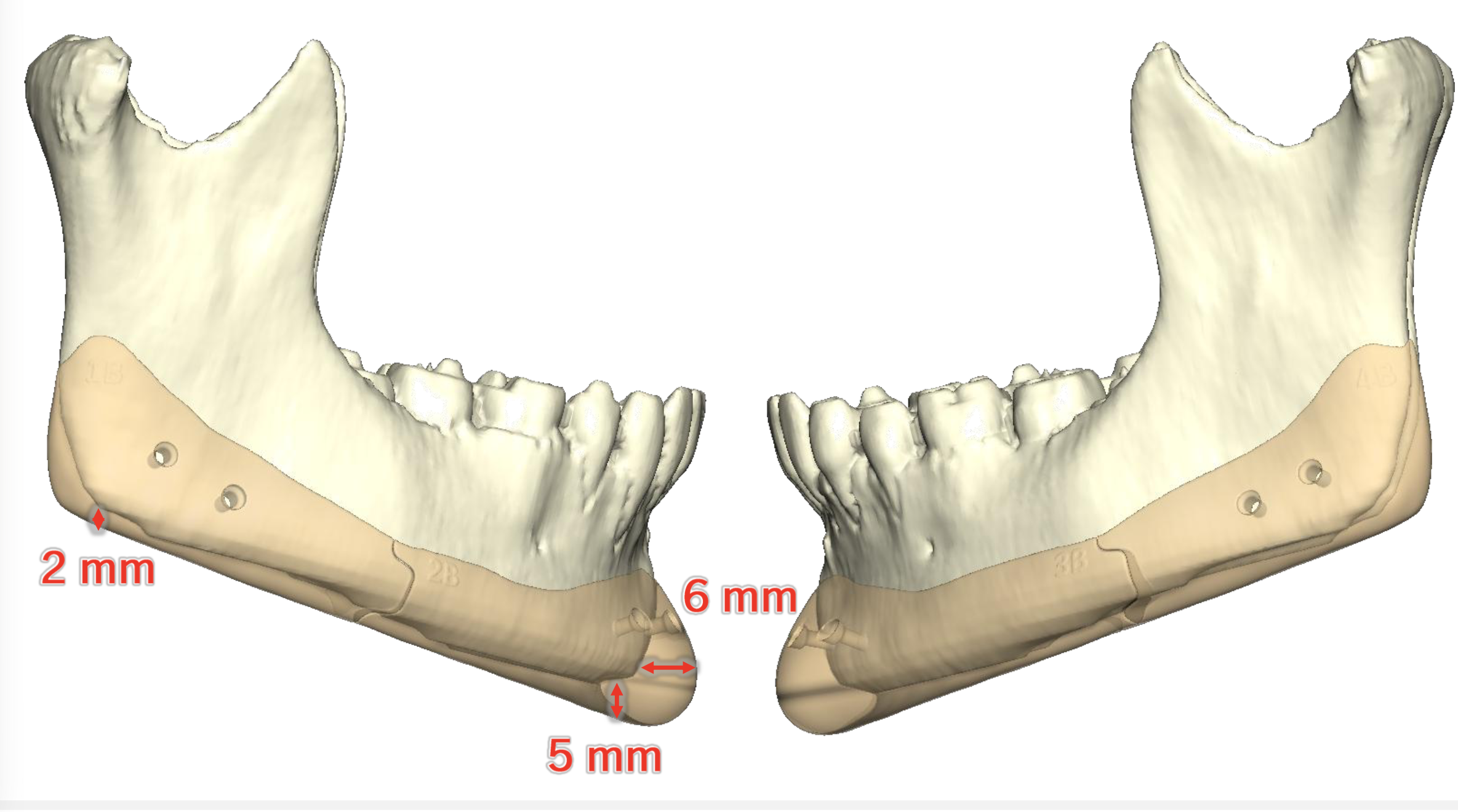
- Build in a positive inferior-border relationship. For a jawline implant, the mandibular lower border is particularly useful as a registration landmark. Conceptually, a controlled wrap or keyed relationship around that border can make superior/inferior positioning much easier to judge than relying only on lateral surface contact.
- Design segment junctions as registration features. With a multi-piece PEEK implant, don’t treat the cuts merely as straight saw lines. The neighboring components can be designed so their intended relationship is visually and mechanically obvious. A keyed, stepped, or otherwise uniquely mating interface can reduce anterior-posterior and vertical mismatch. This is a design inference from the general PSI principle of making anatomical fit constrain implant position rather than relying on freehand positioning.
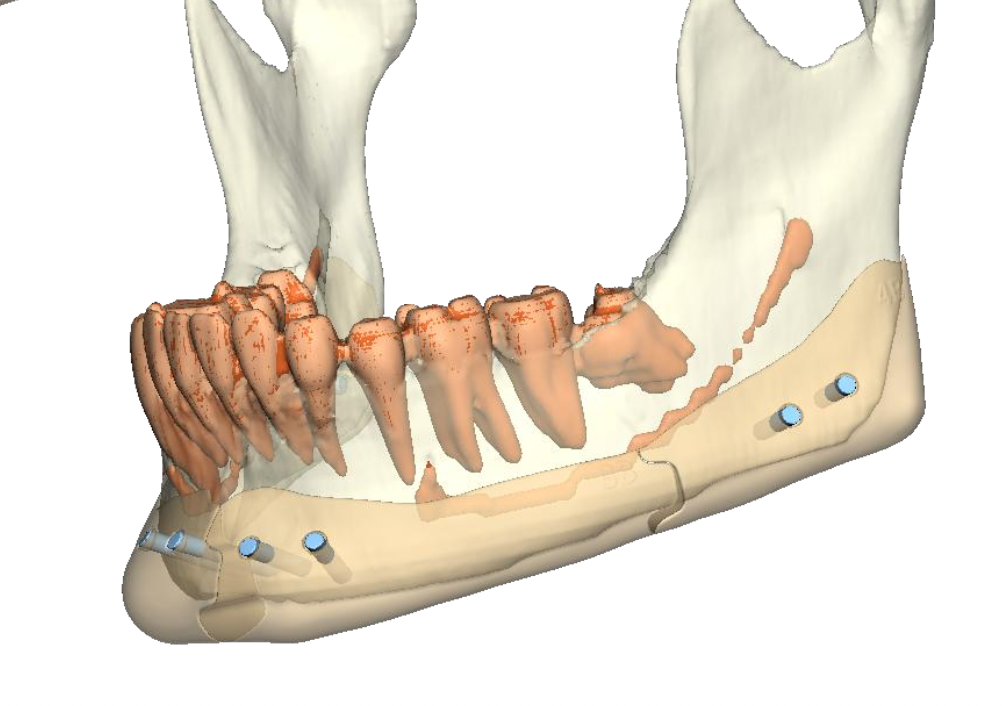
- Plan screw locations during CAD. Predetermined fixation points should sit over adequate bone and avoid the mental foramina, tooth roots, inferior alveolar canal, and thin cortical regions. With the preplaced screw holes they shoulkd be placed with angulations tht are consistent with what the incisional access will allow.
- Use fixation to lock an already registered implant rather than to pull a poorly seated implant into place. Ideally the PEEK component should sit passively in its intended position before final fixation. A screw should preserve that position rather than compensate for an imperfect undersurface.
- Give each segment independent registration. This is particularly important with a three or four-piece jawline. I would want the right angle, chin/body, and left angle components each to have enough patient-specific anatomy on their inner surfaces that the I can confidently determine the correct position before joining the overall contour.
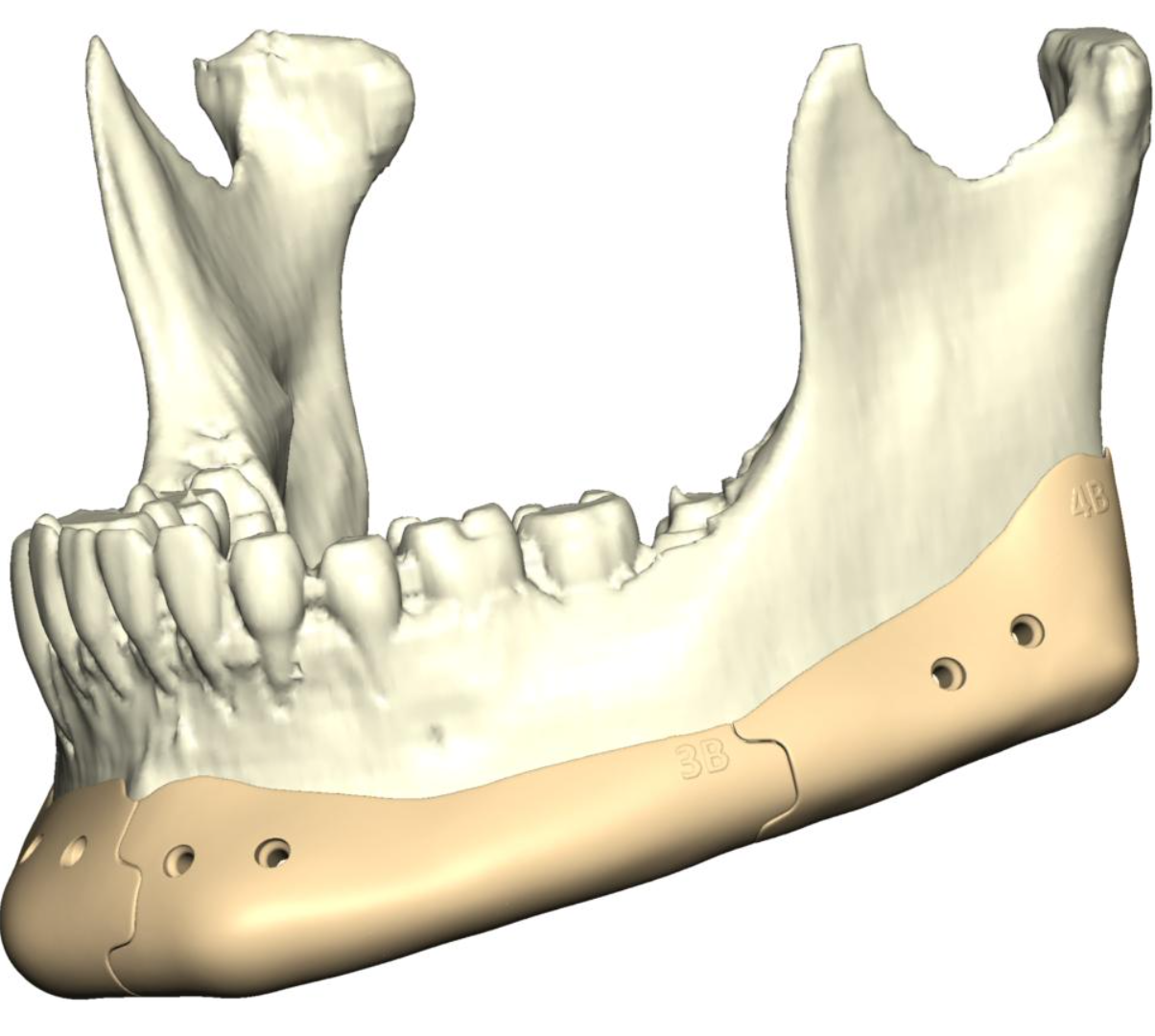
- Keep the mental-nerve region deliberately uncomplicated. Implant edges, junctions, screw trajectories, and areas requiring manipulation should be designed with the mapped mental foramina in mind. In other words keep the implant low underneath it and don’t have a joint connector near it. Due to incisional access there is rarely a concern about fixation location.
- Feather cosmetic edges while preserving registration areas. The outer perimeter should generally transition gradually into native bone where soft-tissue visibility is a concern. But over-thinning every border can eliminate the geometric landmarks that help the implant seat. There is therefore a balance between a smooth aesthetic transition and an adequately constrained fit.
- Account for the surgical approach when deciding segmentation. A CAD design can look perfect assembled on the CT model but be difficult to introduce through the planned exposure because PEEK is rigid. The segment size, number of pieces and where the joint connections will be are considered as part of the implant design.Creare long chin pieces so their ends are very posterior to the mental nerve.While many PEEK jawline implants are made in three pieces this is usually not helpful for placement. To make the connection more visible through the intraoral incisions for accurate piece interdigitatiion a four piece jawline design is my preference.
A useful way to think about the CAD is that it should constrain all six degrees of freedom:
Anterior/posterior translation: controlled by distinctive mandibular contours or segment interfaces.
Superior/inferior translation: strongly constrained by inferior-border registration.
Medial/lateral translation: controlled by intimate bone conformity.
Pitch, yaw and roll: controlled by sufficiently broad, non-planar contact plus fixation.
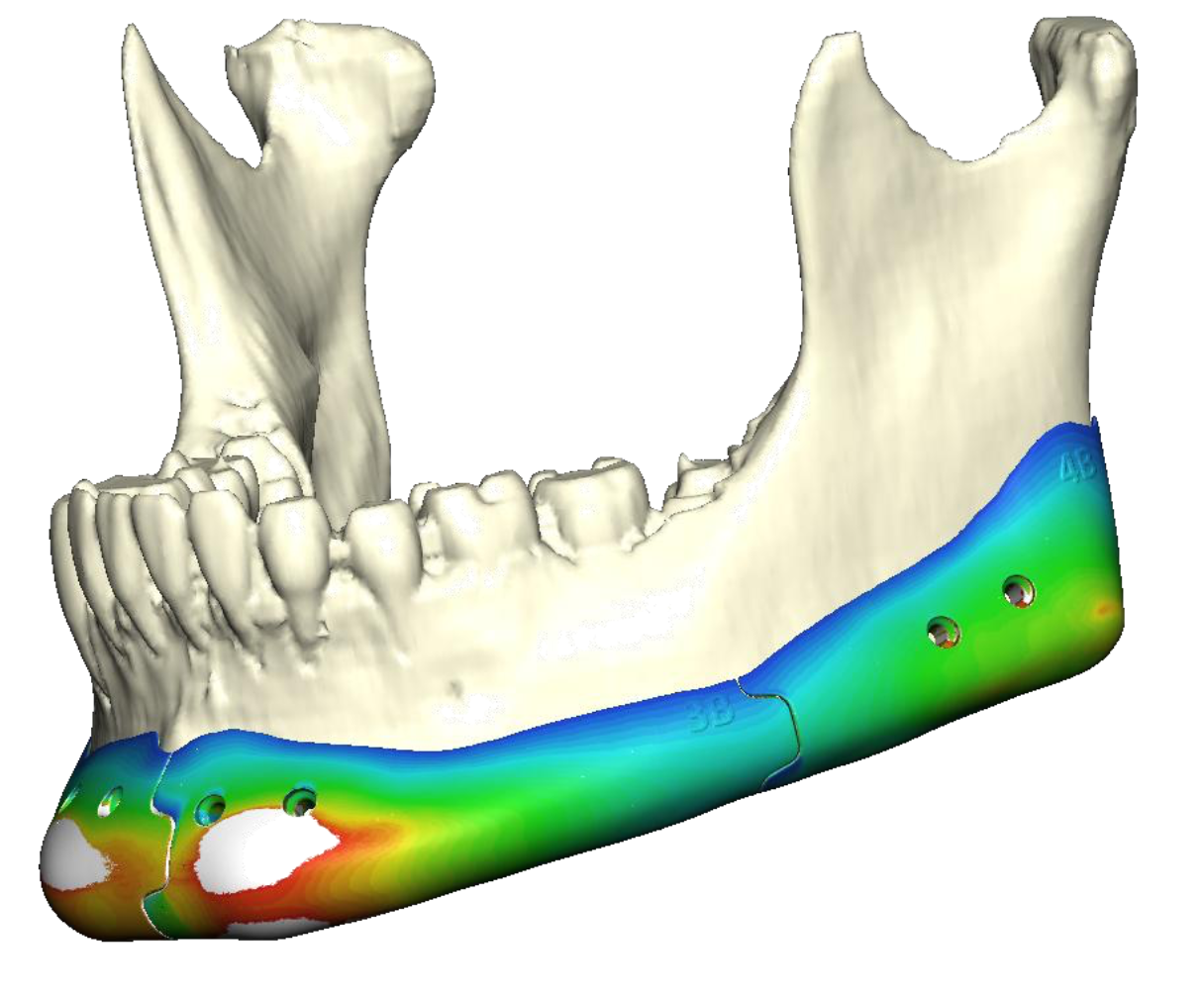
If those are well controlled, when the components are placed intraoperatively it should almost feel like a 3-D puzzle piece that easily fits into its intended position rather than something that has to be forced into place.
There is one other design issue worth emphasizing: don’t assume that perfect skeletal CAD automatically predicts the perfect soft-tissue result. In my extensive clinical experience the relationship between implant thickness and actual postoperative soft-tissue projection differs substantially by anatomic region. A lot of work needs to be done to more asccurately predict the soft-tissue response to an implant augmentation. So I would separate the planning process into (1) desired external contour and (2) geometry required for reliable surgical registration rather than optimizing only the first.
For a three or four-piece wraparound jawline, an especially placement-friendly architecture is conceptually:
left angle/body registration – central chin/body master segment – right angle/body registration, with deliberate junction geometry and predefined fixation zones. The central component can provide a strong midline reference, while each posterior component keys to both its native mandibular anatomy and the adjacent component.
Dr Barry Eppley
Plastic Surgeon