
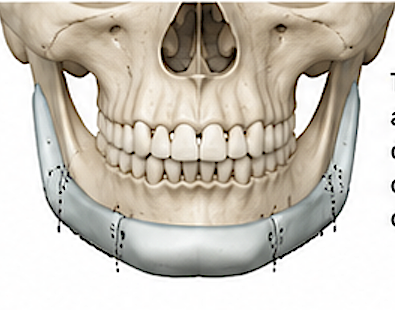
 A PEEK wraparound jawline implant usually needs to be made in multiple pieces because PEEK is very rigid. A full jawline implant can extend from one mandibular angle, across the chin, to the opposite angle. Unlike silicone, PEEK cannot flex enough to pass that entire shape through the relatively small incisions used for placement.
Dividing it into pieces solves several surgical problems:
- Smaller incisions can be used. Each rigid segment can be inserted separately rather than exposing most of the mandible to insert one enormous rigid implant.
- The mental nerves are better protected. A large jaw-angle segment being pushed through a long tunnel toward or past the chin can put traction or pressure on the mental nerve. Segmentation lets the surgeon introduce each component closer to where it belongs.
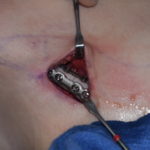
- The pieces can still recreate one continuous contour. The implant can be designed on the CT scan as a single smooth jawline augmentation, then divided at strategic locations for manufacture and insertion. Once positioned, the segments are aligned according to the CAD design and stabilized to the mandible, typically with screws.
- PEEK doesn’t behave like silicone during surgery. A silicone wraparound implant can be folded or flexed considerably during insertion and then recover its designed shape. PEEK essentially retains its manufactured shape, which is useful for dimensional precision but makes a one-piece wraparound implant impractical through limited access.
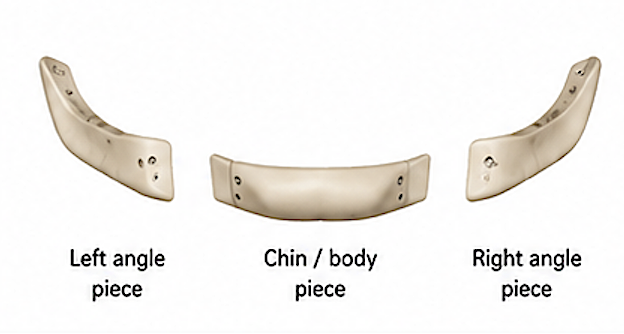 So a“three-piece PEEK jawline implant” doesn’t necessarily mean three independently designed augmentations. It can effectively be one continuous custom jawline design that has been sectioned into, for example, a central chin/body component and two posterior angle components purely so it can be safely inserted and assembled on the mandible. A recent Eppley discussion specifically describes this distinction between the one-piece geometric design and the multi-piece physical implant.
The tradeoff is that the surgeon has to obtain very accurate alignment at the junctions. That makes the design of the interfaces and screw fixation especially important; otherwise a step-off or contour discrepancy could occur where the PEEK pieces meet.
Case Study
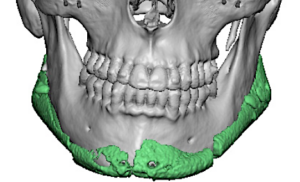
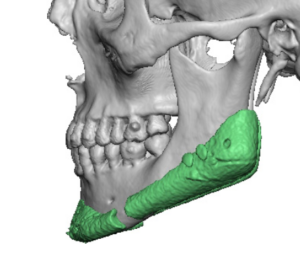
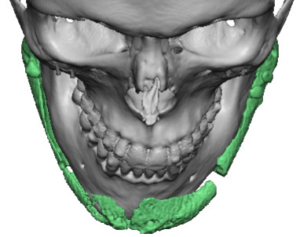
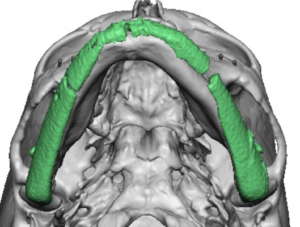 To illustrate the importance of extremely accurate alignment at the junction of a multi piece PEEK jawline implant I present the following case. This patient had a four-piece custom PEEK jawline implant placed six months previously. As the swelling went down, he noticed an overall jaw symmetry, jaw angles that protruded too far posteriorly and palpable gaps between the chin and jaw angle segments which were also uncomfortable. A 3-D CT scan showed misalignments of the segments which started with asymmetric placement of the anterior chin piece (off the midline)
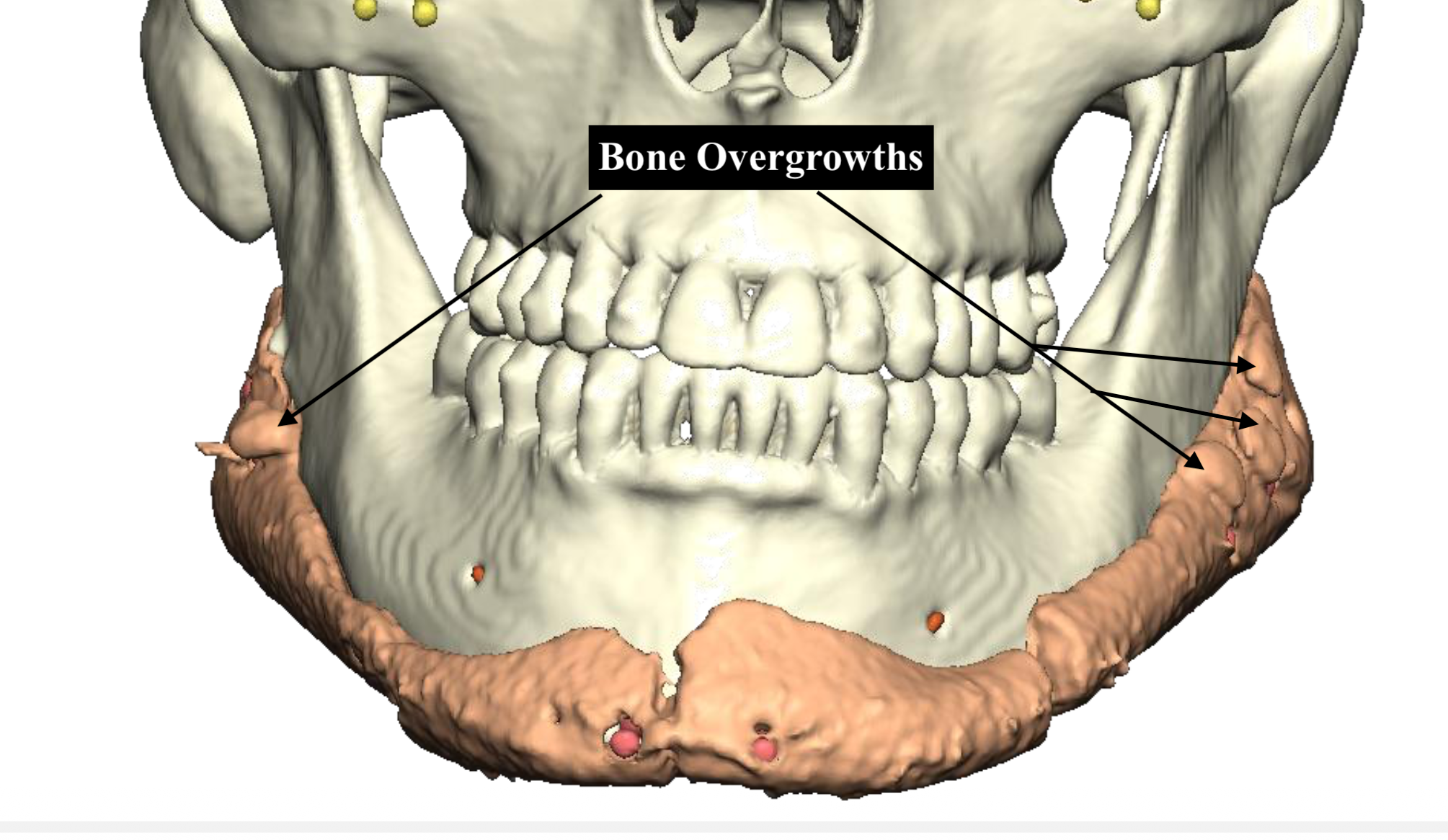 There was also bony overgrowths at the jaw angles and significant segmental gaps for scar tissue ingrowth.
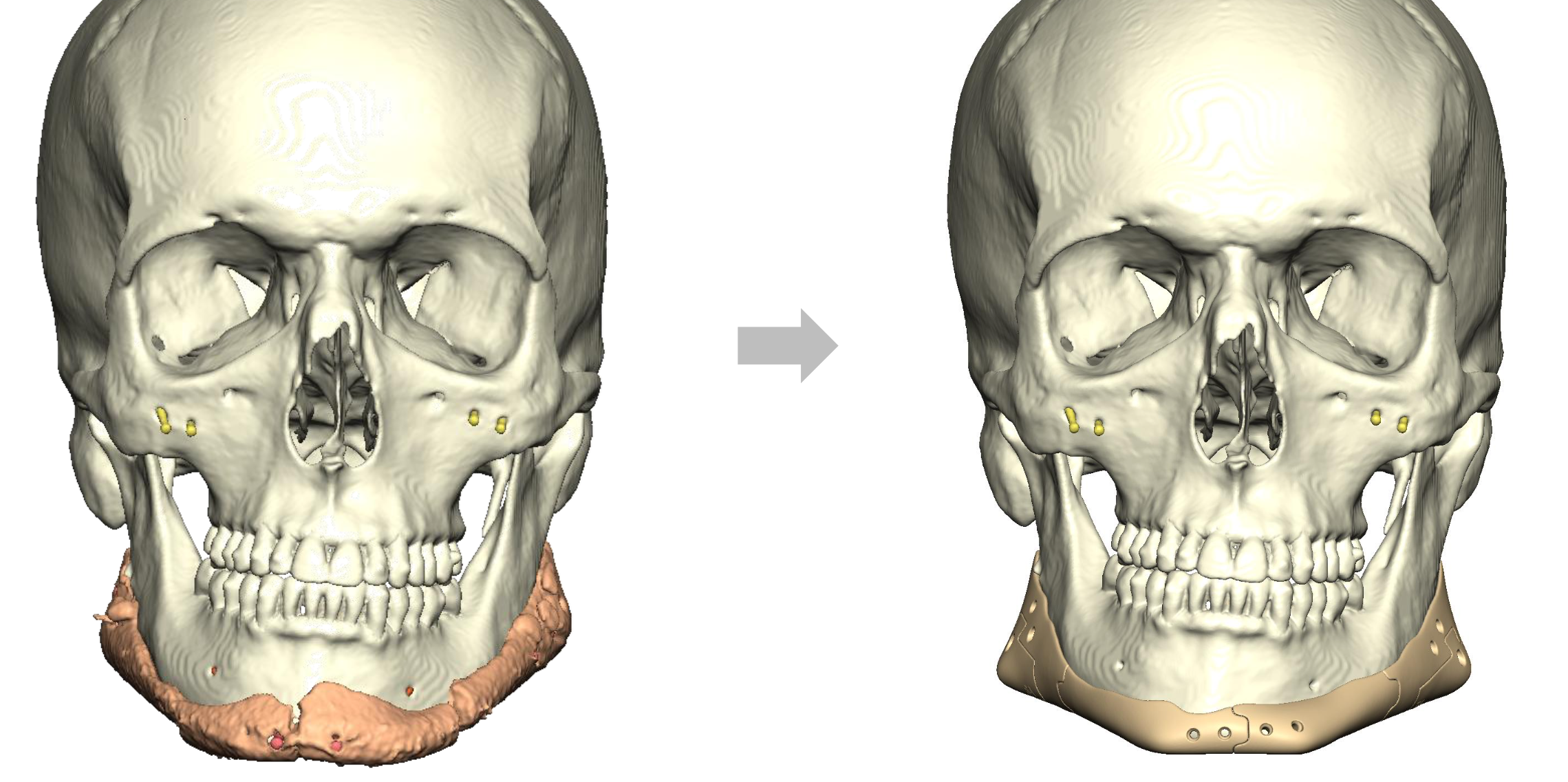
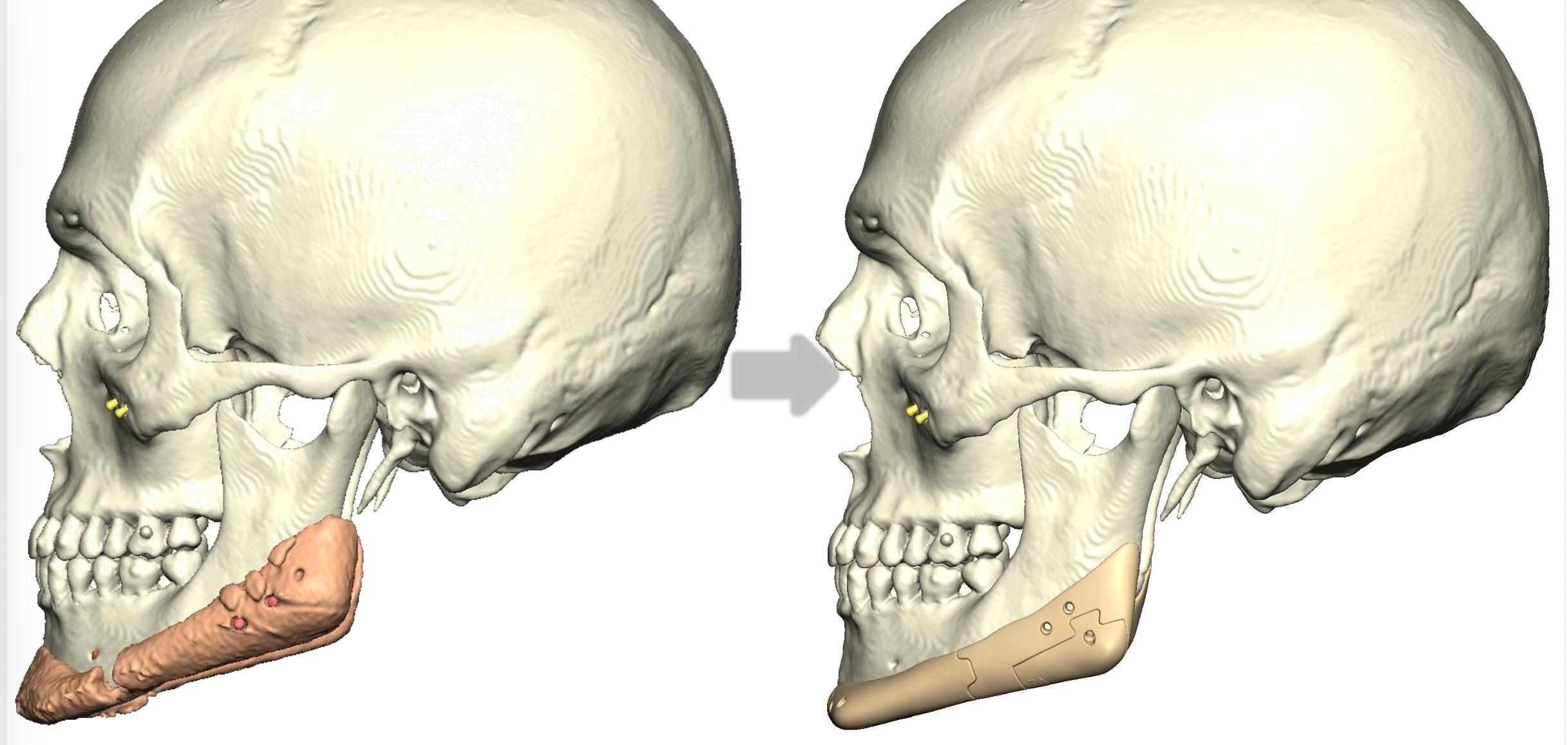 Besides correcting the asymmetry he wanted some changes in the original implant dimensions (less chin projection, more vertical jaw angle lengthening and width. These were made with his new PEEK jawline implant design which was also a segmented four piece design. Because of manufacturing limitations at the jaw angles they were additionally segmented into two pieces..making a six piece jawline implant design.
Removal of the PEEK jawline implant was challenging due to stripped screwheads, dense scar and bony overgrowths but it was able to removed in its entirety.
Prior to insertion off the implant the two jaw angles were out together with screw fixation.
The chin pieces were initially inserted and positioned with screw fixation
The jaw angle segmentwere inserted next with rpeplaced screw using better positioned screw location. Segmental alignment was assured by the positioning of the geometric interlocking design at the mid body of the mandible..
Discussion
The aesthetic effects of a custom jawline implant is a function of two factors, design and placement. Patients spends hours often contemplating millimeters of their implant’s design with the erroneous assumption that its placement is assured. Patient’s also often mistakenly assume that the PEEK material offers a more assured placement because it is very firm and unbendable and that it just ‘snaps’ into place.
But the reality is the material does not have a snap fit quality (no material does) and the need for segmentalizing the implant for placement creates a new set of placement challenges that are bit different than one piece silicone wrap around jawline implants.
In PEEK segmentalizing the implant is a part of the implant’s design. Where the implant is sectioned, the shape of the split ends and how many pieces the implant is split into has an effect on placement success. The most common error is a split along the jawline that is too far forward, which makes it unable to be fully visualized during placement. This was one of the problem’s in this patient’s initial implant design. The intraoperative error was not getting the chin segment positioned in the midline which magnified the lack of good segment alignment..
Key Points
1) PEEK jawline implants requires segmentalizing the design for placement purposes.
2) How the implant is segmentialized is an important part of the design and those decisions can impact implant placement success.
3) Custom jawline implants of any material pose challenges in surgical placement and PEEK is not different in that regard.
Barry Eppley, MD, DMD
World-Renowned Plastic Surgeon