
Why do custom jawlione implants with larger jaw angle segments have the jaw angle segment split into two pieces changing a four piece to a six piece mplant design?
With PEEK, the reason can be even more restrictive than with a large silicone jawline implant: the problem is not simply the total number of pieces. It is whether each individual piece can physically enter its pocket and reach its final position without excessive exposure or soft-tissue stretching. There may also be limits from a manufacturing standpoint in that larger jaw segments may need to be machined as two pieces.
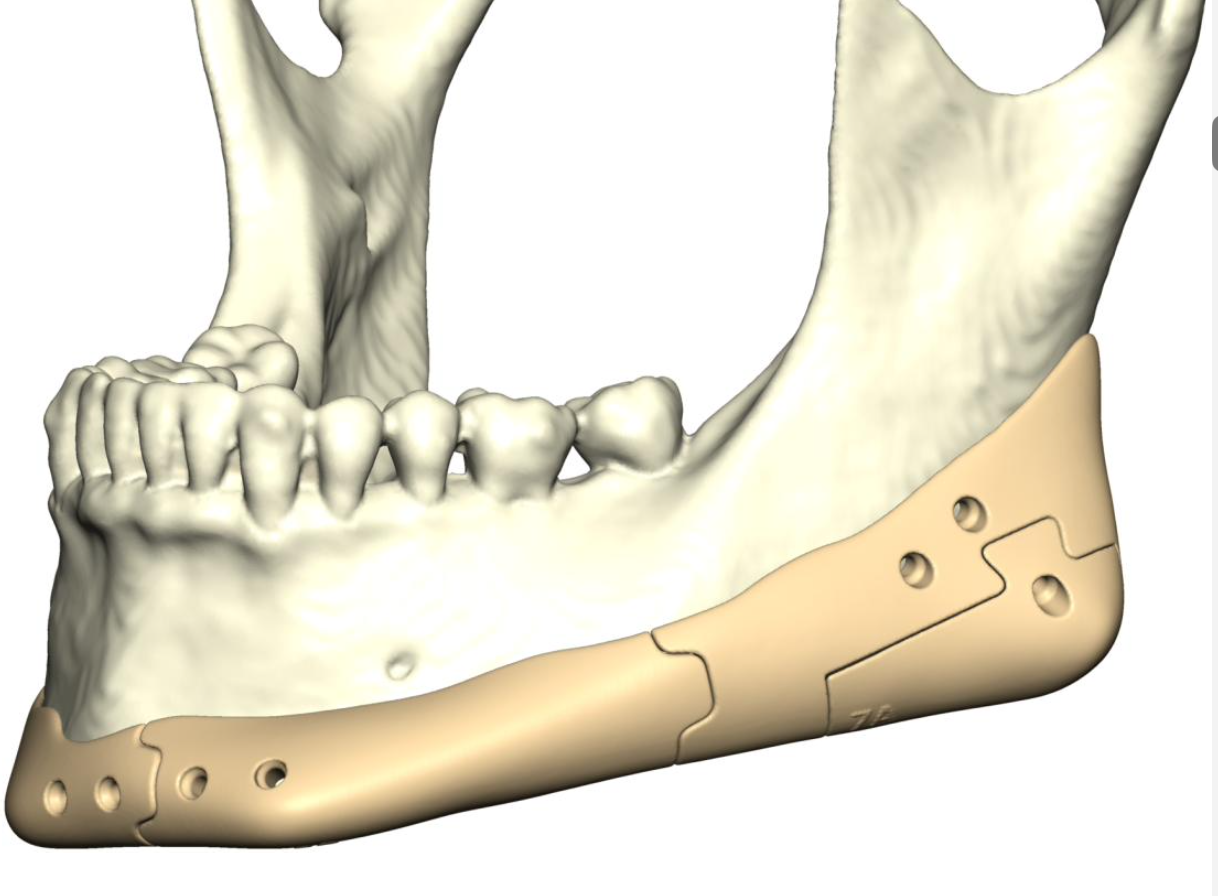
So you can already have a four-piece implant, yet still need to split each very large posterior jaw-angle component into two pieces.
Think of it this way: segmentation solves access geometry and manufacturing limitations, not a predetermined “piece-count” problem.
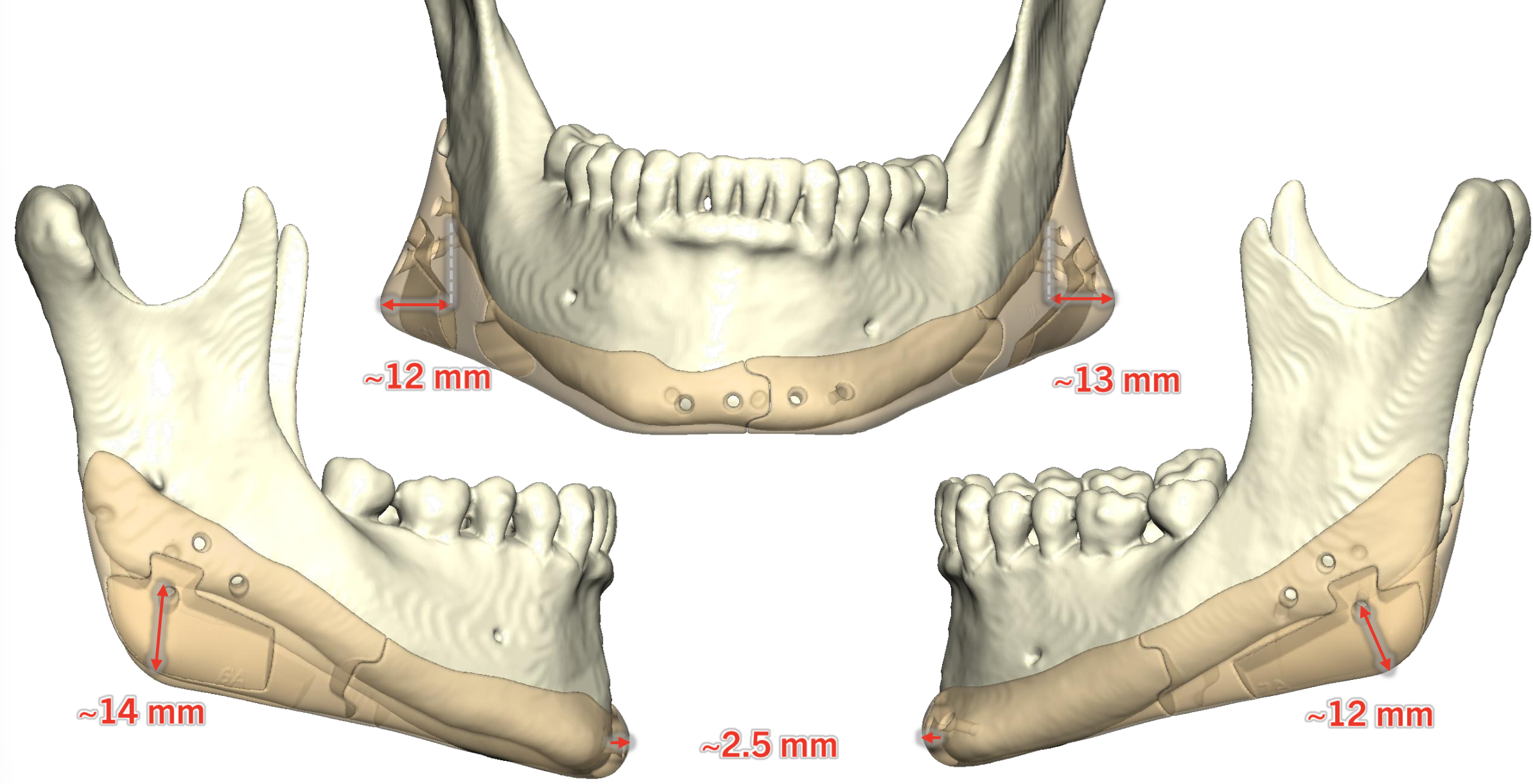
A large jaw-angle segment may have substantial vertical drop, lateral width, posterior ramus extension, or a combination of all three. That creates a rigid, bulky three-dimensional object. With flexible silicone, some large components can be bent, folded, or twisted during introduction. PEEK essentially cannot be elastically deformed in that fashion. Published surgical discussions of large custom jawline implants similarly emphasize that increasing jaw-angle height/bulk eventually makes passage through limited access unsafe; large components are therefore segmented and reconstructed after introduction.
For example, imagine the original four-piece PEEK design as:
Left jaw angle | Left anterior/body | Right anterior/body | Right jaw angle
If each posterior angle is modest, that can work well. But suppose the angle component is designed with a major vertical ramus extension:
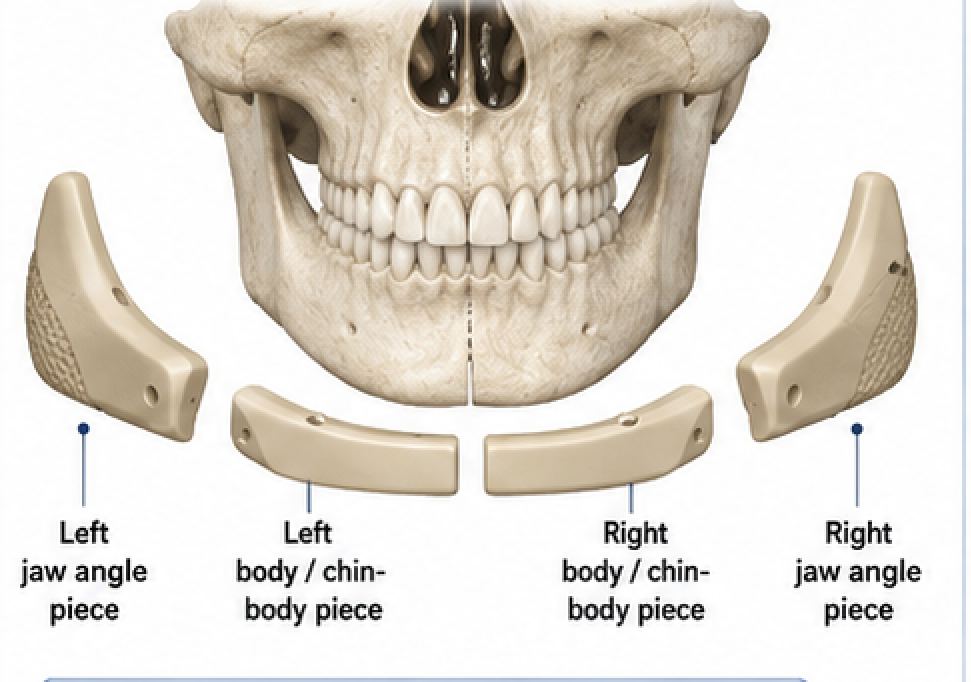
Even though it is already disconnected from the anterior implant, the posterior component itself may still be too large or geometrically hooked to introduce through the posterior vestibular incision and rotate underneath the masseter into its exact subperiosteal position.
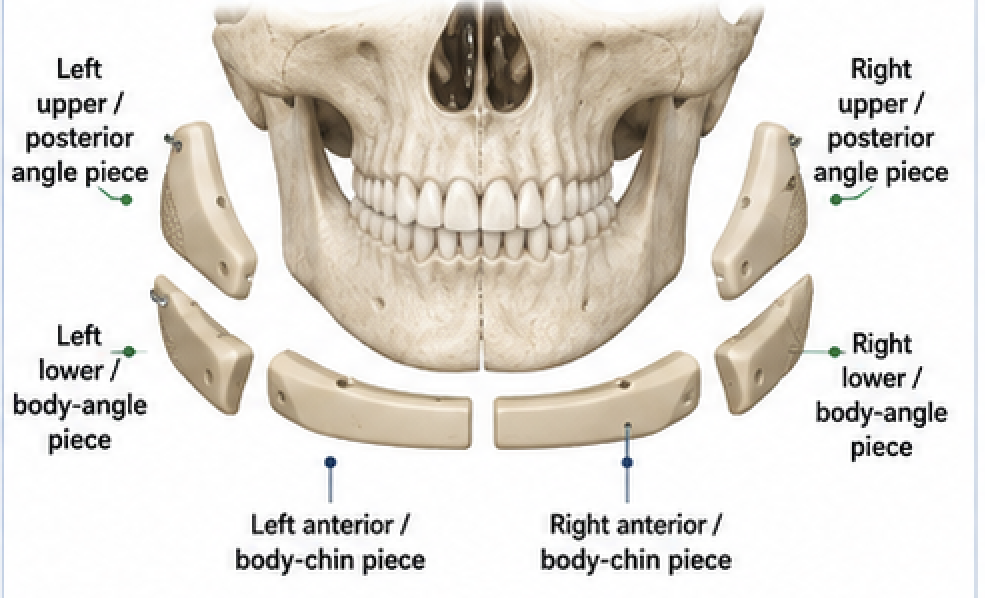
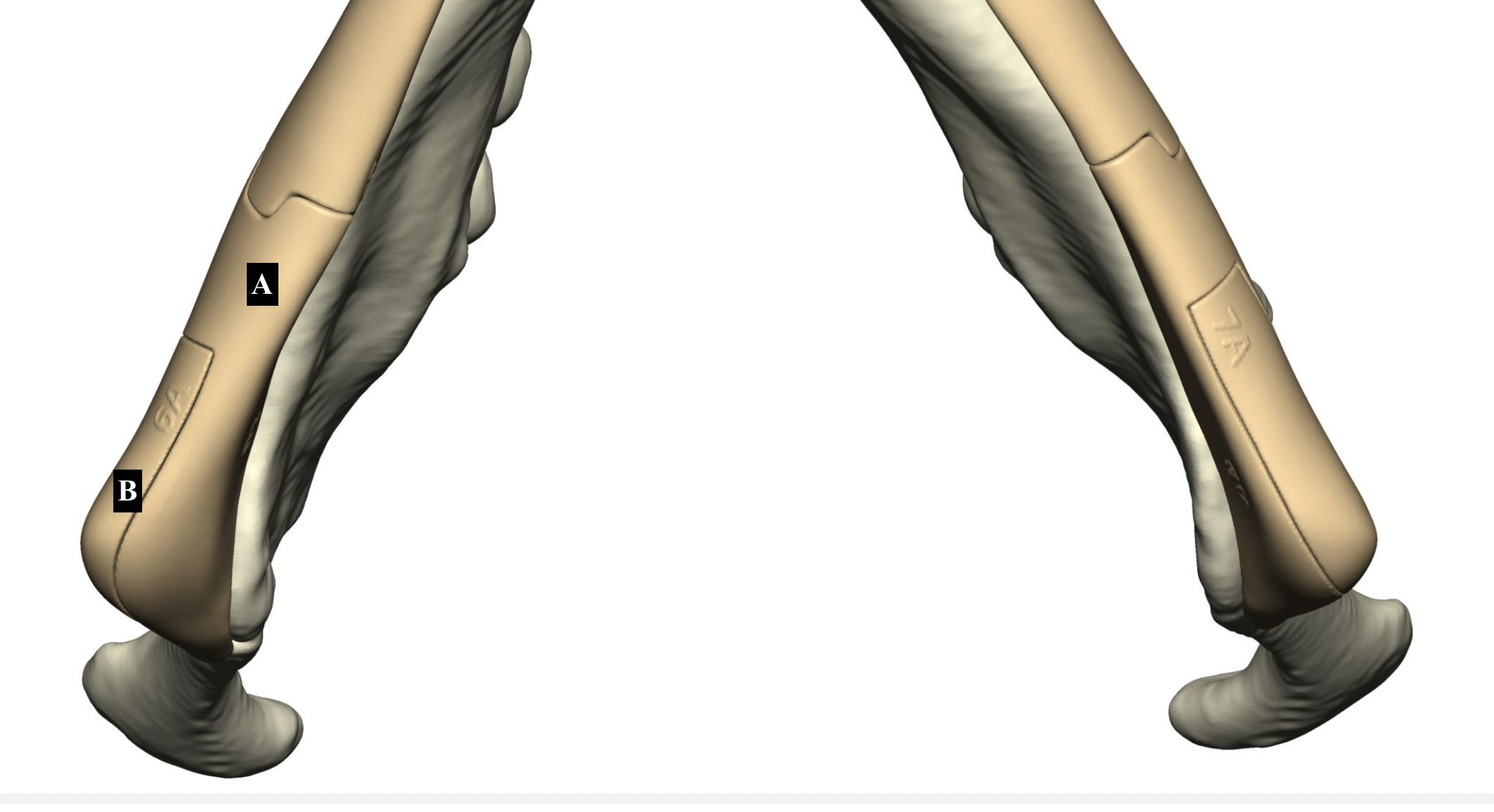
Now A and B can be introduced independently and assembled on the bone.
There are several reasons this becomes particularly important as the angle gets larger.
1. The incision is not the only bottleneck.
Getting a component through the mucosal incision does not mean it can get into position. The implant has to negotiate the subperiosteal pocket, mandibular curvature, masseteric attachments and the limited freedom available for rotation. A tall rigid PEEK angle can behave almost like trying to put a large L-shaped object through a narrow curved slot.
2. Vertical lengthening makes the geometry much harder.
Jaw-angle implants that substantially lower the mandibular angle have a posterior portion considerably taller than the connecting mandibular-body portion. This disproportion is specifically cited as a reason large vertically lengthening jawline implants require segmentation.
3. PEEK cannot exploit temporary deformation.
Silicone’s flexibility is one of the reasons a surprisingly large jawline implant can sometimes be introduced through relatively small incisions. Surgical descriptions specifically contrast this flexibility with the difficulty produced by large jaw-angle dimensions. With PEEK, CAD segmentation has to accomplish what folding accomplishes with silicone.
4. A large angle may require an insertion trajectory that is impossible once it is one rigid piece.
The final implant might fit perfectly against the CT-derived bone, yet there may be no collision-free path between the incision and that final position. This is an important distinction:
Final design…. insertability or manufacturability ??
An implant design can fitsperfectly in its final coordinates but cannot physically be maneuvered there without excessive enlargement the incision or being able to be manufactured.
5. Larger implants amplify the consequences of trying to force placement.
Excessive traction, pocket enlargement, levering or blind manipulation is undesirable around the mandibular soft tissues and neurovascular anatomy. In custom jawline surgery generally, the size of the jaw-angle component is repeatedly identified as the factor determining when segmentation is required.
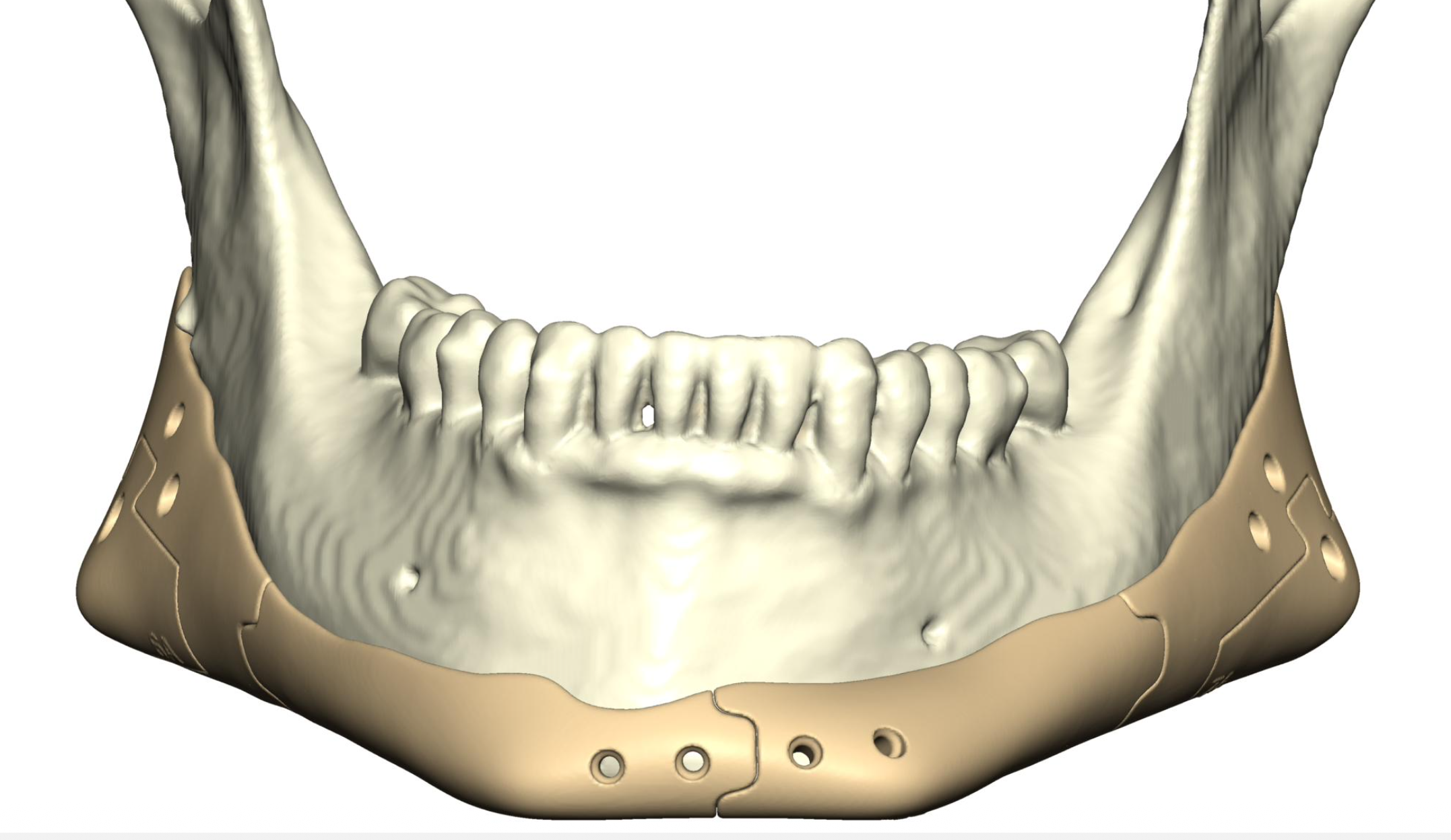
So an initially four-piece design can become six pieces:
That doesn’t necessarily mean the final implant should behave as six separate implants. Ideally, segmentation is an insertion strategy. Once assembled and fixed, the pieces recreate the exact continuous geometry of the original virtual design.
This is also why I would strongly favor intentional CAD-designed junctions rather than simply cutting a finished PEEK implant wherever convenient. A geometric/keyed interface can give the surgeon positive three-dimensional registration when reassembling the angle, analogous to the geometric or “jigsaw” interfaces described for large custom jawline implants.
For a very large PEEK angle, the ideal question during design is therefore not:
“Can we get this down to four pieces?”
It is:
“What is the largest rigid component for which there is a safe, reproducible insertion path from the planned incision to its exact final position?”
Once that threshold is exceeded, splitting the angle itself can make sense even though the overall jawline implant is already segmented.
Dr Barry Eppley
Plastic Surgeon