
Custom infraorbital-malar implants and fat grafting are fundamentally different treatments because they address different anatomical causes of undereye hollowing. Fat grafting restores soft tissue volume, whereas custom implants restore deficient skeletal support. Choosing between them depends less on patient preference and more on identifying whether the primary problem lies in the bone, the soft tissues, or both.
The Anatomical Difference
The lower eyelid and upper cheek are supported by a combination of:
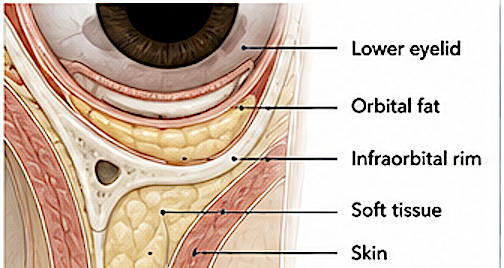
- Facial skeleton
- Orbital fat
- Subcutaneous fat
- Orbicularis muscle
- Skin
Undereye hollowing can result from deficiencies in any of these layers. Successful treatment requires identifying which layer is responsible.
How Fat Grafting Works
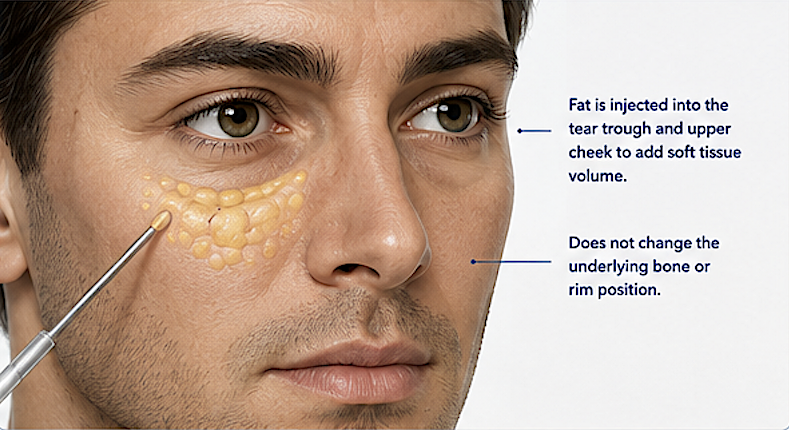
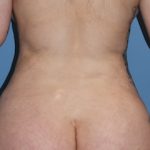
Fat grafting transfers a patient’s own fat, typically harvested from the abdomen or thighs, into the tear trough and upper cheek.
Advantages
- Uses the patient’s own tissue
- No implant required
- Soft, natural feel
- Can improve mild volume deficiency
- Useful for age-related fat loss
- Can improve skin quality through regenerative effects of adipose-derived stem cells
Limitations
- Does not change skeletal anatomy
- Variable fat survival (typically 50–80% retention after healing)
- May require multiple sessions
- Potential for irregularities, lumpiness, or overcorrection
- Difficult to precisely control long-term volume
- Limited ability to improve a negative orbital vector or recessed infraorbital rim
Fat grafting is best viewed as a soft tissue augmentation procedure.
How Custom Infraorbital-Malar Implants Work

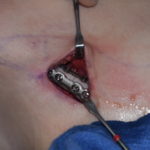
Custom implants are designed from a high-resolution 3D CT scan to restore the missing bony framework beneath the lower eyelid and upper cheek.
Advantages
- Permanent structural correction
- Precisely restores skeletal anatomy
- Corrects infraorbital rim deficiency
- Improves negative orbital vector
- Supports the lower eyelid
- Eliminates bone-based tear troughs
- Predictable, reproducible results
- Corrects asymmetry with patient-specific design
Unlike fat, implants replace the structural foundation upon which the soft tissues rest.
Which Patients Benefit Most?
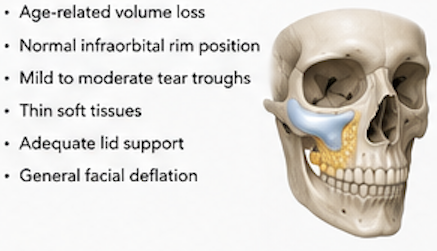
Fat Grafting Is Best For
Patients with:
- Age-related facial deflation
- Thin subcutaneous tissues
- Mild tear trough deformities
- Normal infraorbital skeletal projection
- Adequate lower eyelid support
- Previous weight loss
These patients simply need more soft tissue volume.
Custom Implants Are Best For
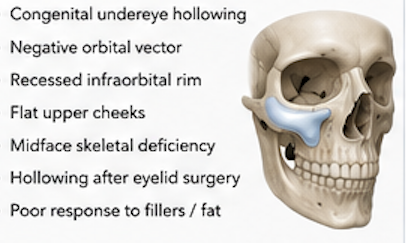
Patients with:
- Congenital undereye hollowing
- Negative orbital vectors
- Recessed infraorbital rims
- Flat upper cheeks
- Midface skeletal deficiency
- Persistent hollows despite fillers or fat grafting
- Hollow appearance after lower eyelid surgery caused by inadequate bony support
These patients lack the underlying skeletal projection necessary to support the lower eyelid.
Skeletal Support vs. Volume Filling
One of the most important distinctions is where the volume is added.
Fat Grafting
Adds volume above the bone within the soft tissues.
Custom Implant
Adds volume to the bone, moving every overlying tissue layer outward together.
This difference explains why implants often produce a smoother lid-cheek transition in patients with skeletal deficiencies.
Precision
Fat
The surgeon estimates:
- injection location
- volume
- distribution
- expected fat survival
Healing remains somewhat unpredictable.
Custom Implant
The surgeon plans:
- exact thickness
- projection
- contour
- asymmetry correction
- implant borders
Everything is digitally designed before surgery, making the final skeletal change highly predictable.
Permanence
Fat Grafting
- Partial fat resorption is expected.
- Long-term volume varies among patients.
- Additional grafting may be needed.
Custom Implant
- Implant dimensions remain unchanged.
- Bone support is permanent.
- Results remain stable unless the implant is removed or revised.
Effect on the Lower Eyelid
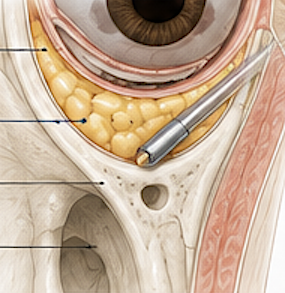
Fat grafting can camouflage hollowing but has little effect on lower eyelid support.
Custom infraorbital-malar implants improve:
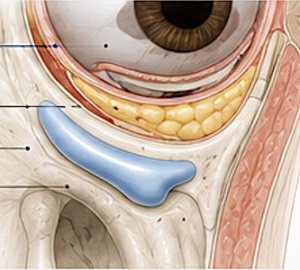
- lower eyelid support
- lid-cheek relationship
- negative orbital vector
- apparent eye prominence in appropriately selected patients
Because they rebuild the skeletal platform, implants can enhance lower eyelid mechanics as well as appearance.
Can They Be Combined?
Yes. In many patients, the most natural result comes from combining both techniques.
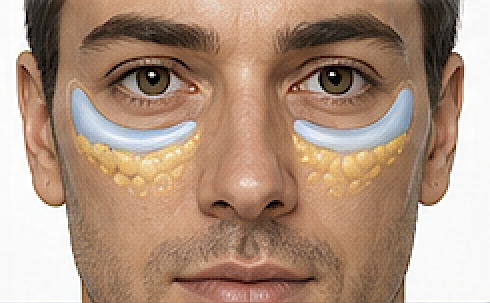
The implant restores the skeletal foundation while fat grafting refines the soft tissue contour, improves skin quality, and smooths any remaining transition. This layered approach treats both the structural and soft tissue components of undereye hollowing.
Comparison Table
|
Feature |
Custom Infraorbital-Malar Implant |
Fat Grafting |
|
Treats bone deficiency |
Excellent |
No |
|
Treats soft tissue volume loss |
Limited |
Excellent |
|
Corrects negative orbital vector |
Excellent |
Minimal |
|
Improves lower eyelid support |
Excellent |
Minimal |
|
Predictability |
Very high |
Moderate |
|
Permanent result |
Yes |
Variable |
|
Volume stability |
Excellent |
Variable |
|
Repeat procedures |
Rare |
Sometimes required |
|
Skin quality improvement |
No |
Yes |
|
Best for congenital hollowing |
Excellent |
Limited |
|
Best for aging-related volume loss |
Good (when bone deficiency exists) |
Excellent |
Bottom Line
The choice between custom infraorbital-malar implants and fat grafting should be based on the underlying anatomy rather than the desire to avoid an implant. Fat grafting is ideal for restoring lost soft tissue volume, while custom implants are the treatment of choice for patients with a recessed infraorbital rim, flat upper cheek, or negative orbital vector. For many patients, particularly those with both skeletal deficiency and soft tissue deflation, combining the two procedures provides the most comprehensive and natural-looking rejuvenation.
Dr. Barry Eppley
Plastic Surgeon