

The biggest difference between an average male jaw and the kind of jawline seen on fashion models or actors is usually a combination of bone structure, body fat, muscle, and lighting, not one single feature.
Here’s what people typically associate with an “ideal” male jawline:
1. Strong mandibular angle
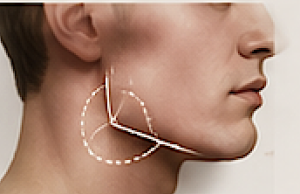
- The angle where the jaw meets the neck is more pronounced.
- Many attractive male faces have a jaw angle around 120–130°, though there is plenty of natural variation.
- A sharper angle creates a more defined, masculine appearance.
2. Wide jaw relative to the chin
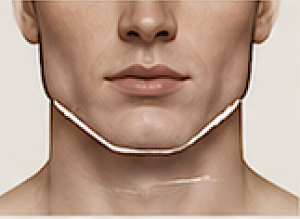
- The lower face appears broad rather than narrow.
- The jaw widens toward the back near the ears.
- This width often comes from genetics (bone structure).
3. Defined jaw border
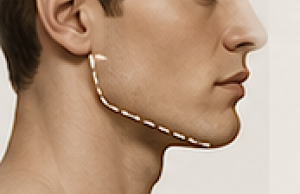
- The lower edge of the jaw is clearly visible from chin to ear.
- Minimal fat beneath the jaw helps create this definition.
- This is one reason leaner individuals often appear to have stronger jawlines.
4. Forward chin projection
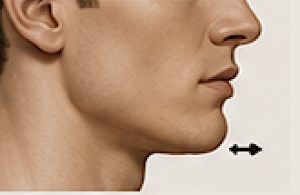
- The chin extends slightly forward rather than receding.
- A well-projected chin improves the side profile and overall facial balance.
5. Good neck-to-jaw separation
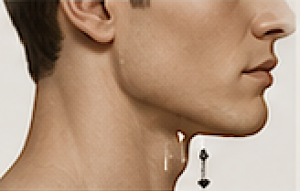
- There’s a clear distinction between the underside of the jaw and the neck.
- Excess fat or loose skin in this area softens the jawline.
6. Facial proportions
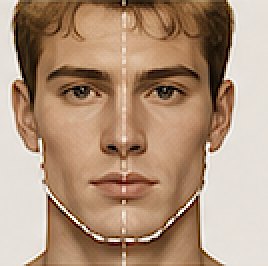
An attractive jaw is usually balanced with the rest of the face:
- Cheekbones that are reasonably prominent.
- A midface and chin that are proportionate.
- Good facial symmetry (though perfect symmetry is uncommon).
What can actually change?
You can improve:
- Body fat percentage. Losing excess body fat is often the most noticeable change for jaw definition.
- Posture. Better neck and head posture can subtly improve how the jaw appears.
- Facial hair. A well-shaped beard can create the illusion of a stronger jaw or more projected chin.
- Dental/orthodontic issues. Correcting significant bite problems can improve facial harmony in some cases.
You generally cannot change naturally:
- Jaw width.
- Bone thickness.
- Mandibular angle.
- Chin projection (without surgery or implants).
What about “mewing” and jaw exercises?
The evidence is mixed:
- Mewing (proper tongue posture) has little strong evidence that it can reshape the adult jaw. It may encourage good oral posture but shouldn’t be expected to change bone structure in adults.
- Jaw exercisers mainly strengthen the masseter muscles. They may slightly increase muscle size but won’t widen the jawbone, and overuse can contribute to temporomandibular joint (TMJ) problems in some people.
Why models often have exceptional jawlines
Many male models naturally have:
- Lower-than-average body fat.
- Favorable genetics for facial bone structure.
- Professional grooming.
- Makeup and contouring.
- Lighting and camera angles that emphasize shadows under the jaw.
- Photo editing in many commercial images.
So the “model jawline” you see is often the result of both natural anatomy and presentation.
Overall, the features most consistently associated with an ideal male jawline are:
- A well-defined jaw border.
- Moderate-to-strong jaw width.
- Good chin projection.
- Clear neck separation.
- Balanced facial proportions rather than an extremely exaggerated jaw.
Case Study
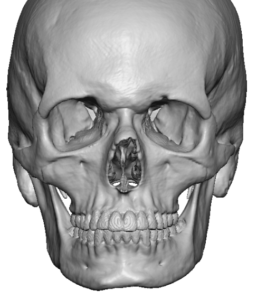
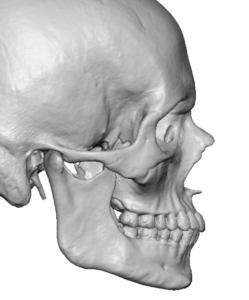 This young male with an average size lower jaw(not deficient by standard measurements) desired a much stronger jawline. Assessment of his 3D CT scan some mild asymmetry of the chin an, slight vertical and horizontal chin deficiency.
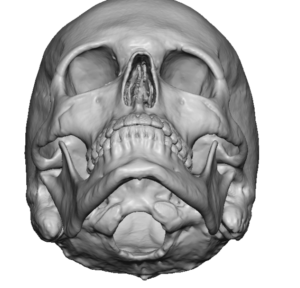 From the submental view the chin had a round shape and the jaw angles turned in from the body at the external oblique line (as is typical for many caucasians).
A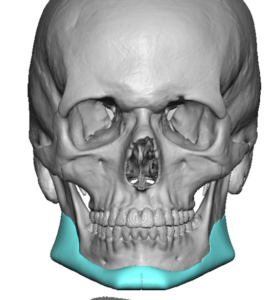
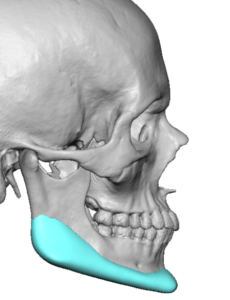 custom jawline implant was designed that added 7mm horizontal chin projection, 2mms of vertical lengthening, created a square chin shape and corrected the chin asymmetry.
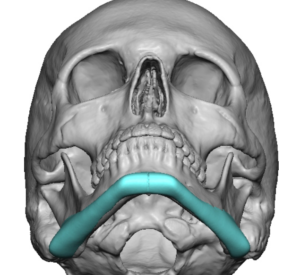 From the submental view the jaw angles were widened by 10mms on each side to correct the lack of jaw angle flare. The width of the jaw angles did not exceed the bizygomatic width.
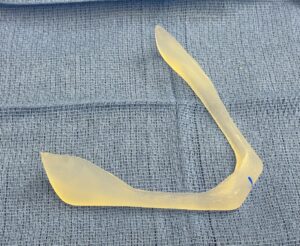
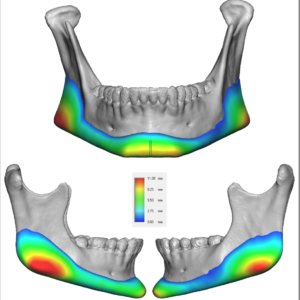 Total implant volume was 19ccs with maximal thickness distribution at the chin and jaw angles.
Discussion
A custom jawline implant can transform an average male jaw into a much stronger, more angular one, but the best results come from designing it to fit the individual’s facial proportions rather than simply making the jaw as large as possible.
A typical design process looks like this:
- 3D Imaging
- A high-resolution CT scan of the skull is obtained.
- A digital 3D model of the facial bones is created.
- Facial Analysis
The surgeon (often with a biomedical designer) evaluates:
-
- Bigonial width (distance between the jaw angles)
- Chin projection and width
- Mandibular angle (typically 120–130° in average males; stronger jaws often appear around 115–120°)
- Lower facial height
- Relationship between the cheekbones and jaw width
- Neck and soft tissue thickness
- Custom Implant Design
Instead of a standard implant, the implant is modeled to fit the patient’s bone exactly.
Common enhancements include:
-
- Jaw angle augmentation: increases width and creates a sharper posterior angle.
- Body augmentation: thickens the horizontal portion of the mandible for a stronger profile.
- Chin augmentation: adds forward projection, width, or vertical height as needed.
- Continuous wraparound implant: combines all three into a single piece or multiple precisely matching pieces.
- Manufacturing
The implant is typically made from:
-
- Solid silicone (most common)
- Porous polyethylene (Medpor)
- PEEK (polyether ether ketone) in selected cases
- Surgery
-
- Usually performed through incisions inside the mouth.
- Implants are fixed to the bone with titanium screws to prevent movement.
- Recovery generally involves swelling for several weeks, with the final definition becoming apparent over several months.
Example of a Moderate-to-Strong Enhancement
An average male might have:
- Jaw width: ~112 mm
- Mild jaw angle definition
- Average chin projection
A custom implant could be designed to provide approximately:
- 6–10 mm increase in jaw angle width per side
- 3–6 mm increase along the mandibular body
- 4–8 mm increase in chin projection
- 2–5 mm increase in chin width
These values vary depending on the person’s anatomy and aesthetic goals. Larger augmentations are possible, but excessive enlargement can look disproportionate or place more tension on the overlying soft tissues.
Example of a Moderate-to-Strong Enhancement
An average male might have:
- Jaw width: ~112 mm
- Mild jaw angle definition
- Average chin projection
A custom implant could be designed to provide approximately:
- 6–10 mm increase in jaw angle width per side
- 3–6 mm increase along the mandibular body
- 4–8 mm increase in chin projection
- 2–5 mm increase in chin width
These values vary depending on the person’s anatomy and aesthetic goals. Larger augmentations are possible, but excessive enlargement can look disproportionate or place more tension on the overlying soft tissues.
What Makes a Jaw Look Strong
It’s not just width. A convincing masculine jaw usually combines:
- Well-defined mandibular angles
- A continuous, straight lower jaw border
- Appropriate chin projection
- Harmony with the cheekbones
- Good neck–jaw separation
A custom implant can address all of these simultaneously, which is one reason it often produces a more natural result than using separate stock jaw angle and chin implants.
If you’re interested in the design aspect, here’s a simplified comparison:
Average jaw: Custom implant result:
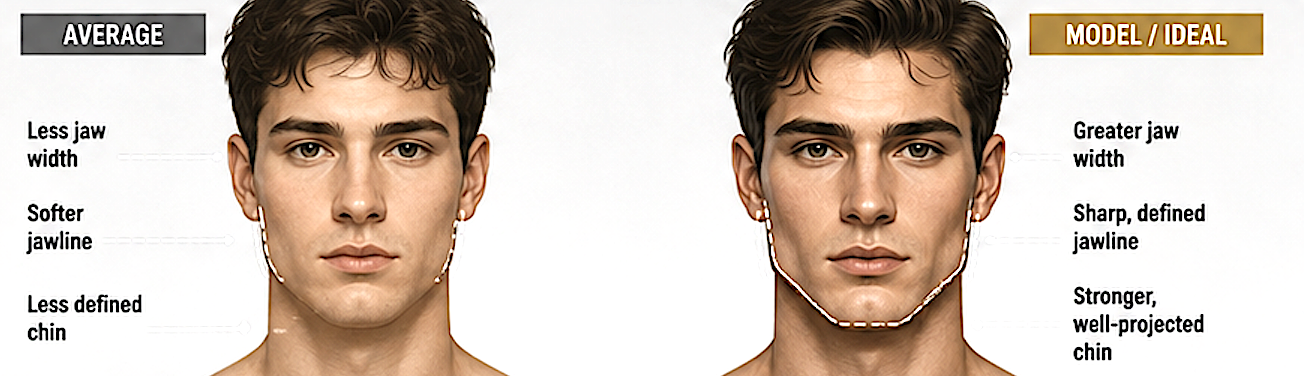
soft angle wider angle
narrow stronger body
average chin more projected chin
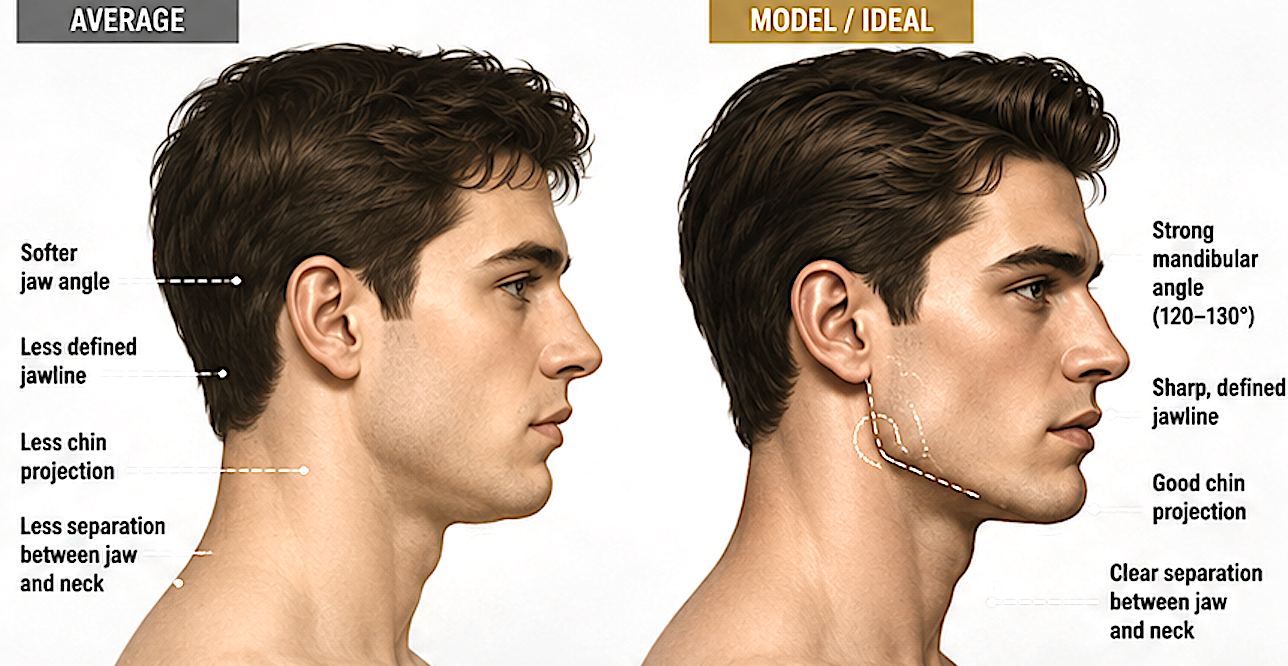
The goal is usually not to create the largest possible jaw, but one that appears naturally strong and proportionate to the rest of the face.
Key Points
1) The single greatest contributor to a mre ideal jawline shape is the uiderlyng bone structure.
2) The most powerful changer of the lower facial shape is a custom jawline implant that incorporates the traits of a strong male jae.
3) The features of increased jaw width and chin projection with a linear jaw-neck separation are the fundamental elements that change an avenge jaw to a defined stronger one.
Barry Eppley, MD, DMD
Plastic Surgeon