

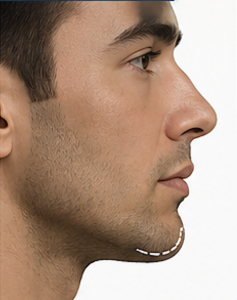
 One of the most common reasons for a request for a custom jawline implant is in the patient who has an existing standard chin implant. In most cases this is because they saw positive improvements from the chin implant and are either:
- trying to extend the benefits of the chin implant to the rest of the jawline,
- to make further improvements in the initial chin implant augmentation and extend that to the rest of the jawline, or
- are unhappy with the initial chin implant, either in size or position, and want to start over and make an entire augmentation of the entire lower third of the face.
In considering a custom jawline implant replacement for an existing chin implant, although I am not sure the term replacement is really accurate the key considerations are:
- Existing chin implant removal: the chin implant removal and the custom jawline implant replacement are typically done at the same time. In removing the chin implant, regardless of its material composition, there may be some existing bone remodeling affects. Most relevant are bony overgrowths, which always needs to be removed and can be seen on a preoperative 3-D CT scan. This is necessary for an accurate fit of the new jawline implant
- Custom implant design: A 3DCT scan is required to create a patient-specific implant that can:
- Reproduce or modify the existing chin implant dimensions. Increase chin width, vertical length, or projection if desired.
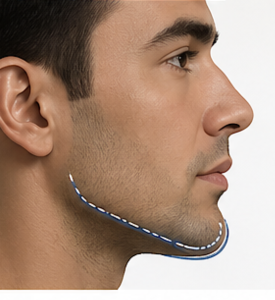
- Extend along the mandibular body and angle regions to create a complete jawline enhancement.
- Fit over altered anatomy: The custom implant is designed with an appreciation of the existing bone remodeling affects and the design incorporates that any bony overgrowths are removed
- Surgical approach: In many cases the custom jawline implant can be placed through a combination of intraoral and/or small external incisions, depending on the design and surgeon preference. In so doing all existing bony overgrowth needs to be removed or significantly reduced.
- Advantages over a standard chin implant:
- More precise symmetry.
- Simultaneous chin and jaw angle augmentation.
- Better control of width, shape, and contour.
- Greater ability to create a continuous jawline rather than an isolated chin enhancement.
Case Study
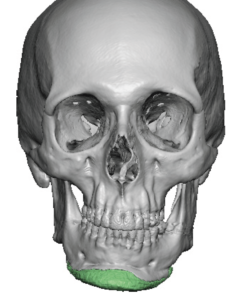 This male had a prior large chin implant which provided him with tremendous improvement in his lower facial projection, and was a result that he liked, and wanted to be slightly improved. But he also had right chin/jawline asymmetry which the chin implant did not improve which was also a primary motivating factor for a wrap around jawline implant.
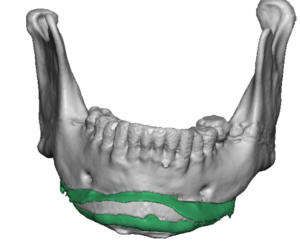
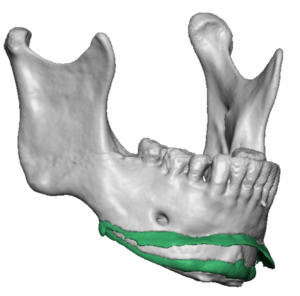 On his 3-D CT scan, extensive bony overgrowth, particularly on the superior side of the implant, could be seen. When colorized in green extent of the bony overgrowth was significant. All of these bony overgrowths would need to be removed.
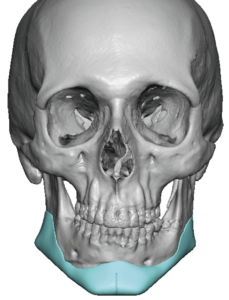
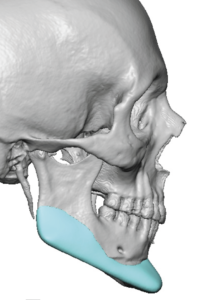 A custom jawline implant as designed that had some a few millimeters of increased, chin projection, squared out the chin, and provided jawline extensions for an enhanced angle effect with correction of his bony asymmetry.
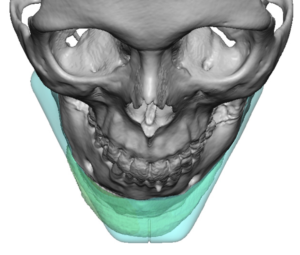 The difference in the effects of the large rounded standard chin implant could be seen compared to the new custom jawline implant by an overlay technique in the design process.
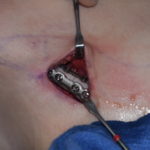
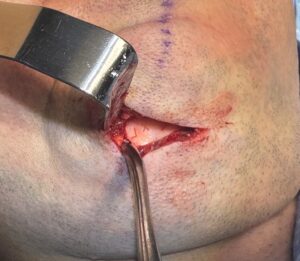 During surgery, the bone remodeling affect of the solid silicone chin implant could be seen by the imprinting on the underlying bone of the size of the implant located on its back surface where it existed as embossed lettering.
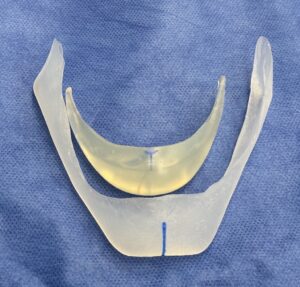 Comparing the removed standard chin implant to that of the custom jawline implant when lane side to side during surgery provides a real 3-D appreciation of their differences.
Discussion
The presence of an existing chin implant with a custom jawline implant replacement has several advantages and disadvantages. The design advantage is that the chin implant provides known dimensions and aesthetic which allows for improvements in the shape and projection of the chin in the new custom jawline implant. Also the implant has created a an existing partial pocket dissection so some of the tissues have already been elevated.
But with the existing pocket comes several significant disadvantages, which must be overcome with its removal and replacement with a new larger implant. As already noted any bony overgrowth must be completely removed to permit the passage of an implant which goes way beyond the wings of the existing chin implant. There is also the scar tissue or capsule on the bone, which cannot simply be left there. The existing capsule must be completely elevated and removed at the bony level. The overlycapsule on the soft tissue must remain as it also impractical or impossible to ever try to remove it. This overlying capsule makes the overlying soft tissues stiffer than otherwise, will exist in a primary augmentation procedure.
The conclusion is that having an existing chin implant in many cases makes the surgery more difficult than if the implant was not there. The challenges of the implant being there must be overcome for a satisfactory placement of a new custom jawline implant. These challenges are routine in such cases, but if the surgeon is not experienced in performing this exchange, they may be unaware of what is necessary for a successful implant replacement outcome. Such challenges become exponentially greater when it involves implant materials which have tissue in growth of any significance.
Key Points
- It is not uncommon for a male to graduate from a standard chin implant to a custom jawline implant for a more complete lower facial augmentation effect.
- An existing chin implant has advantages for the new custom jawline implant design, but also has some challenges to overcome with its removal, and in the placement of the new implant.
- Different chin implant materials can make these removal and replacement challenges, greater or less so.
Barry Eppley, MD, DMD
Plastic Surgeon