

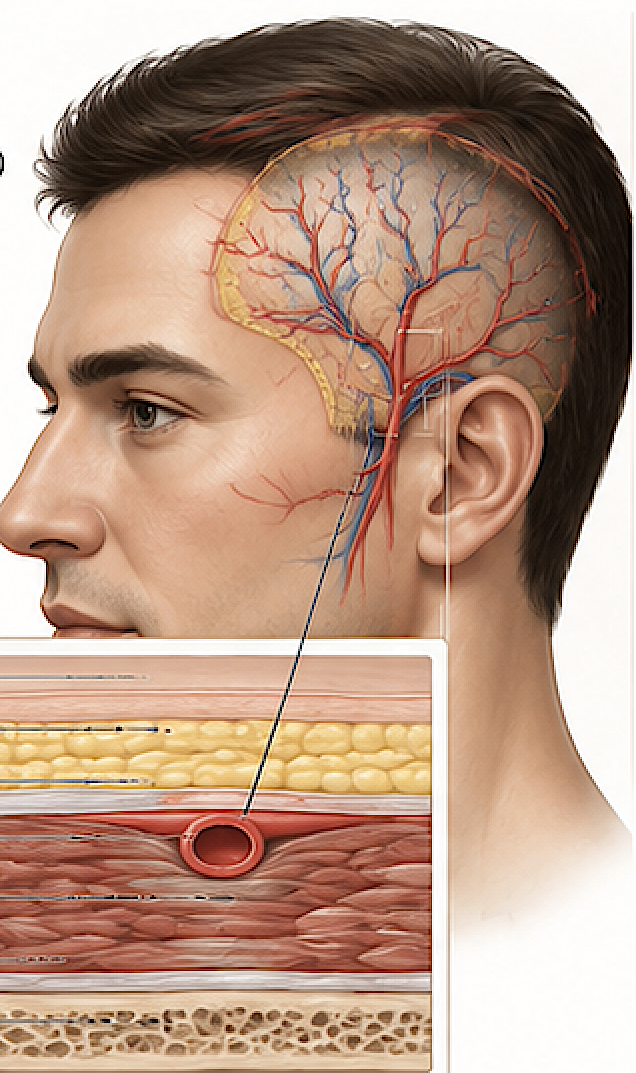
 The temporal arteries on the side of the head are well known because of their more superficial location and their resultant visibility in certain people. Running above the fascia of the temporal muscle over the temporal fossa and onto the side of the forehead makes them susceptible to becoming more prominent later in life. But why do they do so?
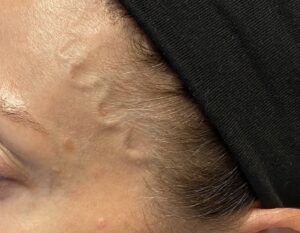 Prominent superficial temporal arteries occur when the artery becomes larger, more tortuous, or more visible through the overlying tissues. In most patients, the cause is a combination of anatomy, aging, and increased blood flow rather than disease.
The common reasons include:
1. Aging and Soft Tissue Thinning (Most Common)
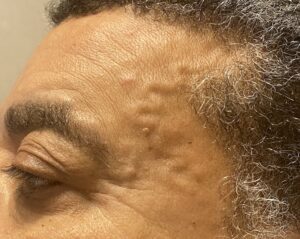
As people age:
- The temporal skin becomes thinner.
- Subcutaneous fat decreases.
- The superficial temporal fascia becomes less padded.
- Temporal hollowing exposes underlying vessels.
The artery itself may not enlarge substantially, but it becomes much more visible because there is less tissue covering it.
2. Arterial Enlargement
Like many arteries elsewhere in the body, the superficial temporal artery can gradually:
- Increase in diameter
- Become elongated
- Develop tortuous loops
This occurs due to:
- Loss of elastic fibers in the arterial wall
- Chronic arterial pressure
- Normal vascular aging
The artery often becomes more serpiginous as it lengthens over time.
3. Increased Blood Flow
The temporal artery can transiently enlarge with increased flow from:
- Exercise
- Heat exposure
- Emotional stress
- Alcohol
- High environmental temperatures
These changes are usually temporary.
4. Low Body Fat/Weight Loss
Lean individuals often have:
- Less temporal fat
- Less scalp thickness
Even a normal-sized artery may appear unusually prominent.
5. Temporal Hollowing
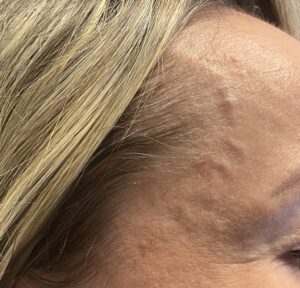
Loss of:
- Temporal fat
- Temporalis muscle bulk
creates a depression around the artery, making it stand out in relief.
This is frequently seen after:
- Aging
- Significant weight loss
- Temporalis muscle atrophy
- Prior temporal surgery
6. Genetic Predisposition
Some people naturally have:
- Larger superficial temporal arteries
- More superficial arterial course
- Less soft tissue coverage
This often runs in families.
Less Common Medical Causes
Giant Cell (Temporal) Arteritis
Inflammation of the artery causes:
- Enlargement
- Tenderness
- Thickening
- Pain
Associated symptoms include:
- Headache
- Jaw claudication
- Vision changes
This is a medical emergency requiring prompt evaluation.
Arteriovenous Malformations or Fistulas
Abnormal vascular connections can produce:
- Enlarged, pulsatile temporal vessels
- Bruits
- Scalp warmth
These are uncommon.
Aneurysm or Pseudoaneurysm
Usually follows trauma.
The artery develops a localized pulsatile mass rather than diffuse prominence.
Why They Often Become Tortuous
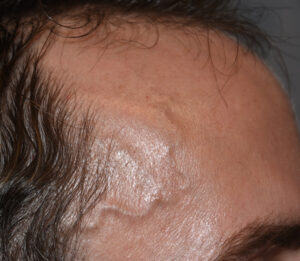
An interesting feature is that arteries do not simply enlarge—they often become more winding (serpiginous).
This happens because:
- The artery gradually lengthens with age.
- Its attachment points remain fixed.
- The excess length has nowhere to go, so it buckles into curves, much like an electrical cord that’s slightly too long.
This explains the characteristic “rope-like” appearance of many prominent temporal arteries.
Why Patients Seek Treatment
Patients usually seek treatment because the artery:
- Is visible in photographs
- Creates an aged appearance
- Appears asymmetrical
- Becomes more noticeable during exercise or heat
- Pulsates visibly
Importantly, the problem is usually cosmetic rather than functional.
Relative Importance of Causes
|
Cause |
Frequency |
|
Aging/soft tissue thinning |
????? |
|
Temporal hollowing |
????? |
|
Arterial aging and tortuosity |
????? |
|
Low body fat |
????? |
|
Exercise/heat-induced dilation |
????? |
|
Genetic anatomy |
????? |
|
Giant cell arteritis |
????? |
|
Trauma/aneurysm |
????? |
In aesthetic surgery, the most common scenario is a patient over 40 with age-related temporal hollowing and thinning of the overlying soft tissues, which makes a mildly enlarged, tortuous superficial temporal artery appear strikingly prominent. This is also why procedures such as temporal fat grafting or temporal implants can sometimes reduce the artery’s visibility even though the artery itself is unchanged, simply by restoring soft tissue coverage.
Dr. Barry Eppley
Plastic Surgeon