
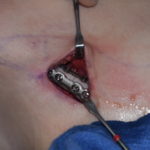
Bony overgrowths occur around facial implants, particularly chin and jaw angle implants, is commonly observed on 3D CT scans and during implant replacement surgery. It is less discussed than bone imprinting changes underneath the implant even though it is part of the overall bone remodeling process that occurs as an adaotive response to implant placement.
Why Does It Occur?
Bone overgrowth around facial implants is generally a form of reactive bone formation rather than true uncontrolled bone growth. It occurs because the implant changes the mechanical and biologic environment of the underlying bone.

Several factors contribute:
- Periosteal stimulation
-
- The periosteum (the membrane covering bone) contains osteogenic cells.
- An implant resting against bone can create chronic low-grade stimulation of the periosteum, encouraging new bone deposition along the implant interface.
- Mechanical loading changes (Wolff’s law)
-
- Bone adapts to stress.
- Certain implants alter how forces are transmitted through the facial skeleton, leading to localized bone apposition where stress is increased.
- Implant material and surface characteristics
-
- Porous polyethylene implants often allow tissue ingrowth and can become firmly integrated with surrounding tissues.
- Rough or textured surfaces may produce more intimate periosteal interaction than smooth silicone implants.
- Titanium and other osseointegrative materials can directly encourage bone contact and growth.
- Long-term periosteal elevation
-
- Facial implants are often placed in a subperiosteal pocket.
- The chronic separation and repositioning of the periosteum can trigger remodeling responses that include both bone resorption and new bone formation.
- Individual biologic variability
-
- Some patients are naturally more prone to heterotopic bone formation or exuberant healing responses.
- Age, genetics, hormonal factors, and local vascularity may play a role.
Common examples
Chin implants
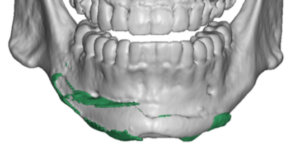
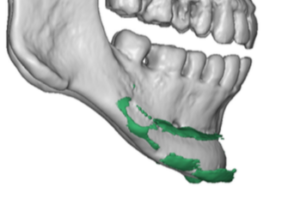
- Often show a combination of pressure resorption centrally and bone apposition around the implant margins.
- Occasionally a distinct “shelf” of bone develops around the implant perimeter.
Jaw angle implants
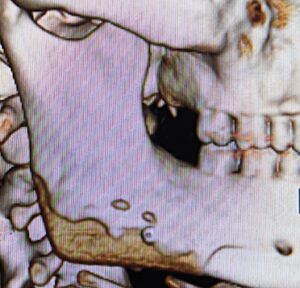
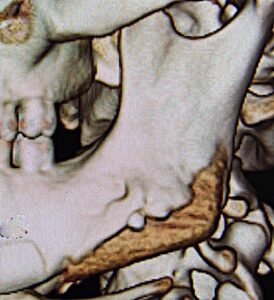
- Can produce significant peripheral bone overgrowth over many years, particularly when the implant is large and well stabilized.
Cheek implants
- Less commonly demonstrate obvious bone overgrowth, but localized cortical thickening may occur.
Is it a problem?
Usually not. Most bone overgrowth around facial implants is:
- Slow
- Stable
- Asymptomatic
However, excessive bone formation can:
- Make implant removal more difficult.
- Alter the aesthetic result.
- Occasionally contribute to nerve irritation if growth occurs near foramina.
In facial implant surgery, what is often more commonly discussed is bone remodeling—a combination of localized bone resorption under pressure and bone apposition around implant edges—rather than pure bone overgrowth.
Interestingly, in patients with facial implants that have been in place for 10–30 years, 3D CT scans frequently show some degree of bone adaptation, demonstrating that the facial skeleton remains biologically active and responsive to the implant throughout life.
Dr. Barry Eppley
Plastic Surgeon