
Introduction
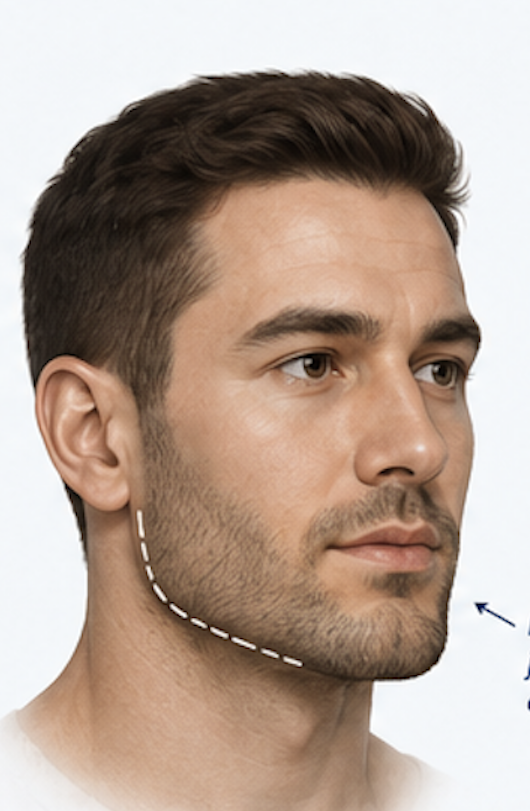
The jawline has become one of the most sought-after facial features in aesthetic surgery. While much attention is given to chin augmentation, the jaw angles—the back corners of the lower jaw beneath the ears—play an equally important role in creating a strong, balanced, and attractive facial appearance.
A well-defined jawline is often associated with youth, strength, attractiveness, and facial harmony. In men, prominent jaw angles are commonly viewed as a hallmark of masculinity. In women, a clean and sculpted jawline can enhance facial definition and improve the transition between the face and neck.
For patients seeking permanent jawline enhancement, jaw angle implants offer a powerful solution that cannot be replicated by fillers or fat grafting alone. By directly augmenting the underlying facial skeleton, these implants create structural improvements that become an integral part of the facial framework.
This article explains everything patients should know about jaw angle implants, including who is a candidate, implant options, surgical techniques, recovery, risks, and how custom-designed implants have transformed jawline enhancement.
Understanding Jaw Angle Anatomy
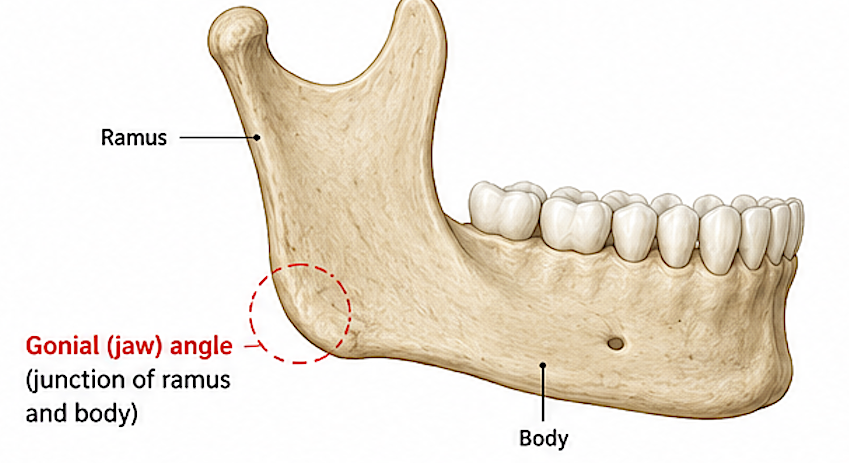
The bony jaw angle refers to the gonial angle, the point where the posterior border of the mandibular ramus meets the inferior border of the mandibular body.
Bones involved
- Mandible (lower jaw) is the only bone involved.
- The angle is located at the junction of:
- Ramus (vertical portion)
- Body (horizontal portion)
Muscular Attachments
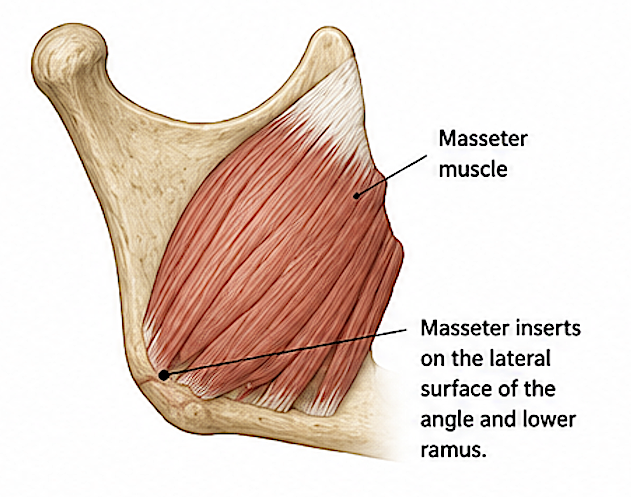
The gonial angle is an important attachment site for the muscles of mastication:
Lateral surface
- Masseter muscle
- Inserts onto the angle and lower lateral ramus.
- Contributes significantly to jaw width and prominence.
Medial surface
- Medial pterygoid muscle
- Inserts onto the medial aspect of the angle.
- Together with the masseter forms a muscular sling around the angle.
Neurovascular Anatomy
Nearby structures include:
- Facial artery crossing the inferior border of the mandible just anterior to the masseter.
- Marginal mandibular branch of the facial nerve coursing superficially near the inferior border.
- Inferior alveolar nerve within the mandibular canal (not directly at the angle but within the ramus).
Aesthetic Significance
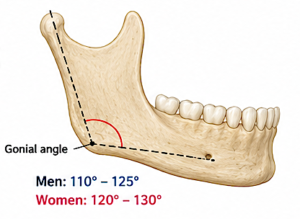
The jaw angle is a major determinant of lower facial shape:
- Strong, square angle ? broader, more masculine appearance.
- Obtuse angle ? softer, more tapered appearance.
- Typical gonial angle:
- Men: approximately 110–125°
- Women: approximately 120–130°
For plastic surgery planning, it is also useful to distinguish between the true bony gonial angle and the soft-tissue jaw angle, since masseter hypertrophy and subcutaneous tissue can substantially alter the visible contour without changing the underlying bone.
Why Jaw Angle Implants Have Become Increasingly Popular
The demand for jawline enhancement has increased dramatically over the last decade.
Several factors have contributed to this trend:
Social Media and Digital Imaging
High-definition photography, video calls, and social media platforms have increased awareness of facial contours and profile appearance.
Growth of Facial Aesthetic Procedures
Patients have become more knowledgeable about facial contouring options and increasingly seek comprehensive lower-face enhancement rather than isolated chin procedures.
The Rise of Jawline Fillers
Injectable fillers introduced many patients to the concept of jawline enhancement. While fillers can improve soft tissue contours, they cannot duplicate the skeletal projection achieved by implants.
Improved Implant Designs
Modern jaw angle implants provide more predictable and customizable results than earlier implant designs.
What Makes an Attractive Jawline?
Male and female attractive jawlines share some traits—clear definition, good bone structure, and harmony with the rest of the face—but the aesthetic ideal is usually different.
Attractive Male Jawline
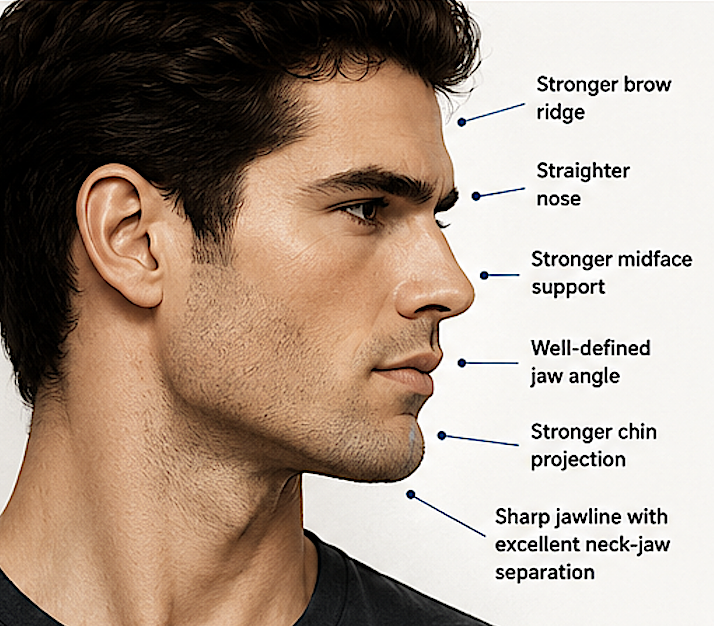
Commonly associated with:
- Broader, wider mandible (jawbone)
- More angular gonial angle (the angle near the back of the jaw)
- Stronger chin projection
- Sharper transition from neck to jaw
- Greater lower-face width relative to cheekbones
Often described as:
- Square
- Strong
- Chiseled
- Robust
Examples: Henry Cavill, Chris Hemsworth, David Gandy.
Attractive Female Jawline
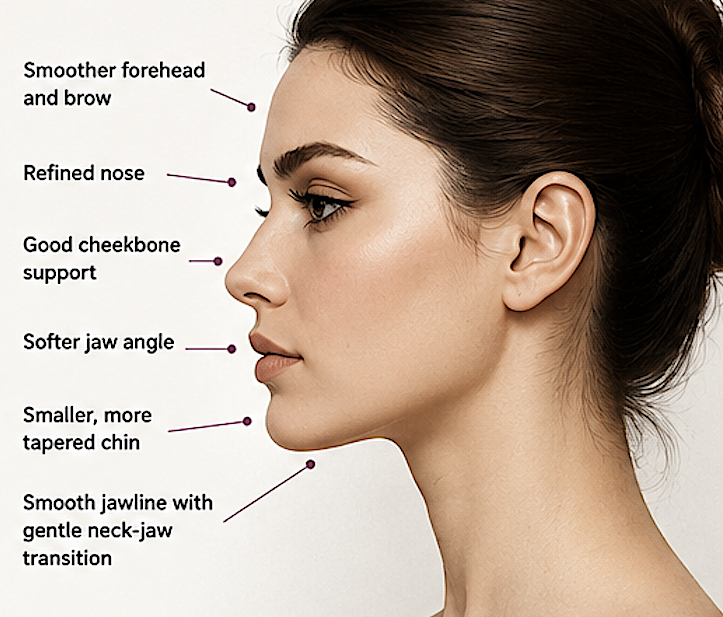
Commonly associated with:
- More tapered or V-shaped lower face
- Softer jaw angles
- Narrower chin
- Smooth contours rather than sharp corners
- Good definition, but usually less width and squareness than in men
Often described as:
- Elegant
- Refined
- Delicate
- Heart-shaped or oval
Examples: Angelina Jolie (strong but feminine), Margot Robbie, Bella Hadid.
Key Anatomical Differences
|
Feature |
Attractive Male |
Attractive Female |
|
Jaw width |
Wider |
Narrower |
|
Gonial angle |
More prominent, squarer |
Softer, less flared |
|
Chin |
Larger, more projected |
Smaller, tapered |
|
Jaw contour |
Angular |
Smooth but defined |
|
Lower-face shape |
Square/rectangular |
Oval, heart-shaped, V-shaped |
Important Nuance
The most attractive faces are usually not at the extremes. A highly attractive woman often has more jawline definition than average women, while a highly attractive man often has strong definition without looking overly exaggerated. What people generally perceive as attractive is a balance of:
- Facial symmetry
- Proper proportions
- Good chin support
- Neck-jaw separation
- Harmony with the nose, lips, and cheekbones
This is why someone like Angelina Jolie can have a relatively strong jaw and still appear highly feminine, while some male models have less extreme jaw width but remain very attractive because the overall facial proportions work together.
Who Is a Good Candidate for Jaw Angle Implants?
Candidates often include individuals who:
- Feel their jawline appears weak or underdeveloped
- Have naturally narrow jaw angles
- Desire a stronger masculine appearance
- Want permanent jawline enhancement
- Have asymmetry of the lower face
- Seek facial balance after chin augmentation
- Have previously been disappointed by filler-based jawline treatments
Ideal candidates should have realistic expectations and this is aided by preoperative imaging of what can and can not be achieved.
Jaw Angle Implants vs Jawline Fillers
This is one of the most common questions patients ask.
What Fillers Can Do
Jawline fillers:
- Add soft tissue volume
- Improve contour temporarily
- Require repeat treatments
- Work best for mild enhancement
What Implants Can Do
Jaw angle implants:
- Create permanent skeletal enhancement
- Produce greater projection
- Improve structural support
- Create more dramatic definition
- Do not require maintenance treatments
For patients seeking substantial jawline enhancement, implants generally provide a level of improvement that fillers cannot achieve.
Types of Jaw Angle Implants
Modern jaw angle implants generally fall into two categories.
Lateral Widening Implants
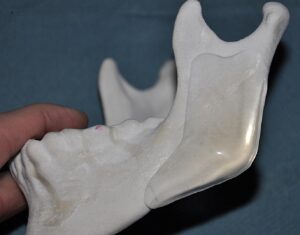
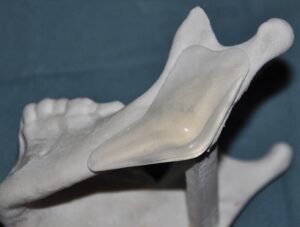
These implants primarily increase jawline width.
They are ideal for patients who:
- Have adequate jaw angle height
- Want a broader jawline
- Desire a stronger masculine appearance
Vertical Lengthening Implants
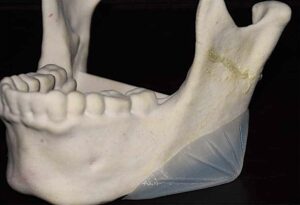
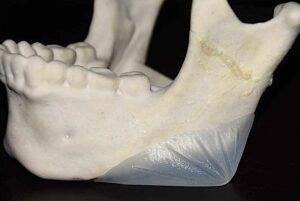
These implants increase jaw angle height while also adding width.
They are often used when:
- The jaw angle sits too high
- The lower face appears vertically short
- Posterior jaw length is needed to create a nore visible and defined jaw angle
The choice depends on a careful analysis of the patient’s existing anatomy and aesthetic goals. Many patients thinik they significant vertical length when they do not. Vertical length may look great in the side and oblique views but can make some patientys boxy looking in the front view
Standard vs Custom Jaw Angle Implants
One of the most significant advances in facial implant surgery has been the development of custom-designed implants.
Standard Implants
Advantages:
- Lower cost
- Proven designs
- Immediate availability
Limitations:
- Fixed shapes
- Limited size options
- Less ability to correct asymmetry
Custom Implants
Custom implants are designed from a patient’s CT scan.
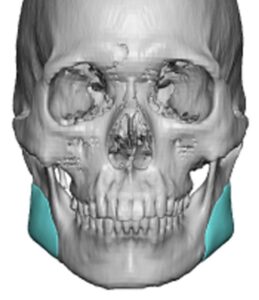
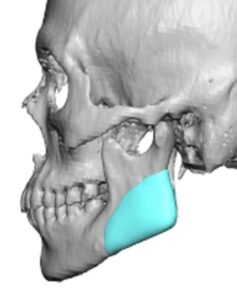
Advantages include:
- Precise fit
- Improved symmetry
- Greater dimensional enhancement
- Ability to address unique anatomy
For patients seeking significant jawline transformation, custom implants frequently provide superior outcomes.
Combining Jaw Angle Implants with Chin Augmentation
Many patients benefit from simultaneous enhancement of both the chin and jaw angles as a single wrap around jawline implant.
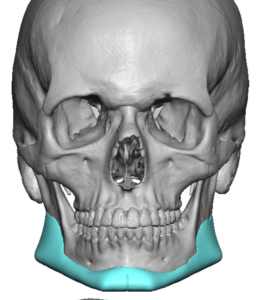
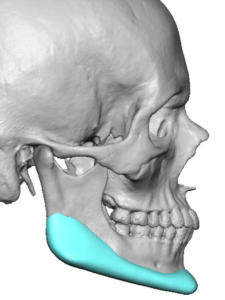
This combination can:
- Create a continuous jawline
- Improve lower facial proportions
- Increase facial balance
- Produce more comprehensive facial contouring
When both areas are enhanced together, the result often appears more natural because the entire jawline is improved rather than a single isolated region.
How Jaw Angle Implant Surgery Is Performed
Jaw angle implant placement is performed under general anesthesia always. This is not a procedure for local or even IV sedation.
The procedure involves:
Intraoral Incisions
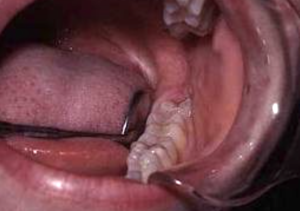
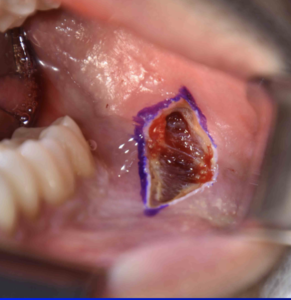
This is the most common approach and a scarless one with posterior vestibular mucosal incisions.
External Approach
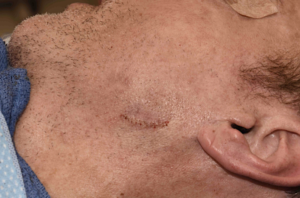 In some cases an external skin approach to the jaw angle may be preferred. While this is typically reserved for secondary or revisional surgery procedures it can be done as the primary approach for those patients who want to lower the risk of infection and have an easier recovery.
Pocket Creation
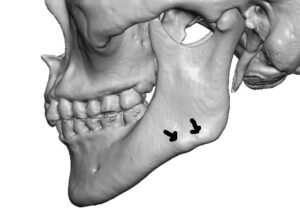
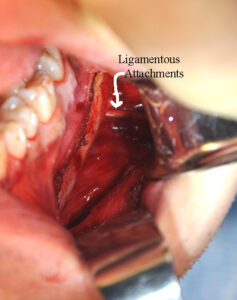
An adequate pocket creation requires awareness and release of the masseter muscle ligamentous attachment(s). Whether this is a partial or full release depends in the style and size of the jaw angle implant.
Implant Placement
The implant is inserted and placed over the angle bone in the desired location. This sounds easy but it is not as the exact location of the implant on the bone can not be fully seen from the intraoral approach. It takes a combination of vision, external feel and landmark identification to get good implant placement.
Screw Fixation
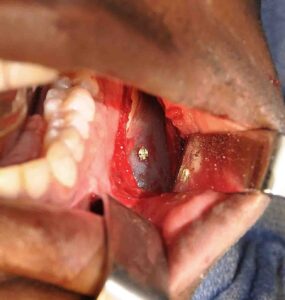
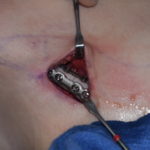
The implants are secured with small titanium screws. Fixation is particularly important with jaw angle implants because it minimizes movement and improves long-term symmetry.
Closure
The incisions are closed using dissolvable sutures.
Recovery After Jaw Angle Implant Surgery
Recovery from jaw angle implant surgery (mandibular angle implants) is usually straightforward but can take several months before the final result is apparent.
Typical Recovery Timeline
First Week
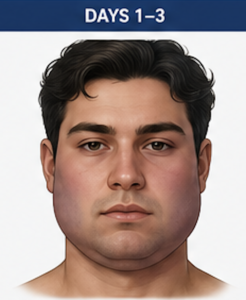
- Significant swelling develops during the first 48–72 hours.
- Mild to moderate discomfort, usually controlled with prescribed medications.
- Soft diet is recommended.
- If the implants were placed through incisions inside the mouth (most common), meticulous oral hygiene is important.
- Bruising may occur but is often less than patients expect.
Weeks 2–3

- Most bruising resolves.
- Swelling begins to noticeably decrease.
- Many patients can return to desk work within 5–10 days, depending on the extent of surgery and comfort level.
- Exercise is usually restricted until cleared by the surgeon.
1–3 Months
- The majority of swelling resolves.
- Jawline definition becomes increasingly visible.
- Residual firmness and subtle swelling may remain, especially near the angle region.
3–6 Months

- Final contour refinement occurs.
- Soft tissues settle around the implants.
- Any numbness or altered sensation usually continues to improve if present.
Common Postoperative Issues
- Swelling (universal)
- Temporary tightness when opening the mouth
- Mild asymmetry from uneven swelling
- Temporary numbness of the lower cheek or jaw area
- Difficulty chewing tougher foods initially
Sleeping and Activity
- Sleep with your head elevated for the first 1–2 weeks.
- Avoid contact sports or facial trauma for at least 6–8 weeks.
- Avoid heavy lifting and strenuous exercise during the initial healing period.
When You’ll Look “Presentable”
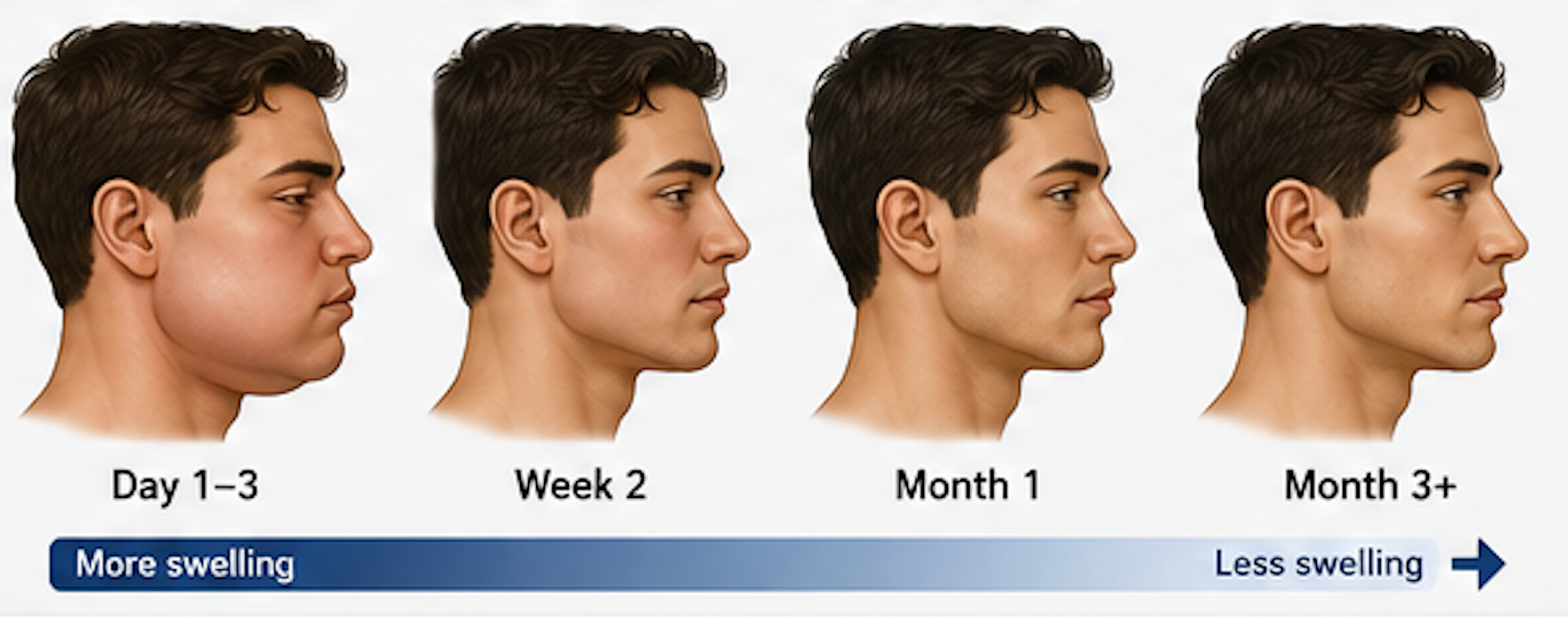
Most patients feel comfortable appearing in public after 10–14 days, but subtle swelling can persist for several months. The jaw often appears somewhat larger than intended early on because of swelling, so it’s important not to judge the final result too soon.
Potential Risks and Complications
While jaw angle implants are highly successful when properly performed, every surgical procedure carries risks.
Potential complications include:
Infection
Because surgery is performed through the mouth, infection risk is slightly higher than with some facial implants.
Implant Asymmetry
Jaw angle implants are among the most technically demanding facial implants to position symmetrically.
Wound Healing Problems
Incisions inside the mouth occasionally separate during healing.
Implant Size Concerns
Some patients later decide they would prefer a different size or shape.
Soft Tissue Changes
There ia always the risk that the masseter muscle may not stay completely stay covered over the implant and can affect the final appearance. (masseter muscle dehiscence) This ris is related to the style and sie of the implants and the surgeon’s experience.
Why Surgeon Experience Matters
Jaw angle implants are often considered among the most technically challenging facial implants.
Successful outcomes depend on:
- Proper patient selection
- Accurate implant choice
- Meticulous pocket creation
- Precise positioning
- Secure fixation
- Experience managing complications
The complexity of the procedure makes surgeon experience a particularly important factor in achieving optimal results.
Frequently Asked Questions
Are jaw angle implants permanent?
Yes. Jaw angle implants are designed to provide permanent structural enhancement.
Can the implants be removed?
Yes. Although removal is rarely requested, implants can be revised or removed if necessary.
Will people be able to feel the implants?
The implants become integrated beneath the soft tissues and generally feel like a natural part of the jawline.
Are there visible scars?
No. The procedure is typically performed entirely through incisions inside the mouth.
Can jaw angle implants be combined with other facial procedures?
Yes. Common combinations include rhinoplasty, cheek implants, and facelift surgery to name a few examples.
Conclusion
Jaw angle implants represent one of the most effective methods for permanently improving jawline definition and lower facial structure. Whether performed with standard implants or fully customized designs, they provide a level of skeletal enhancement that fillers and other non-surgical treatments cannot match.
For patients seeking a stronger, more defined, and more balanced jawline, jaw angle implants can be a transformative procedure. When carefully planned and performed by an experienced facial implant surgeon, they provide long-lasting improvements in facial harmony, profile appearance, and overall jawline aesthetics.
Dr. Barry Eppley
Plastic Surgeon