

Patients frequently request revision of scars from traumatic injuries for improvement, The pertinent question is upfront is what is the likelihood that such scar revisions will make it look better or less visible. This answer partially lies in understanding the concept of RSTLs and the scar’s relationship to them.
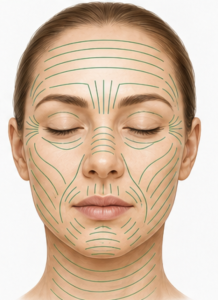
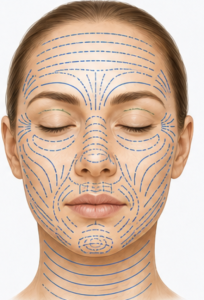
Relaxed skin tension lines (RSTLs) of the face are the natural lines of least skin tension in a relaxed, living patient. Incisions placed parallel to them are well known to heal with less widening and a less visible scar.
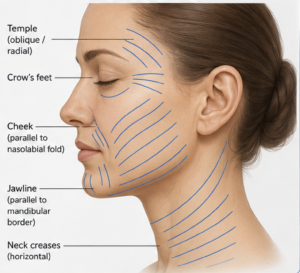
General facial pattern:
|
Region |
Typical RSTL orientation |
|
Forehead |
Horizontal/transverse |
|
Glabella |
Vertical or oblique in frown lines |
|
Upper eyelid |
Curved within lid crease |
|
Lower eyelid |
Horizontal/curvilinear |
|
Temple |
Oblique/radial, often following crow’s feet |
|
Nose |
Variable; often transverse over dorsum/sidewall, alar crease preferred |
|
Cheek |
Curved/oblique, often parallel to nasolabial fold |
|
Upper lip |
Vertical philtral lines centrally; curved along vermilion/alar-facial grooves |
|
Lower lip/chin |
Curved or horizontal in mental crease; vertical perioral rhytids may matter |
|
Jawline/neck |
Parallel to mandibular border or natural neck creases |
Clinically, RSTLs are identified by gently pinching relaxed skin and observing the furrows/ridges; they are often confused with Langer lines, which are differnent and are cadaver-based and may not reflect living facial skin tension.
Key principle: on the face, scar revision is most successful when the reorientation of the scar pattyern, by excision or scar rearrangement lies better oriented to the RSTLs or aesthetic unit borders such as the nasolabial fold, alar crease, eyelid crease, vermilion border, hairline, and mandibular border.
How are Relaced Skin Tension Lines of the Face Different from Langer’s Lines
Relaxed Skin Tension Lines (RSTLs) and Langer’s lines are related concepts, but they are not the same and have different clinical relevance on the face.
|
Feature |
RSTLs |
Langer’s Lines |
|
How determined |
Observed in living skin by relaxation, pinching, or facial expression |
Determined in cadavers by puncturing skin with a circular awl and observing the resulting ellipse |
|
Reflect |
Dynamic skin tension and wrinkle patterns |
Static orientation of dermal collagen fibers |
|
Patient-specific |
Yes |
No |
|
Facial accuracy |
High |
Often poor |
|
Surgical usefulness on face |
Excellent |
Limited |
|
Best incision placement |
Parallel to RSTLs |
Historically parallel to Langer’s lines |
Why they differ
Langer’s lines (Karl Langer, 1861) map the predominant orientation of collagen bundles within the dermis. They are relatively fixed anatomical lines.
RSTLs are influenced by:
- Underlying facial muscle activity
- Skin elasticity
- Age-related rhytids
- Facial subunit anatomy
- Gravity and skin redundancy
Because the face is highly mobile, wrinkle formation and muscle pull often dominate over collagen orientation.
Examples
Forehead
Both generally run horizontally, so there is good agreement.
Glabella
- Langer’s lines: often transverse or variable.
- RSTLs: typically vertical, corresponding to corrugator-induced frown lines.
This is a classic area where RSTLs are more useful.
Cheek
- Langer’s lines often run more horizontally.
- RSTLs tend to follow the nasolabial fold and natural facial creases.
Perioral region
- Langer’s lines are less predictive.
- RSTLs correspond to vertical smoker’s lines and natural lip-unit boundaries.
Surgical significance
For facial reconstruction, Mohs repair, and cosmetic surgery, most surgeons prioritize:
- Aesthetic unit borders
- RSTLs
- Langer’s lines (secondary consideration)
This is why a facial incision hidden in a nasolabial fold or eyelid crease usually heals better cosmetically than one merely oriented along a classic Langer line.
Modern concept
Many facial plastic surgeons now think of incision planning in terms of:
- RSTLs (resting wrinkles)
- Borges lines (same concept as RSTLs)
- Facial aesthetic subunits
- Lines of maximal extensibility (LMEs)
In fact, Borges introduced RSTLs specifically because he felt Langer’s cadaver-derived lines were often inadequate for facial surgery.
A useful way to remember it:
Langer’s lines = collagen anatomy.
RSTLs = what the patient’s face actually does in life.
For facial scar camouflage RSTLs are generally the more clinically relevant guide.
Dr. Barry Eppley
Plastic Surgeon