
Ai Facial Imaging Replication – Understanding What Is Possible
Artificial intelligence (AI) can now create highly realistic images of faces. Some people use these images to visualize facial features they would like to have, such as a stronger jawline, more prominent cheekbones, a more projected chin, or better facial balance.
A common question is:
“Can custom facial implants make me look exactly like an AI-generated image?”
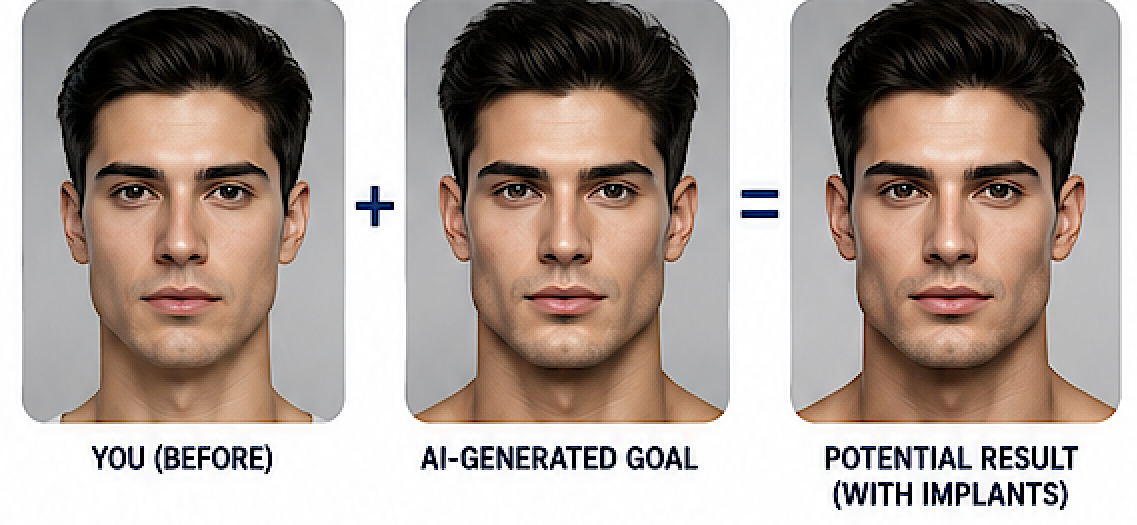
The short answer is sometimes partially, but not exactly.
AI-generated images can be very useful in helping define aesthetic goals and communicate desired facial changes. However, the final surgical result depends on many factors beyond the underlying facial bones.
How AI Images Can Help with Facial Implant Planning
AI-generated images can serve as a visual reference for desired facial changes. They often help patients communicate what they find attractive or what facial characteristics they would like to improve.
For example, an AI image may demonstrate:
- A stronger jawline
- More defined cheekbones
- A wider or more angular lower face
- Greater chin projection
- Improved facial symmetry
- Better midface support
These are all areas that can potentially be influenced by custom facial implants.
Rather than being viewed as a guarantee of the final outcome, AI images are best thought of as a starting point for discussion and planning.
What Facial Implants Can Realistically Change
Custom facial implants are designed to alter the shape of the underlying facial skeleton. Because of this, they are most effective when the desired changes involve bone-supported structures.
Common areas that can be enhanced include:
Chin
Custom chin implants can improve:
- Chin projection
- Chin width
- Chin shape
- Overall facial balance
Jawline
Jaw implants can create:
- Better jawline definition
- Stronger mandibular angles
- A more masculine or structured lower face appearance
Cheekbones
Cheek implants can increase:
- Cheekbone prominence
- Midface contour
- Facial width and support
Midface and Paranasal Region
Implants can improve:
- Midface projection
- Areas around the nose
- Facial harmony and profile balance
Orbital Rim Areas
In selected patients, implants can enhance:
- Under-eye support
- Upper cheek transitions
- Facial skeletal definition around the eyes
Because these changes involve the facial skeleton, they are the areas where custom implant design is most effective.
What Facial Implants Cannot Completely Recreate
Many people are surprised to learn that facial attractiveness is not determined by bone structure alone.
AI-generated faces often appear ideal because they combine numerous features that surgery cannot fully reproduce.
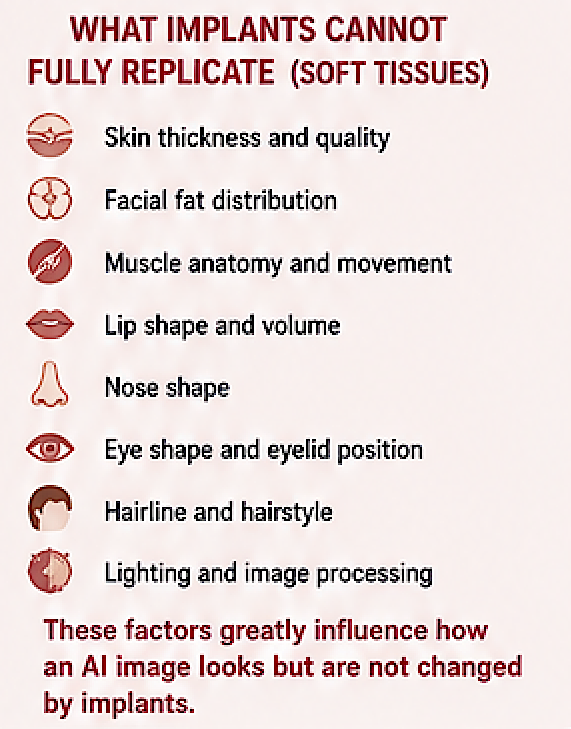
These include:
Skin Characteristics
- Skin thickness
- Skin elasticity
- Skin quality
- Skin texture
Facial Fat Distribution
The amount and location of facial fat greatly influence facial appearance and can vary significantly from person to person.
Muscles and Soft Tissues
The way muscles move and interact with facial structures contributes to expressions and facial shape.
Lips
Lip shape and volume are not significantly altered by facial implants.
Eyes and Eyelids
Eye shape, eyelid position, and brow characteristics are largely independent of facial implant surgery.
Nose
While implants can improve support around the nose, they do not change the nose itself.
Hair and Facial Hair
Hairline position, hairstyle, and facial hair often contribute significantly to the appearance of AI-generated images.
Digital Enhancement
Many AI images contain subtle enhancements that do not exist naturally, including:
- Perfect symmetry
- Idealized proportions
- Optimized lighting
- Digital smoothing
- Unrealistically flawless skin
These factors can make an AI image appear more achievable than it actually is.
How the Process Works
If a patient wishes to pursue facial implant surgery based on an AI-generated image, the planning process typically follows several steps.
Step 1: Create or Select the AI Image
The patient identifies an image that represents the desired facial appearance.
Step 2: Obtain a CT Scan
A high-resolution CT scan provides a three-dimensional representation of the patient’s facial skeleton.
Step 3: Analyze the Differences
Using specialized software, the patient’s anatomy is compared to the desired appearance.
Step 4: Design Custom Implants
Custom implants are created to modify the underlying skeletal contours in ways that move the facial structure closer to the desired appearance.
Step 5: Predict Soft-Tissue Changes
Computer simulations may estimate how the overlying soft tissues will respond to the skeletal changes.
While these predictions can be helpful, they are not perfectly accurate.
How Close Can Surgery Get to an AI Image?
This is one of the most important questions patients ask.
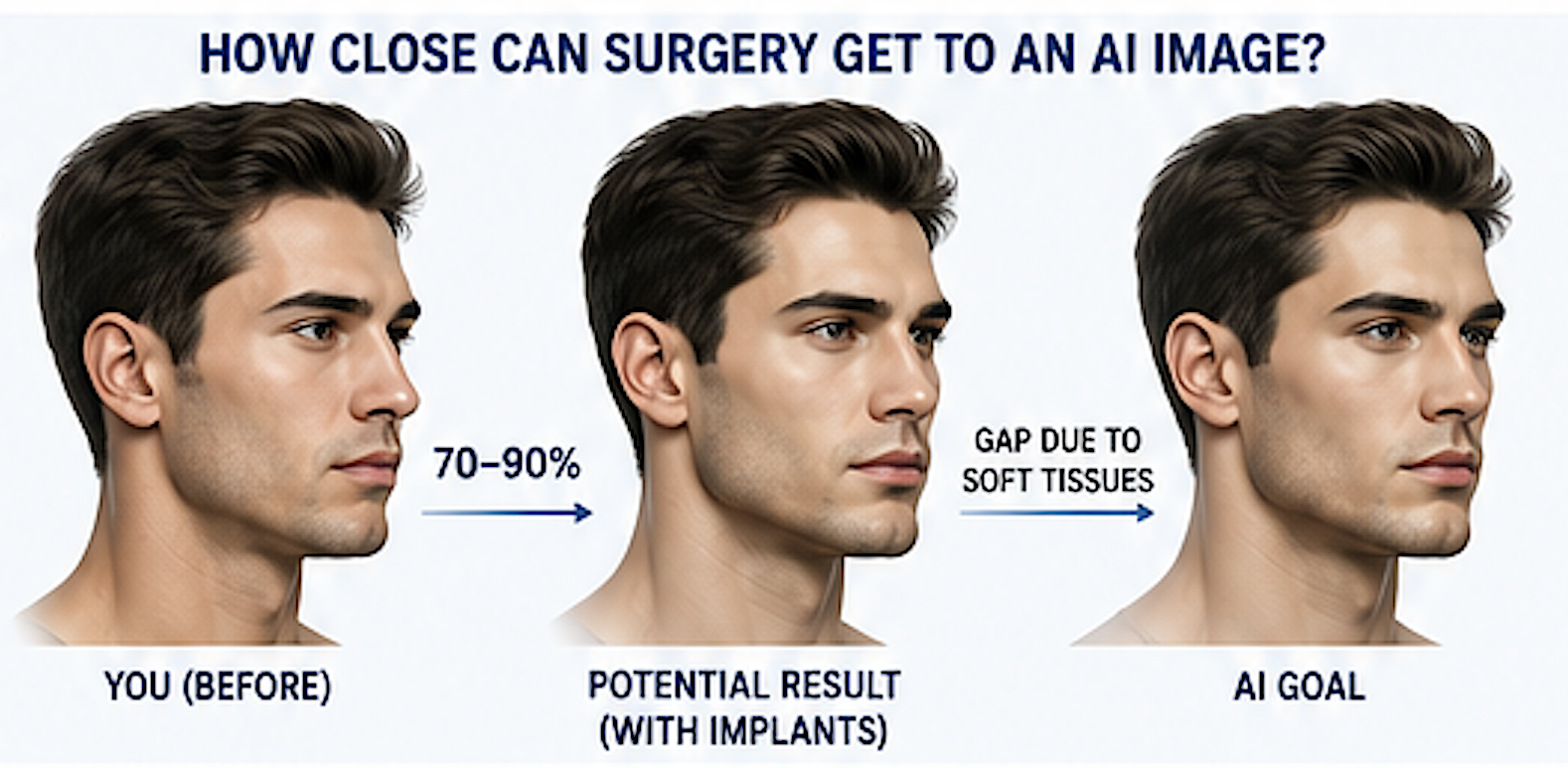
The answer depends largely on whether the desired appearance is being created by skeletal changes or soft-tissue characteristics.
If the AI image primarily differs from the patient’s current appearance in terms of:
- Chin shape
- Jawline structure
- Cheekbone prominence
- Facial width
- Midface projection
then custom implants may achieve a significant portion of those changes.
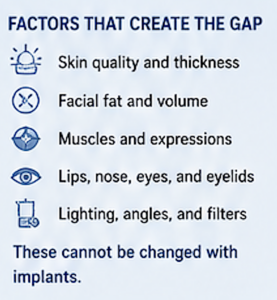
However, if the appearance depends heavily on:
- Skin quality
- Facial fat
- Eye shape
- Lip shape
- Nose shape
- Hair characteristics
then achieving an exact match becomes much less likely.
In many cases, patients can move substantially closer to their desired appearance, but no surgeon can guarantee an exact replication of an AI-generated face.
Setting Realistic Expectations
The most successful patients view AI-generated images as inspiration rather than a promise.
The goal of custom facial implant surgery is not to transform someone into an exact digital image. Rather, the goal is to improve facial balance, proportion, and definition using changes that are anatomically achievable.
When used appropriately, AI images can be extremely valuable tools for:
- Communicating goals
- Guiding implant design
- Improving surgical planning
- Establishing realistic expectations
Key Takeaway
AI-generated facial images can often help guide the design of custom facial implants and may serve as excellent visual references during the planning process. However, facial implants primarily change the underlying bone structure, while many characteristics that make AI-generated faces attractive are determined by soft tissues, skin, fat, muscles, and other factors that surgery cannot fully control.
As a result, custom implants may move a patient’s appearance significantly closer to an AI-generated goal, but they should be viewed as a means of achieving improvement rather than creating an exact duplicate of a digitally generated face.
Dr Barry Eppley
Plastic Surgeon