

Which is more important in custom facial implant outcomes..design vs surgical placement?
For custom facial implants, if I had to rank them, I would say:
1. Design (slightly more important)
2. Surgical placement (very close second)
The reason is that a perfectly placed implant cannot create an outcome that wasn’t built into the design. Placement can only deliver the design that exists.
Why design is so critical
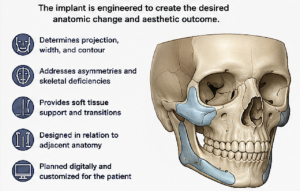
Custom implants are fundamentally different from stock implants because the aesthetic outcome is largely determined before surgery:
- Projection
- Width
- Contour transitions
- Symmetry corrections
- Soft tissue support
- Relationship to adjacent skeletal structures
If the implant is designed incorrectly, even flawless surgical execution will produce a suboptimal result.
For example:
- A custom jaw implant that lacks enough posterior width will never create a stronger gonial angle no matter how perfectly it is positioned.
- An infraorbital implant that does not adequately address the tear trough/skeletal deficiency cannot be “placed better” to achieve the desired correction.
Why placement still matters enormously
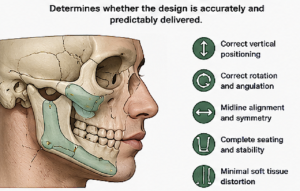
Placement determines whether the design is actually delivered to the patient.
Common problems include:
- Vertical malposition
- Rotation
- Incomplete seating
- Midline shift
- Asymmetrical fixation
- Soft tissue distortion during insertion
A brilliantly designed implant placed 5 mm too high, too low, or rotated can look like a poorly designed implant.
This is especially true for:
- Infraorbital-cheek implants
- Paranasal implants
- Combined jawline implants
- Orbital rim implants
These areas are highly sensitive to small positional changes.
An analogy
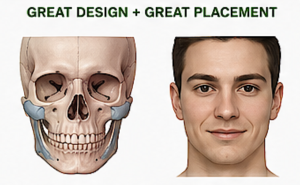
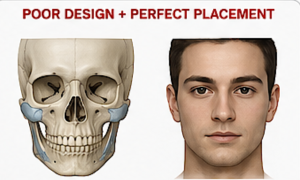
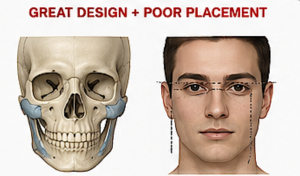
Think of custom implants like building a custom home.
- Design = the architectural plans
- Placement = the construction
Bad plans + perfect construction = disappointing house.
Great plans + poor construction = disappointing house.
Great plans + great construction = exceptional house.
My experience-based assessment

For most custom facial implant cases, I would estimate:
- Design contributes roughly 60-70% of the final aesthetic outcome.
- Surgical placement contributes roughly 30-40%.
But the relationship is multiplicative, not additive. If either component fails significantly, the result suffers.
A useful way to think about it is:
Design determines what is possible.
Placement determines whether that possibility is realized.
The best outcomes occur when the surgeon who performs the operation is deeply involved in the implant design process, because design decisions are made with a full understanding of what can be predictably achieved surgically.
Dr. Barry Eppley
Plastic Surgeon