

The key elements in a custom forehead implant design can be divided into aesthetic goals, anatomical constraints, and implant engineering considerations.
1. Forehead Shape Goals
The first step is defining exactly what forehead change is desired:
- Horizontal augmentation: Increasing overall forehead projection.
- Vertical augmentation: Increasing forehead height.
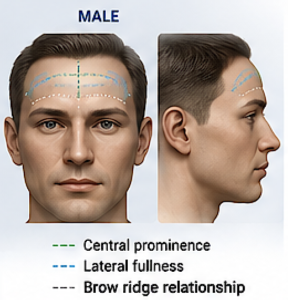
- Central prominence: Creating more fullness in the midline.
- Lateral fullness: Extending augmentation toward the temporal regions.
- Brow ridge relationship: Determining whether the implant blends into, accentuates, or softens the supraorbital rims.
- Gender characteristics :

- Male foreheads often retain stronger brow bossing and flatter upper forehead contours.
- Female foreheads typically have a smoother forehead-brow transition with more convexity.

2. Implant Footprint
The implant’s boundaries are critical:
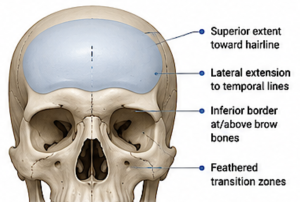
- Inferior border at or above the brow bones.
- Superior extent toward the hairline.
- Lateral extension toward the temporal lines.
- Transition zones that avoid visible implant edges.
A custom implant should feather gradually into surrounding bone to prevent palpable or visible step-offs.
3. Thickness Distribution
A forehead implant design has a broad range of thickness distribution that rarely uses uniform thickness. This is the hardest aspect of any forehead implant design to consider and get right.
It is ntoi as simple as this thickness distribution model looks.
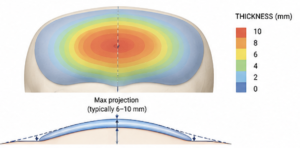
Typical considerations:
- Maximum projection point.
- Rate of tapering toward edges.
- Three-dimensional contouring to create a natural convex forehead shape.
- Symmetry correction if pre-existing asymmetries exist.
For example:
- Central thickness may be 4–6 mm.
- Peripheral margins taper to near zero. or may have a shelf in a male who wants a more pronounced temporal line
4. Relationship to Existing Forehead Anatomy
CT-based design allows assessment of:
- Forehead slope.
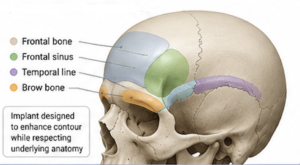
- Frontal sinus location and size.
- Brow bone projection.
- Temporal line position.
- Existing asymmetries.
The implant should enhance the external contour while respecting underlying anatomy.
5. Frontal Sinus Considerations
The frontal sinus is just another edge border of the implant and it must be determined if it even needs to be covered at all.
Design considerations include:
- Determining whether forehead augmentation alone is sufficient or whether a brow bone extension is also required which is often the case in men.
6. Edge Design
Edge design often determines whether the implant appears natural.
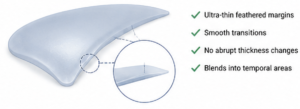
Important characteristics:
- Ultra-thin feathered margins.
- Smooth transitions.
- No abrupt thickness changes.
- Adequate blending into temporal regions.
7. Implant Material
Most custom forehead implants today are designed in:
- Solid silicone (most common)
- Easily inserted and removed.
- Smooth surface.
- Allows substantial augmentation.
- PEEK
- Primarily used for craniofacial reconstruction rather than cosmetic forehead augmentation.
- Has some edging to it
- Requires larger scalp incision to place
8. Surgical Placement Considerations
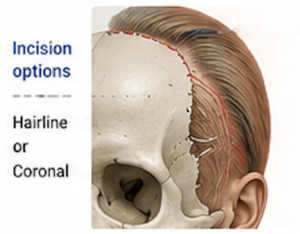
The design must account for:
- Incision location (hairline vs. limited coronal).
- Ability to insert the implant through the planned incision.
- Thickness limitations imposed by soft tissue coverage.
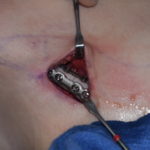
- Fixation method (always needed)
9. Soft Tissue Envelope
A forehead implant design cannot be based solely on bone.
Factors include:
- Forehead skin thickness.
- Soft tissue mobility.
- Hairline position.
- Visibility in thin-skinned patients.
Large augmentations that look acceptable on a computer model may appear excessive once covered by soft tissue.
10. Symmetry Analysis
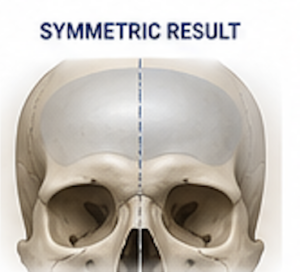
Custom implants are frequently used to correct:
- Plagiocephalic forehead asymmetry.
- Flat forehead deformities.
- Post-traumatic contour irregularities.
- Congenital asymmetries.
The implant may intentionally have different thicknesses on each side to create a symmetric external appearance.
Typical Design Workflow
- Obtain high-resolution craniofacial CT scan.
- Create 3D skull model.
- Define desired forehead contour.
- Design implant footprint and projection map.
- Smooth and feather all margins.
- Verify fit against skull anatomy.
- Manufacture implant from approved biomaterial.
For a purely cosmetic forehead implant, the most critical design parameters are usually implant footprint, maximum projection, thickness distribution, and edge tapering, since these determine whether the result appears naturally skeletal or obviously augmented.
Dr. Barry Eppley
Plastic Surgeon