

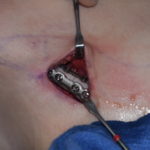
For overall cranial augmentation performed purely for aesthetic enhancement, there is surprisingly little scientific literature defining an “ideal” skull shape compared to the extensive literature on facial aesthetics. Most implant design is therefore based on artistic contouring principles combined with anthropometric measurements rather than any single formula such as the Golden Ratio.
What Makes a Skull Shape Attractive?
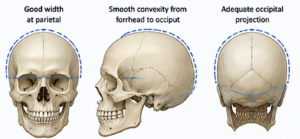
Several characteristics tend to be perceived as aesthetically pleasing:
1. Smooth Convexity
The skull should exhibit a continuous, flowing curvature from the forehead over the vertex and down toward the occiput. Abrupt flattening or contour breaks are often perceived as less attractive.
2. Symmetry
Bilateral symmetry remains one of the strongest determinants of attractiveness. Small asymmetries are normal, but noticeable differences in parietal fullness, temporal contour, or occipital projection can draw attention.
3. Appropriate Cranial Width
From the frontal view, the upper skull should generally maintain harmonious width relative to the face.
For men, many aesthetically desirable skulls demonstrate:
- Good parietal fullness
- Adequate temporal width
- A broad but not spherical appearance
4. Balanced Anterior-Posterior Projection
A well-developed occipital region often contributes significantly to overall cranial aesthetics. Flat posterior skulls are among the most common concerns in aesthetic cranial augmentation.
5. Vertex Position
The highest point of the skull should appear naturally positioned rather than excessively anterior or posterior.
Does the Golden Ratio Enter Anywhere?
Indirectly, perhaps.
If you measure:
- Facial height
- Forehead width
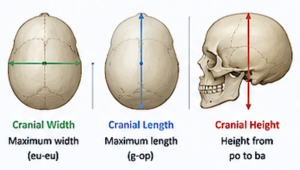
- Cranial width
- Cranial length
you may occasionally find attractive skulls exhibit ratios that approximate classical aesthetic proportions. However, there is no established cranial equivalent of:
- Facial golden ratio
- Neoclassical facial canons
- Ricketts’ facial proportions
Most custom implant designs are not generated from Golden Ratio calculations.
How Custom Cranial Implants Are Actually Designed
For cosmetic cranial augmentation, designers typically begin with a CT scan and create a 3D model.
The design process often involves:
Option 1: Anatomical Enhancement
The existing skull shape is enhanced while preserving the patient’s natural proportions.
Example:
- Increase parietal width by 5–8 mm
- Increase occipital projection by 8–15 mm
- Maintain overall skull identity
Option 2: Target Morphology
The surgeon and patient identify a desired skull shape.
Examples:
- More masculine cranial shape
- More rounded cranial shape
- Greater posterior projection
- Increased upper skull width
The implant is then digitally sculpted to create that contour.
Option 3: Normative Anthropometric Design
Measurements are compared with population norms such as:
- Cranial index
- Cranial width
- Cranial length
- Cranial height
and the implant is designed to move the patient toward a desired range.
Measurements That Are More Useful Than the Golden Ratio
For aesthetic skull augmentation, I find these measurements more meaningful:
Cranial Index
CI=Maximum Skull Length/Maximum Skull Width ×100
This helps quantify whether the skull appears:
- Long and narrow (dolichocephalic) < 75
- Average (mesocephalic) 75 -80
- Broad and short (brachycephalic) > 80
Cephalic Height
Relationship between skull height and width.
Occipital Projection
Degree of posterior fullness.
Parietal Width
Maximum side-to-side prominence.
Aesthetic Trends in Male Cranial Augmentation
Among men seeking total cranial enhancement, the most commonly desired changes are:
- Increased posterior occipital projection.
- Increased upper parietal fullness.
- Reduction of visible flat areas.
- Creation of a stronger, more continuous side profile.
- Preservation of a natural, non-spherical appearance.
The best results usually come from creating a skull shape that looks naturally genetic rather than mathematically idealized.
For surgeons who perform custom cranial implants regularly, the design process is much closer to digital sculpture and contour engineering than to applying a fixed proportional system such as the Golden Ratio.
Dr Barry Eppley
Plastic Surgeon