

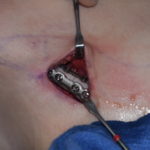
The Golden Ratio (approximately 1.618:1) has some relevance to the design of custom skull implants but it is not rigidly applied. It is helpful in understanding good skull shape proportions
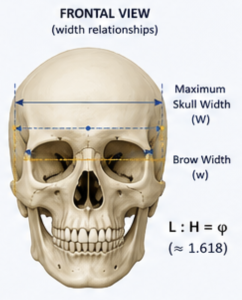
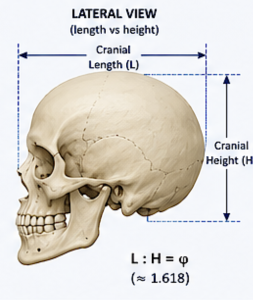
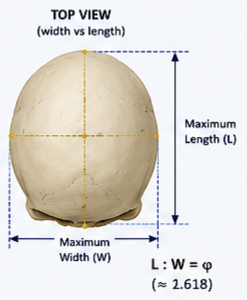
For aesthetic facial procedures, surgeons sometimes reference proportions related to the Golden Ratio when evaluating facial balance, forehead width, facial thirds, or overall craniofacial harmony. However, when designing a custom cranial implant, the primary goals are usually:
- Restoring normal anatomy after trauma, congenital asymmetry, or previous surgery.
- Achieving symmetry between the right and left sides of the skull.
- Creating smooth contour transitions with the surrounding bone and soft tissue.
- Respecting scalp thickness and soft-tissue limitations.
The skull itself does not have a universally accepted set of Golden Ratio measurements. Unlike certain facial features where proportional relationships may be discussed, cranial shape varies significantly among individuals, ethnic groups, and sexes.
For cosmetic skull augmentation (forehead widening, occipital augmentation, temporal augmentation, etc.), implant design is usually based on:
- The patient’s existing skull anatomy from a CT scan.
- Desired contour changes.
- Symmetry and aesthetic flow from multiple viewing angles.
- Scalp stretch limitations.
In practice, I might indirectly create proportions that happen to approximate Golden Ratio relationships, but it is not typically used as a mathematical design criterion for custom skull implants.
For a patient seeking cranial reshaping, the more useful aesthetic concepts are:
- Symmetry
- Smooth curvature
- Appropriate cranial width-to-height relationships
- Balanced transition between forehead, parietal, and occipital regions
Dr Barry Eppley
Plastic Surgeon