
Lip vestibular contracture is an uncommon but challenging problem that occurs when scar tissue shortens the distance between the inner lip and the alveolar sulcus, creating a shallow vestibule. Patients often complain of lower lip tightness, restricted lip movement, and an unnatural smile. In young patients if is most commonly the sequaelae of prior intraoral surgery such as LeFort I and sliding genioplasty osteotomies where long vestibular incisions and wide subperiosteal undermining has been done, Often the patient has a history of multiple procedures or reentry through the incision more than once..
Because scar contractor represents tissue loss the surgical objective is not simply to release the scar but to restore lost tissue volume so the contracture does not recur. While scar release alone temporarily provides some symptom relief, the raw surfaces predictably contract during healing, resulting in a high recurrence. This is why adding tissue volume with a dermal-fat graft is an excellent reconstructive option.
Case Study
This young female had a prior history of LeFort I osteotomy followed secondarily by placement of custom cheek implants downsizing of custom cheek implants and then removal of them. This constituted four (4) entries through the maxillary vestibular incision. She was left with severe upper lip tightness, particularly centrally, loss of vestibular depth and supplements and an inverted upper lip with loss of vestibular volume.
Her lower lip had a prior bony genioplasty and secondary revision totally two vestibular incision entries. The lower lip was tight and constricted but it maintained an adequate horizontal lip level.
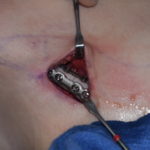
Through the existing intraoral vestibular incision placed along the scar band, the contracted vestibular scar was completely released. Sharp dissection is carried down onto the face of the maxilla where the entire midface tissues were completely elevated including around the pyrform aperture and anterior nasal spine. This produced maximal upper lip release even though it does not lengthen the vestibular depth by doing so..
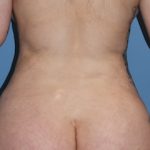
A dermal-fat graft was harvested from the lower abdomen where adequate thickness and excellent donor scar concealment are available. The graft is intentionally harvested 20–30% larger than the measured defect to compensate for postoperative fat resorption. The epidermis is removed, leaving a composite graft consisting of dermis with attached subcutaneous fat.
A long linear strip of the fat graft was placed from one side of the vestibular incision to the other with a large segment crossing under the base of the nose. The mucosa was then closed with interrupted resorbable sutures.
In a similar fashion the lower lip vestibular scar was incised and the chin tissues completely elevated. Care is taken to preserve the mental nerve branches while completely eliminating all tethering scar tissue.
The graft is inserted into the released vestibular pocket nd secured with multiple absorbable quilting sutures to eliminate dead space and prevent graft migration. The oral mucosa is then advanced over the graft and closed with resorbable sutures.
Discussion
Most scar contracture releases have to be coupled with adding soft tissue volume to be effective. The most popular method today of treating certain types of scars is fat injections. Why then is dermal-fat used instead of fat Injections?
Fat injection alone performs poorly in this situation because:
- Scar tissue limits fat graft survival.
- Fat provides little structural resistance against recurrent contraction.
- Multiple sessions are often required.
- Fat cannot reliably create a full and complete scar release
A dermal-fat graft offers several distinct advantages:
- Immediate restoration of soft tissue thickness.
- The dermal layer acts as a biologic scaffold that resists scar contraction.
- Better long-term volume retention than injected fat in heavily scarred tissues.
- For graft placement and extensive scar release must be dine to create a recipient tissue pocket,
- Usually accomplished in a single procedure.
- Will allow for a secondary release and skin graft for vestibular deepening if needed.
Recovery
Recovery is generally straightforward. Patients experience moderate swelling of both the lip and donor site for 2–3 weeks. A soft diet is recommended during the first postoperative week, and aggressive stretching of the vestibule typically begins after initial healing to maximize long-term depth. Complete graft maturation occurs over approximately 3–6 months as revascularization progresses and the graft softens.
Expected Results
Successful release with dermal-fat grafting typically results in:
- Improved lip mobility
- Relief of lip tightness
- Reduced risk of recurrent contracture compared with scar release alone
Although some degree of fat resorption is a risk in my experience the take rate is high. The likely overall outcome is definitive improvement but not a complete cure.
Key Takeaways
- Vestibular lip contractures are most commonly caused by prior surgery with repeat entries through the mucosal incision.
- Vestibular release alone is ineffective without adding a graft interface between the released lip and the underlying bone.
- Dermal-fat is the most effective graft material with good soft tissue thickness and a high rate of take.
Dr. Barry Eppley
Plastic Surgeon