

Recovery after placement of a custom skull implant is generally easier than many patients anticipate because the procedure involves the scalp and skull rather than muscles or joints. While swelling and scalp tightness are expected, pain is usually modest and most patients are able to resume routine activities within two weeks.
The First 24–48 Hours
Immediately after surgery, patients can expect:
- Moderate scalp swelling
- A feeling of pressure or tightness across the scalp
- Mild headache
- Temporary numbness around the incision
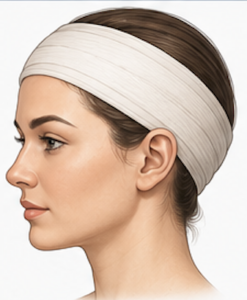
- A compressive head wrap overnight (depending on surgeon preference)
Most patients describe the discomfort as a pressure sensation rather than significant pain. Prescription pain medication is usually only needed for the first few days.
Week One
During the first week:
- Swelling gradually increases for 2–3 days before beginning to subside.
- Bruising is minimal because the scalp contains little loose tissue.
- Hair can usually be washed after 48–72 hours.
- Walking is encouraged immediately.
- Sleeping with the head elevated helps reduce swelling.
Patients can usually return to desk work within 5–7 days.
Weeks Two to Four
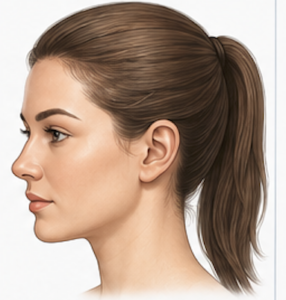
By the second week:
- Most visible swelling has resolved.
- Scalp tightness continues to improve.
- The implant contour begins to become apparent.
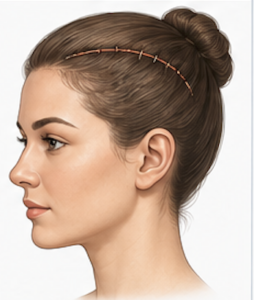
- Sutures or staples are removed if they are not absorbable.
Light exercise can typically resume after two weeks.
One to Three Months
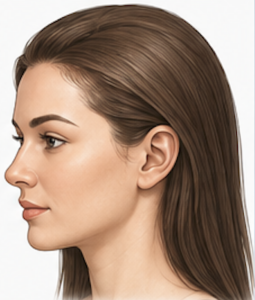
During this period:
- Residual swelling gradually disappears.
- Scalp sensation slowly returns.
- The scalp stretches naturally over the implant.
- The implant becomes essentially undetectable beneath the scalp.
Most numbness improves over several months, although small areas of decreased sensation may persist longer.
Returning to Exercise
Typical guidelines include:
- Walking: Immediately
- Stationary cycling: 10–14 days
- Running: 3–4 weeks
- Weight training: 3–4 weeks
- Contact sports: 6–8 weeks, after surgeon approval
Hair Care
Patients may:
- Wash their hair after several days.
- Color or chemically treat their hair after approximately 3–4 weeks.
- Resume normal hairstyling once the incision has healed.
The incision is typically hidden within the hair and becomes difficult to locate after healing.
Long-Term Healing
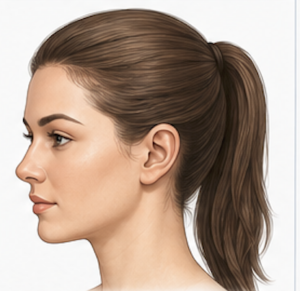
Although patients usually look socially presentable within two weeks, complete healing continues for several months:
- The implant becomes firmly incorporated beneath the scalp.
- Scar maturation continues for 6–12 months.
- The final contour becomes increasingly natural as the scalp adapts to the implant.
Common Temporary Symptoms
Normal recovery often includes:
- Scalp tightness
- Temporary numbness
- Mild itching during healing
- Intermittent tingling as sensory nerves recover
- Minor swelling that is often more noticeable in the morning
These symptoms generally improve steadily over the first few months.
Recovery Timeline at a Glance
|
Time After Surgery |
Typical Recovery |
|
1–3 days |
Peak swelling, scalp pressure, mild discomfort |
|
1 week |
Swelling begins to improve, return to desk work |
|
2 weeks |
Most bruising and swelling resolved, normal daily activities |
|
3–4 weeks |
Resume unrestricted exercise (except contact sports) |
|
6–8 weeks |
Full implant stability for most activities |
|
3–6 months |
Final contour and sensation continue to improve |
For most healthy patients, custom skull implant surgery has a relatively straightforward recovery. Because the implant rests directly on the skull beneath the scalp, there is no movement or mechanical stress on the implant during healing. Once postoperative swelling subsides, patients can expect a stable, permanent improvement in skull contour with little ongoing maintenance or lifestyle restriction.
Dr. Barry Eppley
Plastic Surgeon