
Why is squaring out the jaw angle in custom implant designs not a good idea?
From an aesthetic and anatomic standpoint, creating a perfectly square mandibular angle with a custom jawline implant is usually not the ideal design goal. While many male patients ask for a “square jaw,” the most attractive and natural masculine jawlines are strongly angular, but not box-shaped.
The reasons include:
1. The natural mandibular angle is curved, not a 90-degree corner.
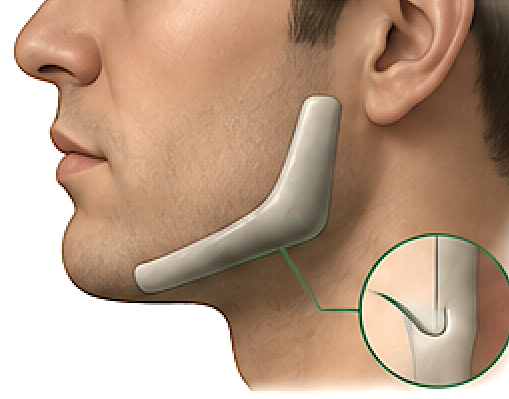
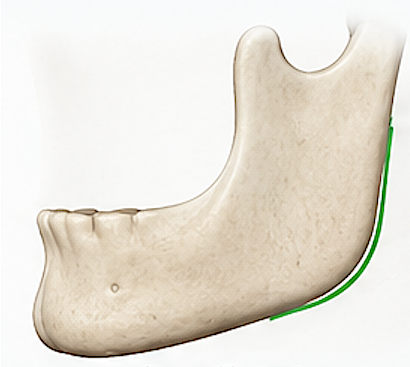
The gonial angle is normally a smooth transition between the posterior border of the ramus and the inferior border of the body. Even in men with exceptionally strong jawlines, this transition is rounded over several millimeters rather than forming a sharp corner. Trying to create a true square angle often looks artificial because it conflicts with normal skeletal anatomy.
2 The implant corner may protrude beyond the masseter muscle.
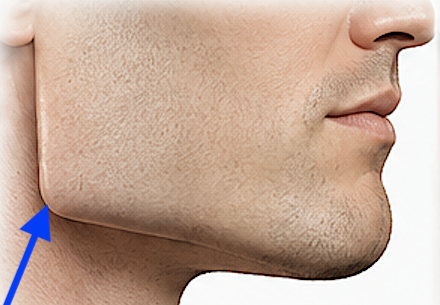
The length and shape of the insertion of the masseter muscle at the jaw angle follows the shape of the bone. Expanding the posterior and inferior jaw angle area by an implant may exceed muscle coverage of the implant. (pseudo masseteric muscle dehiscence) This can create a skeletonized unnatural jaw angle point that looks unnatural.due to the lack of complete muscle coverage.
3. Soft tissue blunts sharp skeletal edges.
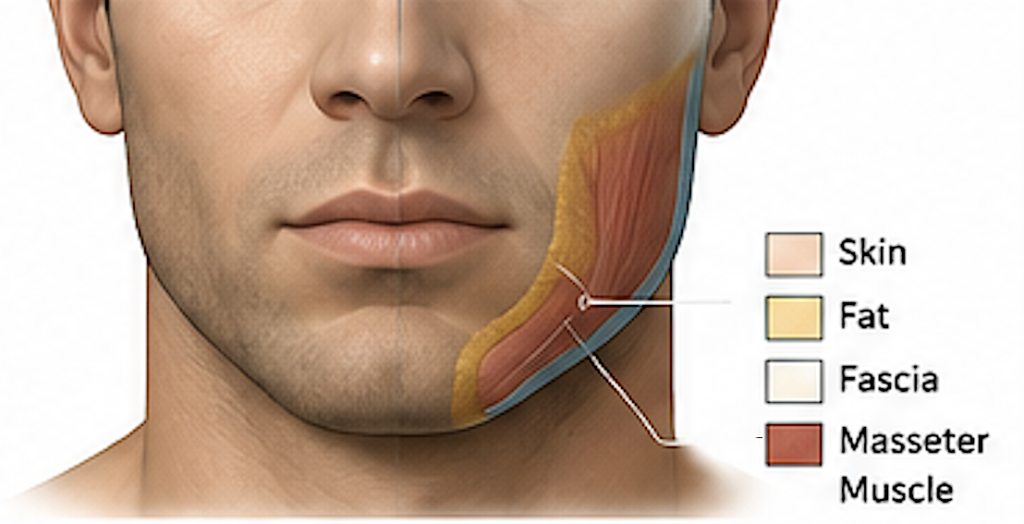
The masseter muscle, parimasseteric fat, fascia, and skin all adds volume to the appearance of the jaw angle. Even if a CAD implant is designed with a perfectly square corner, the overlying soft tissue rounds it off or can just make it look bulkier and not more defined. The result is often a bulky lower face rather than the crisp angularity the patient was seeking.
4. Width is more important than squareness.
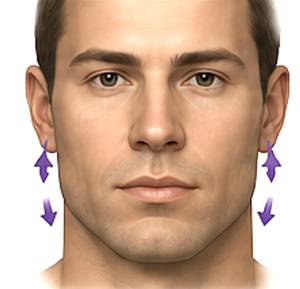
A masculine jaw is defined more by:
- posterior jaw angle width,
- lateral flare,
- inferior border definition, and
- continuity from chin to angle.
Increasing these dimensions creates a stronger jawline without relying on an unnaturally square angle.
5. A squared corner can produce an exaggerated “box jaw.”
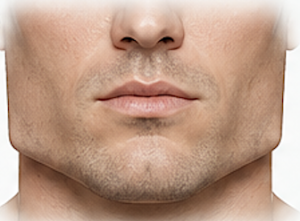
An implant that extends too far inferiorly and posteriorly with a sharp corner can make the lower face appear:
- too wide,
- too heavy,
- older,
- or even somewhat simian in appearance.
This is particularly true in frontal and oblique views.
6. Facial harmony is more important than the jaw angle alone.
The jawline should be viewed as one continuous three-dimensional structure. The chin, body, angle, and posterior ramus should blend into one flowing contour. If only the angle is squared, it may appear disconnected from the remainder of the jawline.
A better design philosophy
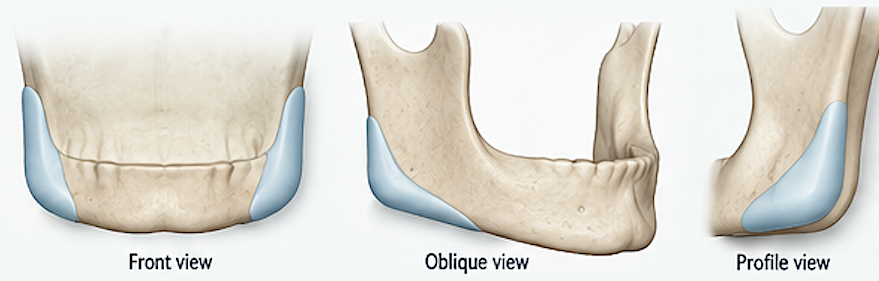
Instead of designing a square corner, I generally favor:
- increased lateral angle width,
- modest inferior vertical lengthening,
- posterior extension behind the native angle,
- a broad but smoothly radiused gonial corner,
- continuous blending into the mandibular body and ramus.
This creates the visual impression of a square, masculine jaw while maintaining an anatomically believable appearance.
The “illusion of squareness”
The strongest custom jawline implants rarely have an actual 90-degree corner. Instead, they create the illusion of squareness through strategic enhancement of three vectors:
- Lateral projection to increase jaw width.
- Inferior projection to sharpen the lower border.
- Slight Posterior projection to lengthen the posterior jawline.
When these three dimensions are balanced, the jaw appears square and powerful from frontal, oblique, and profile views without looking surgically overbuilt. In my experience, this approach produces the most consistently natural and aesthetically pleasing results in custom jawline implant design.
Dr. Barry Eppley
Plastic Surgeon