

Can I Just Let AI Design My Custom Facial Implant?
The short answer is no—not yet. AI has become an exceptionally powerful tool for designing patient-specific implants, but it is still best viewed as an intelligent assistant rather than an autonomous implant designer. While AI can dramatically improve efficiency, accuracy, and consistency, the final implant design still requires human expertise to achieve the best aesthetic and surgical outcome.
The reason is simple: custom facial implant design is not just an engineering problem—it is an artistic and surgical one.
AI Begins with the Anatomy
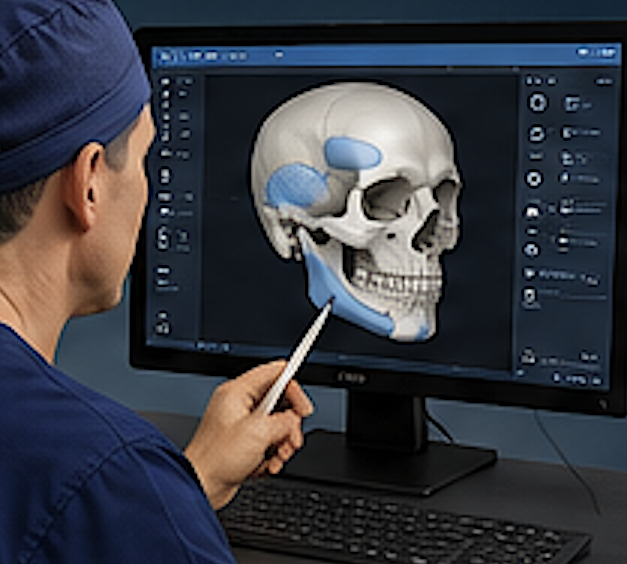
Everything starts with a high-resolution CT scan. AI can quickly segment the scan, separate the facial skeleton from surrounding tissues, and create an accurate three-dimensional digital model of the patient’s skull. What once took an engineer considerable manual effort can now be completed in minutes with remarkable precision.
Once the anatomy has been reconstructed, AI can perform detailed measurements throughout the facial skeleton. It can identify deficiencies in projection, width, height, symmetry, and contour while comparing the patient’s anatomy to either the opposite side of the face or large databases of normal facial anatomy. This makes AI particularly effective for analyzing facial asymmetry, congenital deficiencies, and post-traumatic deformities.
AI Can Generate an Initial Implant Design
After the facial analysis is complete, AI can generate an implant proposal based on the identified deficiencies. Using advanced geometric algorithms, it can:
- Create smooth implant surfaces.
- Feather implant edges naturally into surrounding bone.
- Maintain consistent implant thickness.
- Mirror the unaffected side in asymmetric cases.
- Optimize implant fit to the underlying bone.
- Produce designs that are highly manufacturable.
For relatively straightforward implants—such as forehead augmentation, occipital implants, chin implants, or correction of isolated contour defects—AI can often produce an impressive first design.
In many cases, the initial AI-generated implant may already be 70% to 90% of what the final implant will eventually become.
Where AI Still Has Important Limitations
Despite these impressive capabilities, AI lacks one critical component:
Aesthetic judgment.
Every custom facial implant is ultimately designed to improve appearance rather than simply fill a missing volume of bone. Unlike reconstructive implants, cosmetic implants require subjective decisions about beauty, proportion, masculinity, femininity, facial harmony, and patient preference.
For example, AI cannot truly answer questions such as:
- Should a jawline be wider or simply more projected?
- How much chin projection looks strong without becoming overdone?
- Should cheek augmentation emphasize width or anterior projection?
- Should forehead augmentation preserve masculine angularity or create a smoother feminine contour?
- Will increasing orbital rim projection make the eyes appear deeper or more balanced?
- How much asymmetry should actually be corrected versus intentionally preserved to maintain a natural appearance?
These are aesthetic decisions that rely on experience rather than mathematics.
AI Does Not Yet Understand the Patient
One of the biggest limitations is that AI designs primarily from anatomy, while experienced surgeons design from both anatomy and patient goals.
Two patients with identical CT scans may request completely different outcomes.
One patient may want subtle refinement that nobody notices.
Another may request a dramatic masculine transformation.
A third may want restoration of a youthful appearance rather than enlargement.
Although AI can eventually be trained using patient preferences, it still cannot reliably interpret the emotional and psychological expectations that patients bring into the consultation. Translating those goals into millimeter-by-millimeter implant modifications remains largely a human process.
Surgical Design Is Different Than Digital Design
A beautiful digital implant is not necessarily a surgically practical implant.
An experienced implant surgeon automatically considers factors that AI currently struggles to appreciate, including:
- The incision through which the implant must be inserted.
- Whether the implant can physically pass through that incision.
- Protection of important nerves and blood vessels.
- Muscle attachments that should not be displaced.
- Soft tissue thickness over implant edges.
- Long-term implant stability.
- Ease of positioning during surgery.
- Whether fixation screws will be needed.
- Areas where the implant should intentionally be thinner or thicker.
- How postoperative swelling and soft tissue adaptation will affect the final appearance.
These surgical considerations frequently alter the implant design in subtle but important ways.
Soft Tissue Prediction Remains AI’s Greatest Challenge
Patients do not see their skeleton—they see their skin.
The relationship between implant thickness and external facial change is highly variable.
For example:
- A 6 mm jaw implant may produce only 4 mm of visible widening.
- A 4 mm forehead implant may create almost the full 4 mm externally.
- Thick muscles around the jaw angle may reduce the visible effect.
- Thin tissues around the orbital rim may exaggerate relatively small skeletal changes.
Current AI systems are still limited in accurately predicting how skin, fat, muscles, fascia, and ligaments will respond to skeletal augmentation.
This is one reason experienced surgeons frequently modify implant thickness based on years of observing actual postoperative results rather than relying solely on computer models.
AI Learns From Data—but Experience Is Different
Modern AI improves by learning from thousands or even millions of previous examples.
Experienced custom implant surgeons learn differently.
Over hundreds or thousands of patient-specific implant procedures, they develop an intuitive understanding of:
- Which implant shapes consistently look natural.
- Which transitions become visible under thin skin.
- Which augmentations patients later wish had been larger—or smaller.
- How different facial regions interact with one another.
- Which implant designs minimize revision surgery.
This accumulated surgical experience is difficult to replace because it includes countless subtle observations that are rarely documented in design files alone.
The Ideal Future Is Collaborative
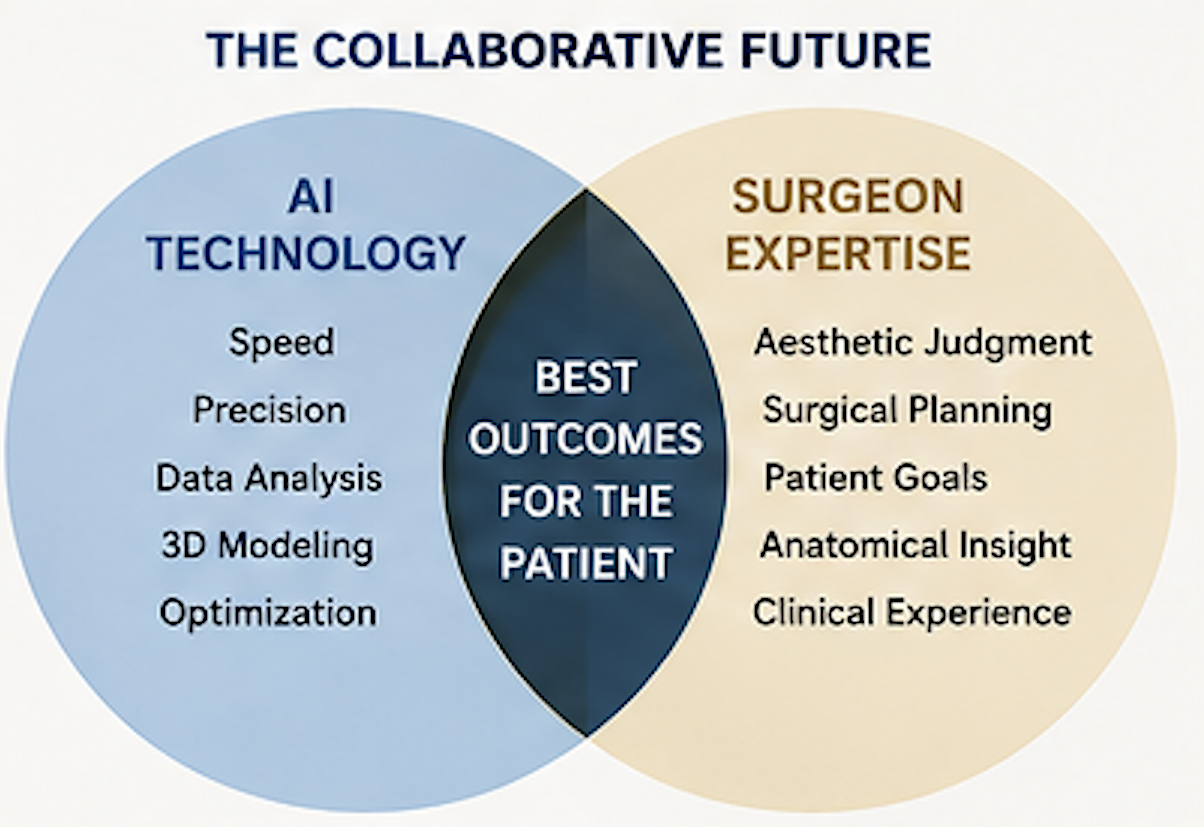
The future of custom facial implants is unlikely to involve AI replacing surgeons.
Instead, AI will increasingly handle the technical tasks:
- Automated CT segmentation.
- Three-dimensional reconstruction.
- Facial measurements.
- Symmetry analysis.
- Initial implant generation.
- Surface optimization.
- Manufacturing preparation.
The surgeon will continue to provide:
- Facial aesthetic analysis.
- Understanding of patient goals.
- Surgical planning.
- Design refinement.
- Final approval.
- Intraoperative execution.
Rather than replacing the surgeon, AI significantly increases the surgeon’s efficiency, allowing more time to focus on the aspects of implant design that require judgment and experience.
Looking Ahead
As AI continues to evolve, it will undoubtedly become better at predicting facial aesthetics, soft tissue movement, and patient preferences. Future systems may incorporate thousands of postoperative outcomes, facial attractiveness models, and machine learning algorithms capable of proposing multiple implant designs tailored to different aesthetic goals.
Even then, however, cosmetic surgery will remain fundamentally personal. There is no single “correct” facial shape—only the shape that best matches an individual patient’s anatomy, goals, and expectations.
The Bottom Line
AI has already transformed the design of custom facial implants by making the process faster, more precise, and more reproducible. It can accurately analyze anatomy, generate highly sophisticated preliminary implant designs, and streamline manufacturing. However, the final design of a successful cosmetic implant still depends on decisions that extend beyond geometry. Aesthetic judgment, surgical practicality, and an understanding of patient expectations remain essential human skills. For the foreseeable future, the best results will come from AI-assisted, surgeon-directed design, where technology provides extraordinary computational power and the surgeon provides the artistic vision and clinical experience that ultimately determine the quality of the final outcome.
Dr. Barry Eppley
Plastic Surgeon