
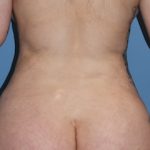
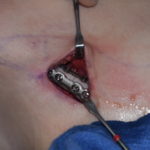
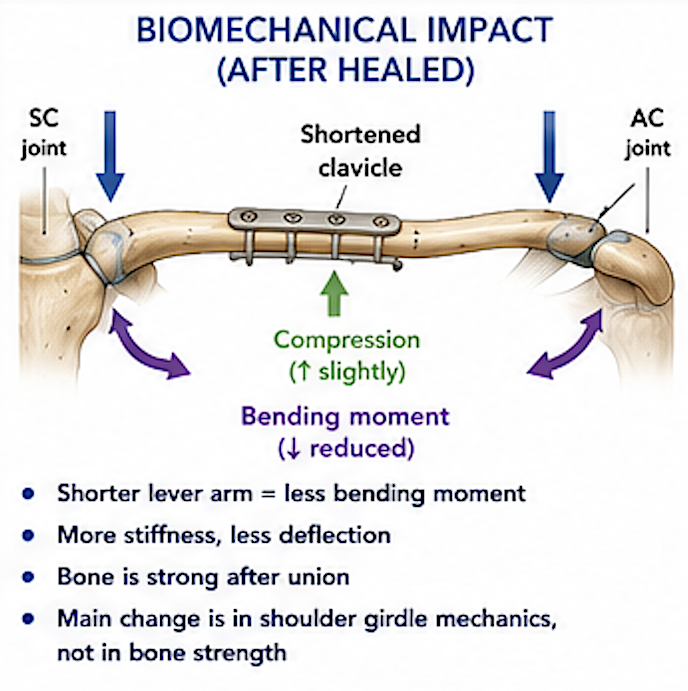
 From the standpoint of clavicle shortening osteotomy for shoulder narrowing, the postoperative recovery is driven much more by muscle and shoulder girdle adaptation than by changes in the strength of the clavicle itself. The bone is actually mechanically favorable after shortening, but the shoulder has to learn to function with a new geometry.
Early Recovery (0–6 Weeks): Protecting the Osteotomy
Immediately after surgery, arm movement is limited primarily to protect the healing osteotomy and fixation plate.
During this period, patients typically experience:
- Pain when lifting the arm above shoulder level due to tension from the deltoid and trapezius.
- A feeling that the shoulders are “held inward” or “tighter” because the scapulae have moved closer to the spine.
- Fatigue with activities such as eating, typing, or holding the arm away from the body for prolonged periods.
The limitations are related more to bone healing than to the permanent biomechanics of the shortened clavicle.
Intermediate Recovery (6–12 Weeks): Neuromuscular Adaptation

Once the osteotomy is healing, the recovery shifts from bone healing to retraining the shoulder muscles.
The scapula now rests:
- slightly more medially,
- slightly more anteriorly,
- and often slightly lower.
As a result:
- the trapezius, deltoid, rhomboids, and serratus anterior all work at slightly different lengths,
- muscle activation patterns change,
- proprioception temporarily feels “off.”
Patients commonly report:
- shoulder fatigue,
- mild stiffness,
- awkward overhead reaching,
- reduced endurance rather than true weakness.
These symptoms gradually improve as the nervous system adapts to the new shoulder position.
Overhead Motion
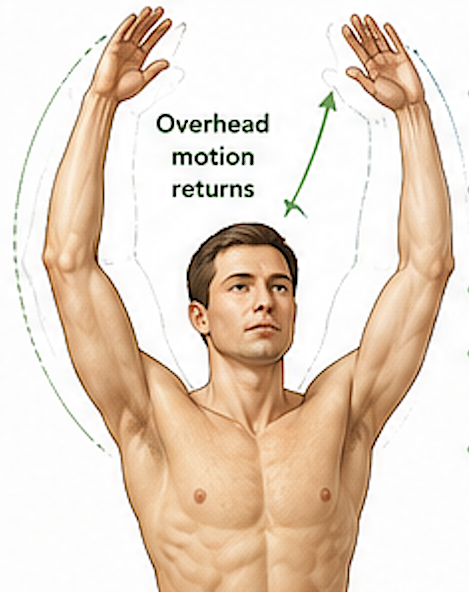
Most patients regain nearly full shoulder elevation.
However, because the scapula rotates from a slightly different starting position:
- reaching straight overhead may initially feel tighter,
- terminal overhead motion can require more effort,
- some patients notice mild stiffness when reaching behind the head.
These changes usually diminish over several months with rehabilitation.
Strength
Once the clavicle has healed, overall strength can return to near preoperative levels.
The limiting factor is generally:
- muscle conditioning,
- not the shortened bone.
The clavicle itself is actually:
- stiffer,
- subjected to lower bending moments,
- structurally stable after union.
There is no biomechanical reason why a healed shortened clavicle should permanently reduce lifting strength.
Heavy Lifting
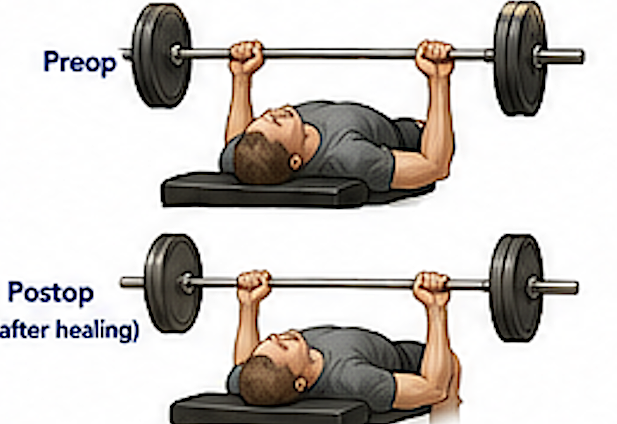 During activities such as:
- bench press,
- push-ups,
- overhead press,
- pull-ups,
the clavicle transmits large compressive forces.
Because the shortened clavicle experiences:
- less bending,
- slightly more axial compression,
these activities are generally well tolerated after complete healing.
Most surgeons still recommend delaying maximal loading until solid radiographic union has occurred.
Throwing and Sports
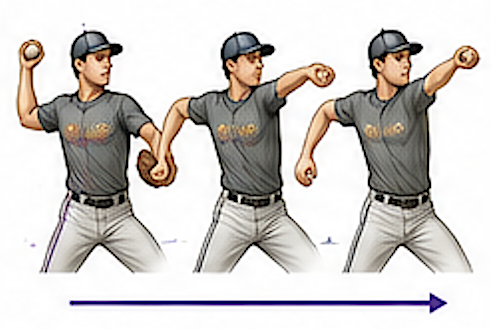
Dynamic sports require coordinated scapular motion.
Initially patients may notice:
- slower throwing velocity,
- altered throwing mechanics,
- decreased endurance.
These changes are primarily neuromuscular rather than structural.
Most athletes gradually recover normal mechanics through repetition and strengthening.
Long-Term Arm Motion
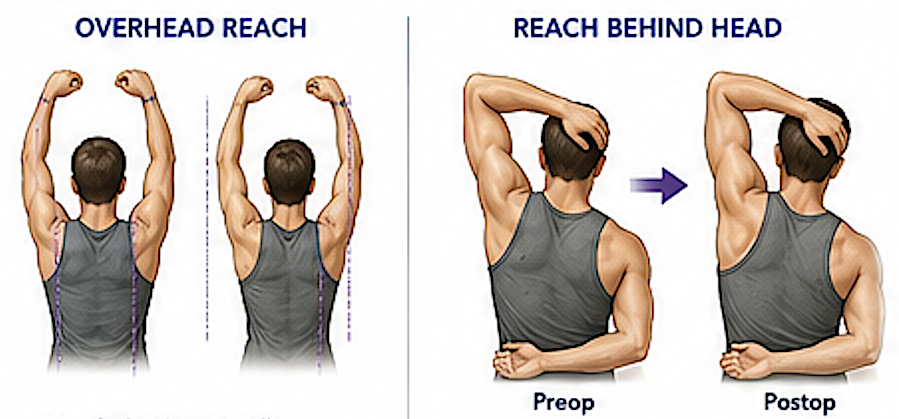
After complete recovery, most patients can expect:
? Full elbow motion
? Full wrist and hand function
? Nearly full shoulder range of motion
? Normal daily activities
? Ability to lift overhead
? Ability to return to recreational sports
Minor long-term differences may include:
- slightly reduced shoulder width,
- altered resting scapular position,
- subtle changes in muscle leverage that are usually imperceptible during routine activities.
Why Patients Feel “Different”
The most important concept is that shortening the clavicle changes the starting position of the entire shoulder girdle rather than weakening it.
Think of it as moving the mounting point of a crane slightly closer to the building. The crane can still lift the same weight, but every cable, pulley, and support operates from a slightly different angle. After a period of adaptation, the system functions efficiently again.
Clinical Implication for Shoulder Narrowing Surgery
For patients undergoing cosmetic clavicle shortening, the limiting factor in recovery is not the mechanical strength of the shortened clavicle. Instead, recovery depends on:
- achieving reliable bony union,
- restoring scapulothoracic rhythm,
- rebuilding muscle endurance,
- allowing the central nervous system to adapt to the new shoulder geometry.
This explains why most patients recover normal arm function over time despite having permanently shorter clavicles. The shoulder girdle is remarkably adaptable, and once healing is complete, the new biomechanics are generally well accommodated by the musculoskeletal system.
Dr. Barry Eppley
Plastic Surgeon