

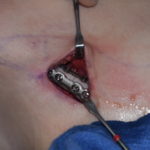
A limited-incision sliding genioplasty is a modification of the traditional intraoral sliding genioplasty in which the mucosal incision is kept as short as possible while still providing adequate access to perform the chin osteotomy safely. The goal is to reduce soft tissue disruption, minimize swelling, and preserve blood supply without compromising the accuracy of the bone movement.
Key Technical Features:
 A 2 to 3 cm horizontal vestibular incision centered in the lower labial sulcus rather than extending across the full width of the canine-to-canine region.
- Careful subperiosteal dissection limited to the area required for the osteotomy, preserving as much soft tiussue attachment s as possible.
- Identification and protection of the mental nerves through the limited exposure.
- Performance of the osteotomy using a reciprocating saw or piezoelectric instrument through the restricted access.
- Advancement, setback, vertical lengthening, shortening, or asymmetry correction of the chin segment as needed.
- Rigid fixation with titanium plates and screws through the same limited incision.
- Layered closure with meticulous reapproximation of the mentalis muscle to reduce the risk of chin ptosis.
 A 2 to 3 cm horizontal vestibular incision centered in the lower labial sulcus rather than extending across the full width of the canine-to-canine region.
 Careful subperiosteal dissection limited to the area required for the osteotomy, preserving as much soft tiussue attachment s as possible.
 Performance of the osteotomy using a reciprocating saw or piezoelectric instrument through the restricted access.
 Rigid fixation with titanium plates and screws through the same limited incision.
 Layered closure with meticulous reapproximation of the mentalis muscle to reduce the risk of chin ptosis.
Advantages
- Less soft tissue dissection
- Lower risk of vestibular scarring/contracture
- Better preservation of mentalis muscle function
- Less postop numbness
- Potentially faster recovery
Why Does It Work?
Intraoral mucosal tissues have great elasticity (stretch). As z result it is not necessary to have a long incision for adequate visibiliy for performing safe osteotonm cuts. Using a Converse retractor narrow tunnels are made laterally. With the central vertical dissection this creastes an inverted T shaped pathway of exposure.
Limitations
A limited-incision approach is best suited for straightforward genioplasty movements. Large asymmetry corrections, complex multi-directional movements, or procedures combined with extensive mandibular contouring may require a longer incision to provide adequate visualization and ensure safe fixation.
When performed by an experienced surgeon, a limited-incision technique can achieve the same skeletal result as a traditional sliding genioplasty while reducing unnecessary soft tissue trauma.
Dr. Barry Eppley
Plastic Surgeon