

What Does Rib Shaving Mean?
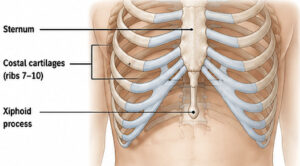
Shaving of ribcage protrusions is a surgical contouring procedure in which a prominent portion of a rib or ribs is reduced through excision of its outer convexity through bone or cartilage removal rather than removing the entire rib segment. Typically this is done for protrusions of the costal or cartilage-comprised ribs which are easiest to shave and are usually anterior along the subcostal rib margins (light blue in illustration).
The most common reasons include:
- Congenital rib prominence or asymmetries
- Flared lower ribs
Surgical Technique:
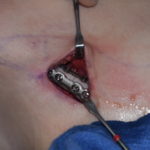
- The rib is typically exposed through a small incision directly over the prominence.
- A high-speed burr or scalpel blades are used to reduce the projecting portion of the rib.
- The goal is to smooth the contour while maintaining rib strength and chest wall stability.
- Recovery usually involves soreness for several weeks, similar to a rib bruise.
- Risks include pain, contour irregularities, injury to the pleura (lining around the lung), pneumothorax, infection, and recurrence if the prominence is not adequately reduced.
Lower Sternal-Rib Junction Protrusion
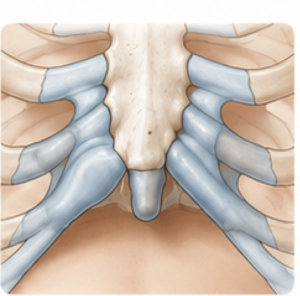
One such area where rib protrusions can occur and create noticeable asymmetry is the junction of the cartilaginous rib to the sternum. A lower sternal-rib junction protrusion usually refers to prominence at the xiphoid process, the xiphisternal junction, or the adjoining costal cartilages of ribs 7–9.
From a surgical standpoint, the treatment depends on the anatomy:
If the prominence is the xiphoid process
- The xiphoid can be naturally enlarged, elongated, or angled anteriorly.
- The simplest correction is xiphoidectomy (removal of the xiphoid process).
- This is a relatively straightforward outpatient procedure with a small incision.
- It generally provides the most predictable contour improvement when the xiphoid is the source.
If the prominence is costal cartilage
- Commonly seen as a localized bulge where the lower ribs meet the sternum.
- Cartilage can be selectively trimmed or sculpted.
- Care must be taken to preserve chest wall stability.
- Results are usually good for isolated unilateral or central prominences.
The first step is determining exactly what structure is protruding. A physical exam is often sufficient, although a 2D or 3DCT scan can be helpful to provide a clear understanding of the problem.
Case Example
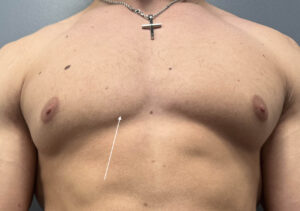
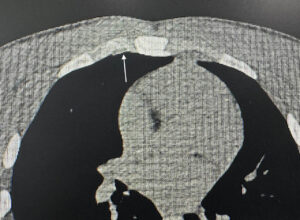
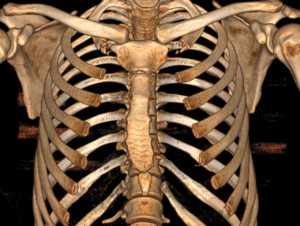 This young athletic muscular male was bothered by a prominence on his right ribcage which was greatest at the lower sternal sternal junction. A 2D CT showed the sternal-rib protrusion in cross section. A 3D CT scan showed a mild deviation/tilt of the sternum to the right side.
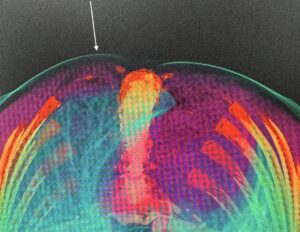
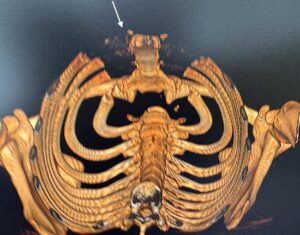 A colorization of the 3D CT scan more clearly showed the overall prominence of the right ribcage in general which was greatest at the rib 8 and 9 junction with the sternum.
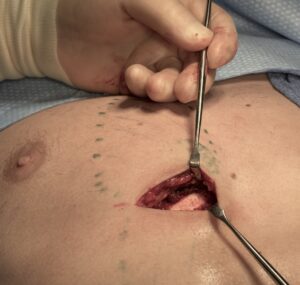
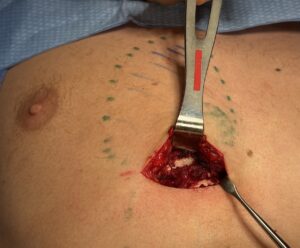 Under anesthesia a small medial incision at the inframammary crease was made through which the medial ends of ribs 8 and 9 were shaved down with sternal bone removed at the junction.
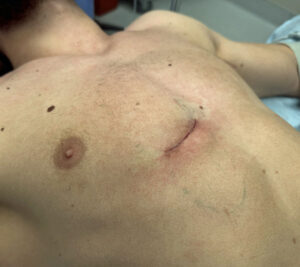 While the protrusion involved parts of the ribcage superior to this area the thickness of the pectoralis major muscle and its tight attachments did not permit chasing the protrusion higher up onto the ribcage.
Discussion
Cartilaginous rib protrusions can always undergo shaving and the question is not whether it can be done but whether it should be done. This depends on three factors: 1) how much of the protrusion can be safely reduced, 2) the location and length of the incision needed to do it and 3) how motivated is the patient (which is undoubtably influenced by #1 and #2).
Based on my ribcage modification surgery experiences most cartilaginous rib protrusions can never be fully reduced for ideal symmetry usually due to the desire to keep the incision and resultant scar small. This makes access to the full problem limited and one has to accept improvement or reduction of the most prominent portion of the protrusion. Usually the scars needed for rib protrusion reductions cannot usually be placed in ideal locations, this present case example is an exception as it was down along the inframammary crease although this is not as favorable a location as it might otherwise be in a female.
In the end it usually comes down to whether the patient feels that the fine line scar is better than the protrusion that they have. While some patients may feel that way, as this one did, that does not mean every rib protrusion patient will.
Dr. Barry Eppley
Plastic Surgeon