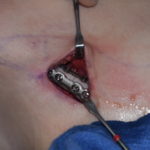
While PEEK has great utility in the mandible as an aesthetic onlay implant its structural rigidity as it moves up into the midface begins to impose some limitations, A not unknown issue that I see is in the patient who has had PEEK cheek implants that did not met their aesthetic goals.
For replacing custom PEEK cheek implants with custom silicone infraorbital–malar implants, the goal is usually not merely changing materials. It is an opportunity to change the footprint of augmentation from a primarily cheek/zygomatic implant to a continuous infraorbital–malar construct.
PEEK is rigid and works well when the objective is precise, bone-like augmentation fixed directly to the facial skeleton. It can be used in the zygomatic and infraorbital regions, but its rigidity affects how thinly and smoothly it can transition across complex contours. By contrast, custom solid silicone can be designed with very thin, tapered margins and can more readily saddle the infraorbital rim, extend medially and laterally, and blend the infraorbital and malar augmentation into one implant. Solid silicone is particularly suited to custom infraorbital–malar designs because rim saddling and feathered edges are important beneath the thin lower-eyelid tissues.
So conceptually, the conversion is:
Current custom PEEK cheek implant
? principally malar/zygomatic skeletal projection
? rigid, screw-fixed construct
? may stop inferior or lateral to the true infraorbital rim depending on its design
New custom silicone infraorbital–malar implant
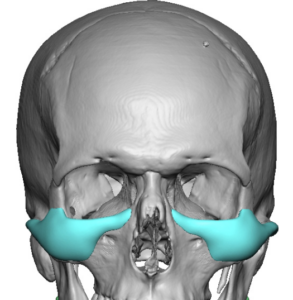
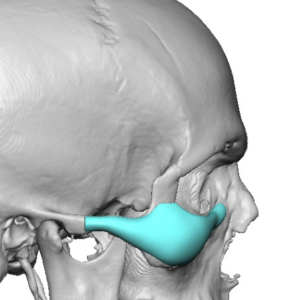
? extends augmentation superiorly onto/over the infraorbital rim
? integrates the orbital rim, anterior malar prominence, and lateral zygoma
? allows thinner peripheral feathering
? can create a smoother lower-eyelid–cheek transition, rather than simply increasing cheek projection.
That distinction is particularly important as in most cases the PEEK implants gave good cheek projection but left infraorbital hollowing, a negative-vector appearance, an abrupt lid–cheek junction, insufficient anterior projection, or an unnatural transition between the implant and surrounding skeleton.
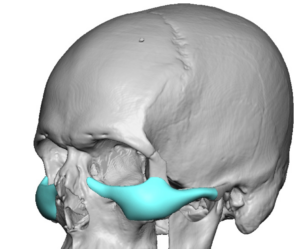 The implant designing question I would focus on is not “silicone versus PEEK?” but “what skeletal envelope should the new implant cover?” The replacement implant can potentially incorporate the existing PEEK augmentation into the new design while adding whatever is missing at the infraorbital rim and along the zygomatuic arch. That means using the 3D CT scan to identify the existing PEEK implant shape ansd volume, determining what portion of that projection should be preserved, what part of the PEEK implant that is not needed (usually the submalar component) then extending the silicone implant to create the desired external skeletal contour change. This creates the wrap around concept of the infraorbital-malar implant concept.
There is also no strong evidence that PEEK is categorically safer or superior to silicone for aesthetic cheek augmentation. Modern systematic reviews support the general safety of alloplastic facial implants, but comparisons are limited by heterogeneous implant sites, indications, and techniques. A recent technical report is interesting in this context because it specifically exploited the complementary properties of rigid PEEK for structural orbital support and flexible silicone/PDMS for malar contour restoration, illustrating why material choice may depend on the desired geometry rather than one material simply being “better.”
Dr. Barry Eppley
Plastic Surgeon