

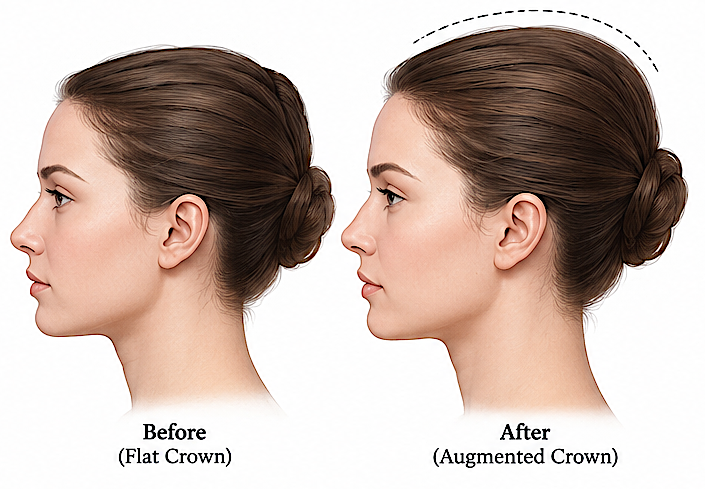
 A custom crown-of-the-skull implant is designed to increase the height and smooth the contour of the upper central skull (vertex) while maintaining a natural feminine head shape. Unlike implants that widen the sides of the head or augment the back of the skull, a crown implant selectively builds the highest point of the skull to improve overall cranial proportions.
Indications
A female crown implant is most appropriate for patients who have:
- A congenitally flat or low crown.
- A head shape that appears broad but lacks vertical height.
- A flattened transition from the forehead to the upper skull.
- Loss of crown projection after previous cranial surgery or trauma.
- A desire for a more balanced, oval-shaped head without increasing head width.
Implant Design Principles
The implant is designed from a 3D CT scan and is unique for each patient.
Typical design characteristics include:
- Centralized augmentation over the vertex.
- Maximum thickness usually between 5 and 12 mm, depending on scalp laxity and the patient’s goals.
- Smooth feathered edges that taper to nearly zero thickness over several centimeters to eliminate palpable transitions.
- An elliptical or teardrop footprint rather than a circular one to match the natural curvature of the female skull.
- Avoidance of excessive lateral extension, which could make the head appear wider rather than taller.
The design objective is subtle vertical enhancement that is not detectable as an implant.
Female Design Characteristics
Compared to male skull implants, female crown implants generally emphasize:
- More vertical height than width.
- Softer, smoother contours.
- Preservation of the naturally rounded female cranial silhouette.
- No angular or ridge-like transitions.
The highest point is usually positioned just slightly posterior to the midpoint of the skull, reproducing the normal female vertex.
Implant Material
Solid custom silicone is generally the preferred material because it:
- Can be manufactured in virtually any shape or thickness.
- Is flexible enough for insertion through a limited scalp incision.
- Has an excellent long-term safety record.
- Can be modified or removed if ever necessary.
Advantages of a Custom Implant
- Precise fit to the patient’s skull.
- Natural transition into surrounding bone.
- Predictable increase in skull height.
- No donor-site morbidity.
- Long-lasting, stable results.
A custom-designed crown implant is often the most effective way to increase skull height because it allows millimeter-level control of projection while preserving a soft, feminine cranial contour that appears completely natural.
Case Study
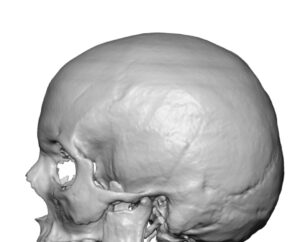
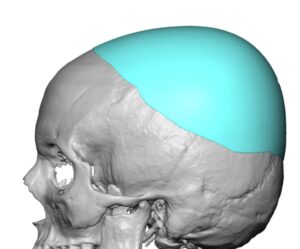 This female desired a higher crown height of her skull for which a custom skull implant was designed to achieve. The implant had a maximum crown height of 14mms with a volume of 150ccs.
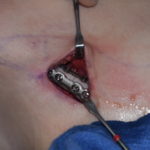
Under general anesthesia and in the prone position a 7-cm scalp incision was made on the back of her head without shaving any hair and paralleling the direction of the hair shafts. A precise subperiosteal pocket was developed over the crown.The implant was insertion, positioned, and secured with small titanium micro screws.The incision was closed in layers after the placement of a drain.
While this sound sstraightforward there are several implant design and intraoperative techniques that aid in its placement. These include:
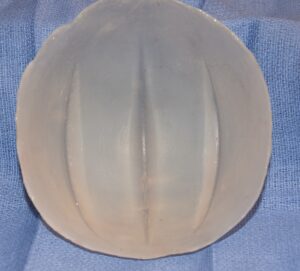 Internal relief wedges designed into the undersurface of the implant to aid inseertion.
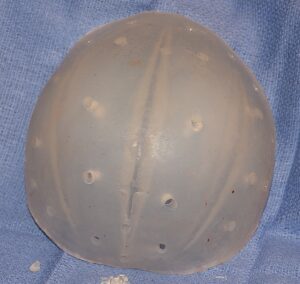 Perfusion holes cut into the implant to aid postoeprative tissue ingrowth.
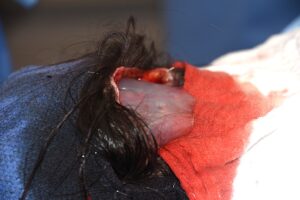 Deforming (folding the implant into a roll) the implant for passage through a much smaller scalp incision.
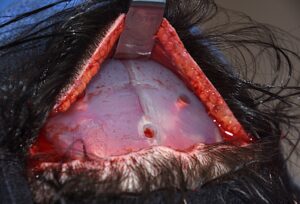 Designed orientation markers on the implant to have a visual aid for symmetry of implant positioning.
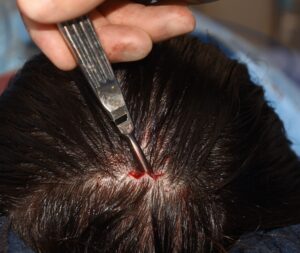 Snall anterior sagittal incision for instrument check of anterior implant edge to ensure it is unflded and laying flat.
The recovery from the surgery includes:
- Mild to moderate scalp swelling for the first week.
- Temporary scalp tightness or numbness is common.
- Hair washing usually begins after several days.
- Most patients return to normal activities within 10–14 days.
- Final contour becomes apparent as swelling resolves over 6–8 weeks.
Discussion
A high crown of the head is considered aesthetically attractive because it creates a smoother, more balanced cranial shape that enhances overall facial harmony and femininity. By increasing the vertical proportions of the head, a higher crown can make the face appear more oval and refined while providing better support for hair, resulting in a fuller, more youthful appearance. It also improves the profile by producing a continuous, graceful curve from the forehead over the top of the head to the back of the skull, making the forehead appear less prominent and the neck appear longer and more elegant.
While an elevated crown can be achieved naturally through various hair styling methods, a custom skull implant provides a permanent method to do so. How much augmentation is needed depends on the natural skull shape and how much implant volume the stretch of the overlying scalp will accommodate. In general he most attractive result is a subtle enhancement that improves overall head proportions without appearing obvious or artificial.
Key Points
1) Increasing the height of the crown is one of the most common female requests for skull augmentation.
2) The limitation of implant projection is an estimate of the safe scalp stretch of which 150ccs in a Caucasian female is the maximum.
3) The posterior approach in the prone position is the preferred approach for crown of height skull implant placement.
Dr Barry Eppley
Plastic Surgeon