
As a surgeon I have to think a variety of technical issues when comparing materials for custom jawline implants. These include incision strategy, screw fixation, mental nerve considerations, implant thickness, long-term bone changes, revision/explant technique, and how I would counsel a cosmetic patient choosing an implant material..
For a custom wraparound jawline implant—chin + mandibular body + angles—I would think about silicone and PEEK differently at almost every step of the operation. The published evidence is stronger for reconstructive PEEK and conventional chin implantation than for true head-to-head cosmetic wraparound comparisons, so some of this is surgical-principles-based rather than proven superiority of one material.
|
Surgical issue |
Custom silicone |
Custom PEEK |
|
Access/insertion |
Major advantage: flexible; can be folded/compressed |
Rigid; usually requires more exposure or segmentation |
|
Seating |
More forgiving, but can buckle/shift during placement |
Precise, positive bony fit if design and exposure are correct |
|
Fixation |
Screws useful, especially chin/angles |
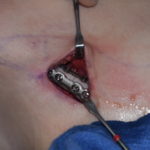
Rigid screw fixation is essentially integral to the plan |
|
Mental nerve |
Flexible implant can be manipulated around nerve, but migration/compression still matters |
Rigid edge and screw trajectory must be planned carefully around foramen/nerve |
|
Large thickness |
Softer contour, but large volume may increase pressure/dead space |
Holds large augmentations accurately, but thick rigid edges demand excellent tapering |
|
Bone response |
Fibrous capsule; remodeling, neo-ossification and some resorption possible |
Bioinert; limited native osseointegration; generally dimensionally stable |
|
Revision |
Usually easier to remove and modify |
Removable, but rigid fixation/multi-piece construct can make revision more involved |
|
Best use case |
Cosmetic contouring, smooth wraparound augmentation |
Major asymmetry/deficiency where rigid 3-D accuracy is the priority |
1. Incision strategy
This is where silicone has its clearest technical advantage.
A large silicone wraparound implant can be flexed and fed through a relatively modest submental incision. For a true angle-to-angle implant, however, I would not view the submental incision as magically eliminating posterior access: adequate subperiosteal release around the angles can still require intraoral access. An experienced custom-implant surgeon describing this technique uses the submental route for delivery while supplementing it with posterior vestibular incisions for angle dissection and positioning.
With PEEK, you lose that flexibility. A large one-piece implant that perfectly fits the entire lower mandibular border can become mechanically difficult—or impossible—to introduce through limited access.
That leads to two PEEK strategies:
More exposure, or multiple implant segments that are inserted separately and aligned/fixed after insertion. Segmented PEEK designs have been used successfully in maxillofacial reconstruction, including cases where different components were introduced through different approaches.
So for a purely cosmetic patient where I am trying to minimize surgical access:
Silicone ? simpler insertion geometry.
PEEK ? more preoperative thought about how the implant physically gets from outside the patient onto the mandible.
That sounds elementary, but with a large custom implant it can determine the entire operation.
2. Screw fixation
I would strongly favor planned screw fixation with either material for a full custom jawline implant.
With silicone, fixation turns a relatively mobile, flexible implant into a reproducibly positioned device. Particularly with a large wraparound design, I would not want to depend entirely on pocket confinement.
The practical distinction is that silicone has some tolerance:
seat ? inspect ? adjust ? trim if necessary ? fix.
PEEK is more like:
achieve exact registration ? confirm that the implant is fully seated ? fix it exactly where planned.
Because PEEK is rigid, a partial seating error can be deceptive. If one area is hanging up on periosteum, an irregularity of bone, or inadequate pocket release, tightening a screw is not something I would want to use to force the implant onto the mandible. The problem should be identified first.
Patient-specific PEEK’s value is precisely this rigid reproduction of planned geometry; published craniofacial series report good positional stability and low rates of implant displacement.
For either material I would want the screw positions designed ahead of time, rather than deciding casually after insertion.
3. Mental nerve considerations
This is one of the most important issues in a wraparound jaw implant.
The implant passes immediately through the region of the mental foramina, typically near the premolar region, and the course/anterior loop of the nerve varies between patients. CBCT/CT assessment is therefore valuable for identifying the mental foramina and related nerve anatomy before surgery.
There are three separate nerve issues:
Pocket dissection.
The dissection needs to pass around/below the mental nerve without excessive traction.
Implant geometry.
The superior border of the implant should not create a hard point or restrictive notch against the nerve.
Screws.
Screw locations and trajectories need to respect the mental foramen, anterior loop and inferior alveolar canal.
This is where I would be particularly meticulous with PEEK.
Silicone gives a little when the nerve moves or when the implant is maneuvered beneath it. PEEK doesn’t. A poorly designed PEEK notch or superior edge could function as a very rigid mechanical contact point.
That doesn’t make PEEK intrinsically more likely to injure the nerve; it means the CAD design has to anticipate the anatomy extremely well.
For either material, postoperative lower-lip/chin paresthesia is one of the complications I would explicitly discuss with the patient.
4. Implant thickness
This is more important than many patients realize.
Suppose the patient wants:
- 8–10 mm more posterior angle width,
- several millimeters along the mandibular body,
- chin width,
- and additional anterior projection.
That is a lot of implant.
Silicone
The advantage is that a thick implant still has some compliance.
The disadvantage is that very large augmentation means:
- more soft-tissue displacement,
- more dead space,
- more pressure on the underlying skeleton,
- potentially greater edge visibility,
- and greater importance of fixation.
I would particularly avoid abrupt thick-to-zero transitions. Long feathered transitions are generally preferable.
PEEK
PEEK handles large geometric augmentation extremely well because a 10-mm-thick section remains exactly a 10-mm-thick section.
That is useful in major asymmetry.
But the rigidity means the design becomes less forgiving. A 1–2 mm design mistake can remain a 1–2 mm palpable skeletal error rather than being partially softened by the material.
So with PEEK I would obsess over:
edge feathering + implant-to-bone registration + soft-tissue thickness.
PEEK’s mechanical properties, including stiffness considerably closer to cortical bone than metallic reconstruction materials such as titanium, are one reason it has become attractive for patient-specific craniofacial reconstruction.
5. Long-term bone changes
This deserves a more nuanced discussion than the traditional statement:
“Silicone causes bone erosion.”
That is too simplistic.
A 2025 review specifically examining bone changes beneath silicone chin implants concluded that both new bone formation and resorption can occur. Subperiosteal manipulation itself can induce bone formation; limited pressure-related resorption may occur, while extensive resorption appears to be considerably less common than older descriptions sometimes imply.
So for silicone I would counsel:
some long-term remodeling of the mandible is possible, particularly beneath areas of pressure.
That matters more to me as implant size and projection increase.
PEEK
Standard PEEK is bioinert rather than strongly osteointegrative. Its relatively inert surface is actually considered one of the material’s biological limitations; substantial current research is devoted to coatings and surface modification that improve bone integration.
That means conventional PEEK generally behaves as an accurately fitted onlay rather than becoming biologically fused to the mandible.
For cosmetic augmentation, that isn’t necessarily undesirable—it helps preserve revisability.
What I would not tell a patient is:
“PEEK becomes bone.”
Standard PEEK doesn’t.
6. Revision and explantation
Here I give silicone a practical advantage.
If a silicone implant needs revision, you can often:
- reopen the pocket,
- remove fixation screws,
- mobilize the implant,
- remove it,
- trim or replace it,
- revise the capsule/pocket as necessary.
And because the material is flexible, delivery back out through the incision is generally manageable.
With PEEK, removal is certainly feasible; standard PEEK’s limited osseointegration actually helps in this regard. Published long-term maxillofacial series include implant removal when indicated.
But mechanically it can be more involved:
find/remove every fixation screw ? fully release the implant ? retrieve a rigid component through sufficient exposure.
For a multi-piece PEEK jawline, every piece has to be addressed.
So if I had a patient whom I thought had a relatively high likelihood of wanting the jaw smaller, wider, narrower, or otherwise different five years later, silicone’s revision friendliness would weigh somewhat in its favor.
7. Where PEEK becomes especially compelling
Imagine a patient with:
- markedly different right and left mandibular angles,
- congenital mandibular asymmetry,
- previous orthognathic surgery,
- previous angle reduction,
- trauma,
- a complex bony defect,
- or a very irregular mandibular surface.
Now I start leaning toward PEEK.
The geometry is essentially:
CT ? digital reconstruction ? precise implant ? rigid registration against the skeleton.
That is PEEK’s sweet spot.
Clinical studies of PEEK patient-specific implants in cranio-maxillofacial reconstruction have shown good long-term aesthetic/functional outcomes, although most of that literature concerns reconstruction rather than healthy cosmetic jaw augmentation.
8. Where silicone becomes especially compelling
Now imagine a healthy cosmetic patient with:
- normal mandibular anatomy,
- mild/moderate skeletal deficiency,
- desire for wider angles,
- a cleaner mandibular border,
- slightly more chin width/projection,
- and an otherwise symmetrical jaw.
For that patient, custom silicone is very difficult to dismiss.
It gives you:
excellent custom geometry + smaller delivery footprint + intraoperative adjustability + easy fixation + easier potential revision.
The fact that PEEK is technologically sophisticated doesn’t automatically make it a superior cosmetic implant.
9. What I would tell the cosmetic patient
I would frame the choice roughly this way:
“Both materials can produce an excellent result. The bigger determinant of your outcome is the implant design and its placement, not whether the implant is silicone or PEEK.”
Then:
If choosing silicone
“This is a softer, flexible solid implant. The flexibility lets me introduce a relatively large jawline implant through smaller access and gives me some ability to make adjustments during surgery. It has a long history in facial augmentation. It doesn’t fuse to your bone, and there can be some long-term bone remodeling underneath it, particularly with larger implants. If you ever want it removed or modified, revision is generally straightforward.”
If choosing PEEK
“This is a very rigid patient-specific implant. Its strength is that the shape designed on your CT scan is reproduced extremely accurately and stays rigid after fixation. That’s especially useful when we’re correcting substantial skeletal asymmetry. The tradeoff is that it cannot be folded during insertion, so the surgical access or implant segmentation becomes more involved. It also needs very careful design around the nerves and implant edges. It doesn’t normally fuse strongly to the bone, so it remains removable.”
My decision tree for a cosmetic jawline patient
For a straightforward bilateral aesthetic augmentation, I’d usually put custom silicone ahead on practicality.
For a complex skeletal correction, I’d progressively favor PEEK.
The dividing line for me would look something like this:
Normal skeleton + cosmetic enlargement
? Silicone advantage
Moderate asymmetry but otherwise cosmetic
? Either; design matters more than material
Severe congenital/post-traumatic/postoperative asymmetry
? PEEK advantage
Very large full wraparound implant with limited desired incisions
? Silicone advantage
Need extremely rigid registration against irregular bone
? PEEK advantage
Patient likely to want future contour adjustments
? Silicone advantage
Need to reproduce a very complex asymmetric correction exactly
? PEEK advantage
The important caveat is that neither material rescues a poor implant design. For a cosmetic wraparound jawline, I would prioritize the CT/CAD design, mental-nerve clearance, smooth superior and posterior transitions, screw plan, pocket accuracy, symmetry, and the relationship between skeletal augmentation and overlying soft tissue before I worried about whether the material label said silicone or PEEK.
Dr Barry Eppley
Plastic Surgeon