
Today’s midface augmentation patient is less often asking simply for “bigger cheeks.” More commonly, they are seeking better facial structure, balance, and restoration of youthful contour without looking filled or operated on.
There are several common patient profiles:
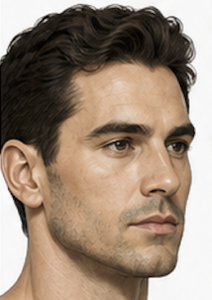
- The younger structural patient, often in their 20s–40s, has congenitally flat or underprojected malar bones, a narrow midface, facial asymmetry, or inadequate cheek projection relative to the eyes, nose, or jaw. Their goal is usually sharper facial architecture—more defined cheekbones, improved ogee curve, or better overall “facial balancing.” Permanent augmentation can be particularly attractive to patients who do not want repeated filler treatments.
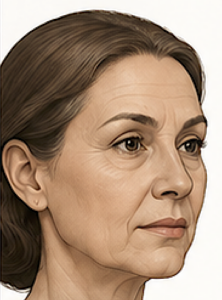
- The aging or volume-deficient patient notices flattening of the upper cheek, loss of anterior midface projection, deepening of the lid-cheek junction or nasolabial folds, and apparent descent of the cheek tissues. In this group, augmentation is often viewed as part of rejuvenation rather than simply enlargement. Midface volume restoration remains a major indication for HA fillers, although surgical and fat-grafting alternatives are increasingly part of the discussion.

- The “filler-fatigue” patient has already tried cheek or midface fillers—sometimes repeatedly—and likes the concept of added skeletal support but dislikes maintenance, expense, variable longevity, migration, or an increasingly soft/overfilled appearance. Current aesthetic discussion has increasingly emphasized natural-looking structural solutions and more selective filler use.

- The post-weight-loss patient is increasingly relevant as substantial medical and surgical weight loss becomes more common. These patients may have relatively good skeletal anatomy but marked midfacial deflation, making it important to distinguish whether they need true skeletal augmentation, fat restoration, lifting, or some combination rather than simply placing a larger implant.
Psychologically, the contemporary patient often arrives much more visually sophisticated than in the past. They may talk about projection, facial width, cheekbone height, ogee curves, “facial balancing,” or show digitally altered photographs. Social media and 3-D visualization have increased awareness of skeletal facial proportions and customized implants.
The important distinction is what the patient is actually deficient in. A patient asking for “cheek augmentation” may have:
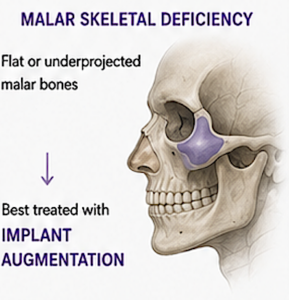
malar skeletal deficiency ? implant augmentation,
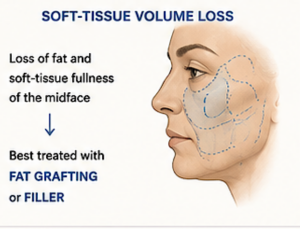
soft-tissue volume loss ? fat or filler,
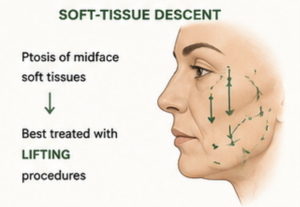
soft-tissue descent ? lifting, or
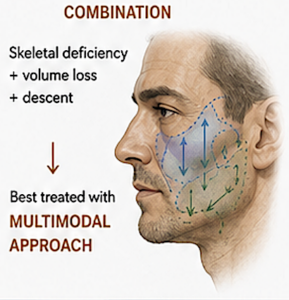
a combination ? multimodal treatment.
 While there are some modern midface augmentation patients seeking generalized cheek fullness most are not. They will usually define their goals as seeking better midfacial defintion within the context of balanced facial proportions. But it will take imaging, particularly from the 3/4 or oblique facial views, to determine what that midface change is exactly.
Dr Barry Eppley
Plastic Surgeon