

A custom aesthetic forehead implant is a patient-specific implant designed from a CT scan to change the contour of the frontal bone with permanent volume..Fat grafting may work for modest soft-tissue contour changes, though volume retention can be unpredictable and repeat treatment may be needed. Injectable filler is sometimes proposed for small forehead changes, but the forehead and glabella are high-risk vascular areas: accidental injection into a blood vessel can rarely cause skin necrosis, blindness, or stroke. Forehead filler should therefore not be regarded as a risk-free “test run.
A custom forehead implant is best understood as a three-dimensional thickness or projection map, rather than a standard implant in small, medium, or large. Its inner surface follows the skull, while its outer surface creates the intended contour. The perimeter should blend tangentially into the surrounding bone rather than ending as an abrupt ledge.
There are five (5) main types of aesthetic forehead implants including full-forehead augmentation.This is a broad implant covering the entire frontal bone. It can:
- Increase overall projection
- Correct a backward-sloping forehead
- Produce a smoother, more convex contour
- Fill central or upper-forehead flatness
Two common variants are a rounded design, with greater central convexity and a smooth transition into the brow, and a straighter design, which projects the upper forehead while preserving a more defined brow-to-forehead angle.
Case Study
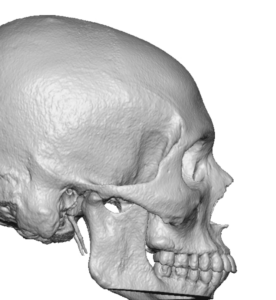
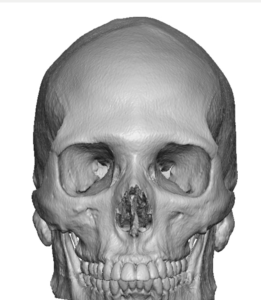 This male desired correction of a backward sloped forehead. The forehead slope extended all the way back to the crown of his head. There was no distinct top of the head separate from his forehead. He had adequate brow bone projection.
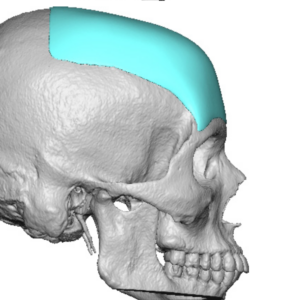
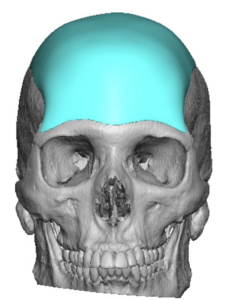 A custom forehead implant without the brow bone was designed that provided maximum projection of 9mms at his upper forehead . It extended all the way back to the crown area. Total implant volume was 83ccs.
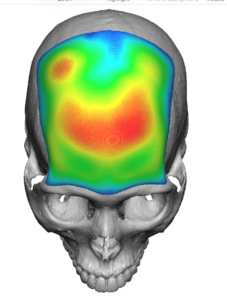 Besides the slope correction it improved the inverted V shape of the forehead-skull seen frontally for a rounder shape by the distribution of the implant’s thicknesses as seen in the color thickness mapping.
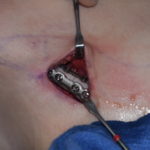
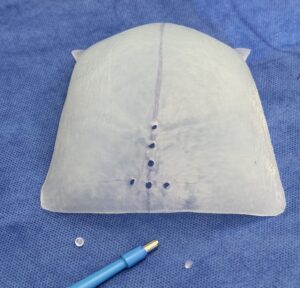 The implant was placed through a scalp incision located at its posterior end. The implant was prepared by placing 4mm holes in it in the midline and horizontally for orientation once inside the subperiosteal pocket
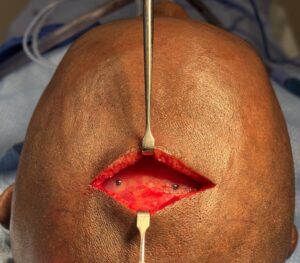 Once positioned as close to the implant design as possible it was secured with with two micro screws. The incision as closed over a drain.
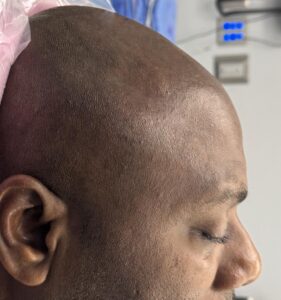
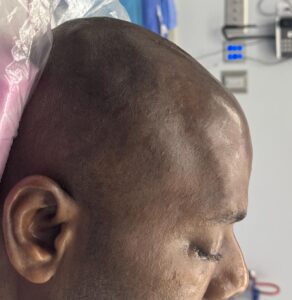 The forehead slope change was immediately apparent as would be anticipated with usually a near 1:1 external soft tissue change to that of the implanted bone dimensions.
Discussion
Best implant concept for a backward-sloping male forehead
When the brow ridge is already adequately projected and the forehead begins sloping backward around the mid-forehead, the most appropriate concept is usually a broad, upper-forehead–dominant custom implant rather than an implant of uniform thickness.
The design should bring the upper forehead forward while preserving a relatively straight, mildly posteriorly inclined masculine contour. It should not automatically make the forehead completely vertical or create a rounded central dome. Population studies find that men, on average, have greater glabellar/medial-brow projection and a flatter, more posteriorly inclined upper forehead than women, but there is considerable individual variation; these averages should guide discussion, not dictate the result.
First determine where the backward slope begins
|
Pattern |
Appropriate design concept |
|
Slope begins above the mid-forehead; brow projection is normal |
Upper-forehead or “high forehead” implant with minimal lower-forehead augmentation |
|
Slope begins immediately above the brows |
Broader full-forehead implant with controlled filling of the suprabrow transition |
|
Brow ridge and glabella are also recessed |
Combined forehead–brow implant, with brow projection designed separately |
|
Forehead is narrow or accompanied by anterior temporal hollowing |
Forehead implant with selective lateral/temporal extension |
|
One side slopes farther backward |
Asymmetric left/right thickness map rather than a symmetric implant |
For the most common situation—normal masculine brow ridge with upper-forehead retrusion—adding significant thickness over the brow would be counterproductive. It could make the supraorbital region look unnecessarily heavy while leaving the actual upper slope incompletely corrected.
Recommended three-dimensional design
Side profile
The sagittal thickness distribution should generally follow this pattern:
- Glabella and brow ridge: approximately unchanged when their projection is already satisfactory.
- Lower forehead: very thin, serving mainly as a smooth transition.
- Mid-forehead: gradual increase in projection.
- Upper-middle forehead: area of maximum projection.
- Upper border beneath the hair-bearing scalp: gradual reduction to the surrounding skull, extending far enough superiorly to prevent an abrupt break at the hairline.
The intended outer contour should resemble a broad, straighter plane with restrained convexity, not a focal bump. The precise point of maximum thickness depends on where the patient’s skull first departs from the desired profile.
Frontal and oblique views
The implant should usually be broad enough to approach the anterior temporal lines. A narrow central implant may correct the lateral photograph while producing a vertically elongated central prominence in frontal view.
For a conventionally masculine result, the design commonly aims for:
- A broad central forehead
- Relatively restrained central roundness
- Preservation of the brow-to-forehead break
- Smooth but not excessively rounded lateral transitions
- Independent correction of any left-right asymmetry
Extension across the temporal lines should be considered only when the upper face is narrow or the forehead-to-temple transition is hollow. A retrospective study found improved photographic scores with integrated forehead-temporal augmentation compared with forehead-only augmentation, but it was nonrandomized, and does not establish that every patient needs temporal extension.
Implant edges
Every perimeter should be designed with continuous curvature and tangency to the underlying skull. In practical terms, the thickness map should fade to the manufacturer’s feasible minimum rather than ending as a visible step.
How much projection?
There is no universally accepted “ideal male forehead angle” or standard implant thickness. The correct amount depends on:
- The measured severity and location of the slope
- Brow and nasal-root projection
- Hairline height and recession
- Scalp and forehead soft-tissue thickness
- Frontal width and temporal contour
- The desired degree of masculinity versus verticalization
A useful planning approach is to request three virtual versions with the same footprint but different maximum projection, separated by small increments. Each should be reviewed through calibrated side, frontal, top and oblique renderings. This is more informative than approving a design based on one maximum-thickness number.
Design Brief
Objective: Correct excessive posterior inclination of the male forehead while maintaining a natural masculine contour.
Profile: Bring the upper and upper-middle forehead forward, retaining a mild posterior inclination rather than creating an excessively vertical or spherical forehead.
Brow relationship: Preserve the existing glabella and supraorbital-ridge projection. Maintain a controlled brow-to-forehead break; do not routinely augment the brow ridge.
Thickness distribution: Minimal thickness over the lower forehead, progressive increase through the mid-forehead, maximum projection in the region of greatest upper-forehead deficiency, followed by gradual superior taper beneath the hair-bearing scalp.
Footprint: Broad bilateral coverage approaching the anterior temporal lines, with temporal extension only where needed for width or hollowing.
Surface contour: Broad and relatively straight in sagittal profile, restrained central convexity, no focal midline dome or abrupt lateral step.
Design features to avoid
- Uniform thickness from brow to hairline
- Maximum projection concentrated over an already strong brow ridge
- A narrow central footprint
- An abrupt upper edge terminating exactly at the visible hairline
- A rounded, hemispherical contour when the goal is a straighter masculine profile
Dr Barry Eppley,
Plastic Surgeon