
 PEEK (polyether ether ketone) is a high-performance thermoplastic that has become increasingly popular for patient-specific facial implants because it combines high strength, dimensional stability, radiolucency, and a bone-like elastic modulus. Its mechanical properties are generally superior to porous polyethylene (Medpor) and more similar to cortical bone than titanium in terms of stiffness.
Here’s a summary of the key mechanical properties of medical-grade implantable PEEK (ASTM F2026):
| Property | Typical Value | Clinical Relevance |
|---|---|---|
| Density | 1.30–1.32 g/cm³ | Lightweight implant |
| Tensile strength | 90–100 MPa | Resistant to fracture under normal facial loading |
| Tensile modulus (Young’s modulus) | 3.6–4.1 GPa | Much closer to cortical bone than titanium |
| Compressive strength | 120–140 MPa | Excellent resistance to compressive forces |
| Compressive modulus | 3.5–4.0 GPa | Similar stiffness in compression |
| Flexural strength | 160–180 MPa | High resistance to bending |
| Flexural modulus | 4.0–4.5 GPa | Maintains shape under load |
| Elongation at break | 20–40% | Tough rather than brittle |
| Fatigue resistance | Excellent | Withstands cyclic loading over years |
| Hardness | Rockwell R126–129 | Highly scratch resistant |
| Water absorption | <0.5% | Excellent dimensional stability |
Comparison with common facial implant materials
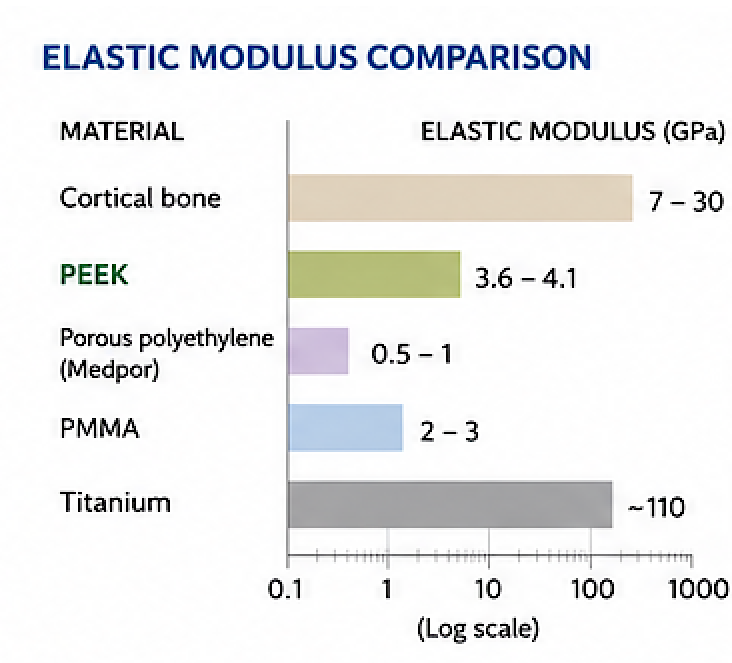
PEEK is significantly less stiff than titanium, reducing stress shielding, while being considerably stiffer than porous polyethylene.
Strength advantages
PEEK offers:
- High impact resistance
- Excellent fatigue life
- Minimal creep under physiologic loads
- Stable dimensions over decades
- Resistance to crack propagation
For facial implants, this means it is highly resistant to fracture during:
- Mastication
- Minor facial trauma
- Screw fixation
- Long-term cyclic loading
Machinability
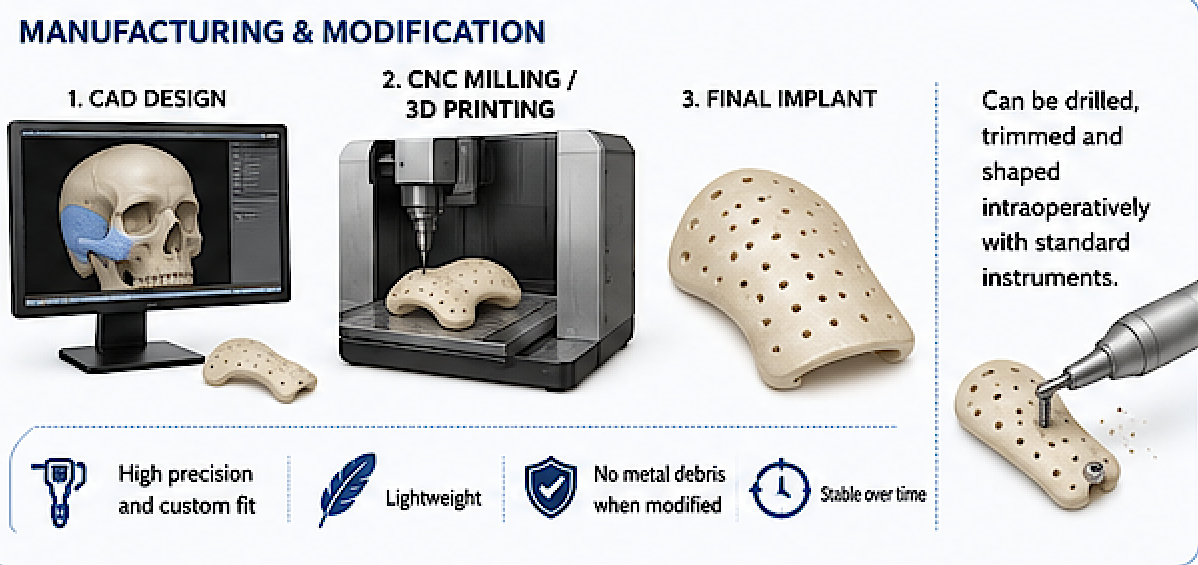
PEEK can be:
- CNC milled to tight tolerances
- 3D printed (medical-grade processes)
- Drilled intraoperatively
- Trimmed with rotary instruments if necessary
Unlike titanium, it does not generate metal debris when modified.
Imaging properties
One of PEEK’s major advantages is that it is:
- Radiolucent on CT
- MRI compatible
- Produces minimal imaging artifact
This makes postoperative assessment of the surrounding bone much easier. However radiolucency can also be a disadvantage as the most common reason to do postoperative radiographic analysis on any facial implant patient is to check current implant position for possible positioning, and/or replacement.
Limitations
Despite its excellent mechanical performance, PEEK has some drawbacks:
- Bioinert surface with limited natural osseointegration unless surface-treated or coated
- Lower stiffness than cortical bone, which may be advantageous in many applications but can be limiting in very high-load reconstructions
- Higher material and manufacturing cost than standard off-the-shelf implants
Why PEEK is attractive for facial implants
For patient-specific craniofacial implants (malar, mandibular angle, chin, orbital, forehead), PEEK provides an excellent balance of:
- High strength without brittleness
- Bone-like mechanical behavior
- Long-term dimensional stability
- Excellent fatigue resistance
- Excellent CT/MRI compatibility
- Precise CAD/CAM manufacturing capability
These characteristics have made it a ve4ryt useful material for many custom aesthetic implant applications where accurate fit and durable mechanical performance are important.
Dr. Barry Epley
Plastic Surgeon