
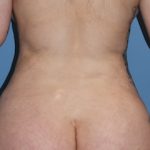
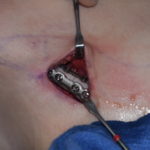
How much can the clavicle be shortened before it affects arm range of motion? This is one of the key unanswered questions in cosmetic clavicle shortening surgery because there are no published biomechanical or clinical studies that define a precise threshold. Most of what we know comes from studies of malunited clavicle fractures, clavicle resections, cadaveric biomechanics, and clinical experience.
From those sources, it appears that the shoulder girdle tolerates small to moderate shortening remarkably well, but there is likely a point at which scapular mechanics begin to deteriorate.
Estimated Effects by Amount of Shortening
|
Total Clavicle Shortening (each side) |
Expected Effect on Shoulder Function |
|
5–10 mm |
Essentially no measurable long-term loss of motion after rehabilitation. |
|
10–15 mm |
Minimal biomechanical changes; all patients regain full ROM +/-therapy. |
|
15–20 mm |
Mild alterations in scapular kinematics become more likely, although all patients still have achieved full function. |
|
20–25 mm |
Increasing risk of subtle reductions in overhead endurance, scapular dyskinesis, and altered muscle mechanics. May be only relevant in high performance athletes or activities |
|
>25 mm |
Greater likelihood of measurable biomechanical compromise, particularly with overhead sports or heavy labor. |
Why There Isn’t a Sharp Cutoff
Shoulder motion is produced by three coordinated systems:
- Glenohumeral joint
- Scapulothoracic articulation
- Clavicular rotation at the SC and AC joints
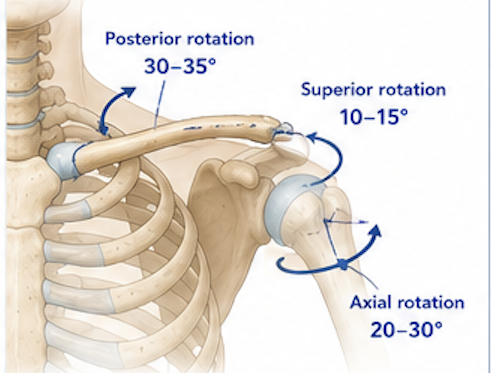
The clavicle rotates approximately:
- 30–35° posteriorly
- 10–15° superiorly
- 20–30° axially
during full arm elevation.
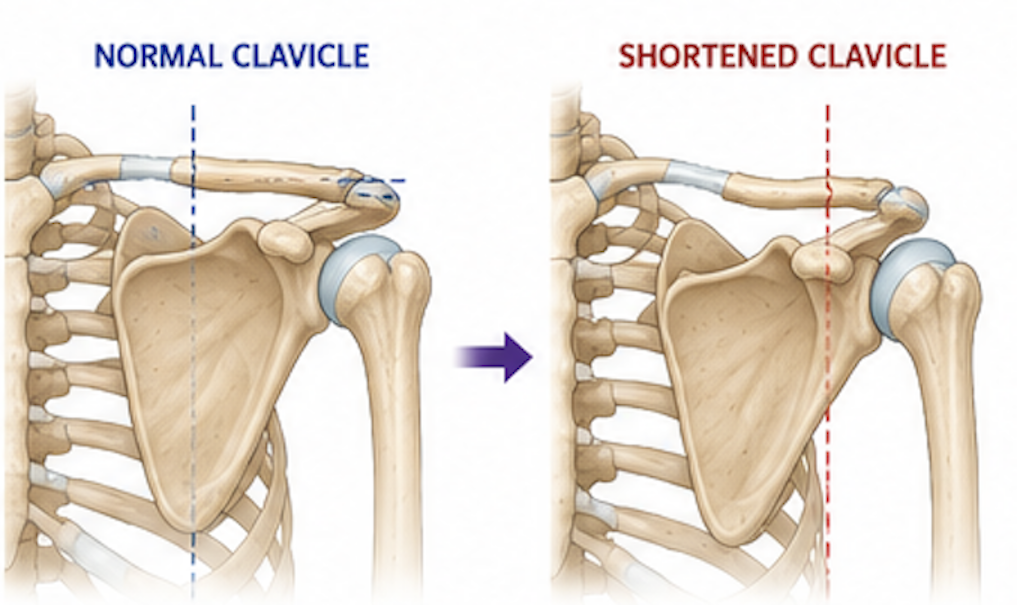
A shortened clavicle still rotates normally, but because it starts from a more medial position, the scapula begins from a different resting orientation.
Initially, this mainly affects:
- scapular upward rotation,
- posterior tilt,
- external rotation.
The body can compensate for these changes up to a point.
What Fracture Studies Tell Us
Patients with healed clavicle fractures shortened by more than 15–20 mm have been reported to experience:
- reduced shoulder endurance,
- earlier muscle fatigue,
- mild weakness,
- scapular dyskinesis,
- decreased patient satisfaction.
Interestingly, many still retain near-normal passive range of motion.
This distinction is important:
Range of motion is usually preserved before strength and endurance decline.
Cosmetic Shoulder Narrowing Is Different
In fracture malunion:
- shortening is irregular,
- rotation is often abnormal,
- angulation is common,
- muscle balance is disrupted.
In planned shortening osteotomy:
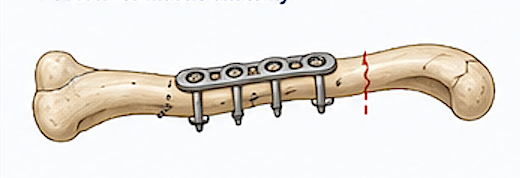
- shortening is symmetric,
- rotational alignment is restored,
- plate fixation is rigid,
- muscle anatomy is preserved.
These factors likely allow greater shortening before functional deficits appear than in malunion studies.
My Biomechanical Estimate
Based on clavicular geometry, scapular kinematics, and the available literature, I would estimate:
- 10–15 mm per clavicle is unlikely to produce permanent limitations in arm motion.
- 15–20 mm per clavicle still well tolerated by most patient with no report arm or shoulder issues.
- 20 – 25mm per clavicle well tolerated by most patients but approaches the point where compensatory mechanisms become more important.
- Beyond approximately 30 mm per clavicle, the risk of altered scapular mechanics and reduced overhead performance likely rises progressively.
For most patients seeking shoulder narrowing, 20 – 25 mm of shortening per clavicle (40–56 mm total shoulder-width reduction from bone alone) appears to offer a favorable balance between aesthetic improvement and preservation of shoulder function. Soft-tissue adaptation can make the visible narrowing slightly greater than the bony reduction alone.
What Is Most Likely to Be Affected First?
If shortening becomes excessive, the sequence of functional changes is likely to be:
- Overhead endurance (fatigue with prolonged reaching)
- Throwing velocity and power
- Heavy overhead lifting
- Scapular rhythm and coordination
- Maximum overhead range of motion (affected last, and often only with substantial shortening)
Thus, in most cases, patients would notice earlier fatigue or altered shoulder mechanics before they lose measurable arm motion.
For a surgeon performing cosmetic clavicle shortening, the limiting factor is therefore not the structural strength of the healed clavicle, but the shoulder girdle’s ability to maintain efficient scapulothoracic biomechanics after medializing the scapula. This suggests that preserving normal scapular mechanics—not simply avoiding fracture or nonunion—should define the upper limit of safe shortening.
Dr Barry Eppley
Plastic Surgeon