
The development of patient-specific forehead implants represents the single greatest advancement in aesthetic forehead augmentation over the past two decades. Earlier augmentation techniques relied primarily on intraoperative molding of bone cements or manually modified stock implants, both of which depended heavily on surgical experience and offered limited precision in reproducing complex three-dimensional contours. Contemporary computer-aided implant design has fundamentally changed this process by allowing every aspect of the implant to be planned before surgery. Instead of creating the forehead shape in the operating room, the surgeon now creates it in the digital environment where contour, symmetry, projection, and transition zones can be evaluated and refined before implant fabrication.
Despite these technological advances, successful implant design remains an artistic and anatomical exercise rather than a purely engineering process. A computed tomography scan provides only the patient’s existing skeletal anatomy. It does not determine the ideal forehead shape, implant dimensions, or aesthetic outcome. Those decisions continue to rely on the surgeon’s understanding of craniofacial proportions, soft tissue behavior, and the patient’s individual aesthetic goals. Computer software facilitates implant creation, but it does not replace surgical judgment.
CT-Based Digital Planning
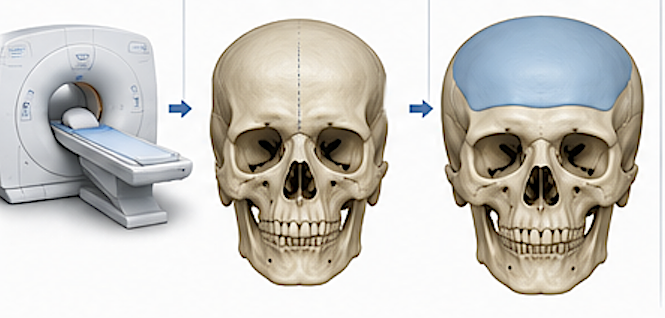
Every custom forehead implant begins with a high-resolution craniofacial CT scan using thin-cut axial acquisition, typically 0.5 to 0.625 mm slice thickness. These data are reconstructed into a three-dimensional digital model of the patient’s skull that serves as the foundation for implant design.
The first step is not designing the implant but analyzing the existing skeletal architecture. Areas of deficiency, asymmetry, excessive projection, or abrupt contour transition are identified. Particular attention is directed toward the forehead inclination, brow projection, frontal convexity, temporal transitions, anterior temporal lines, and the relationship between the forehead and the anterior cranial vault.
This analysis determines whether the patient requires isolated forehead augmentation, brow augmentation, forehead-skull augmentation, temporal extension, or a combination of these modifications.
Designing the Desired Forehead
The objective of implant design is not simply to add volume. Rather, it is to create an entirely new skeletal contour that appears anatomically natural while achieving the patient’s aesthetic goals.
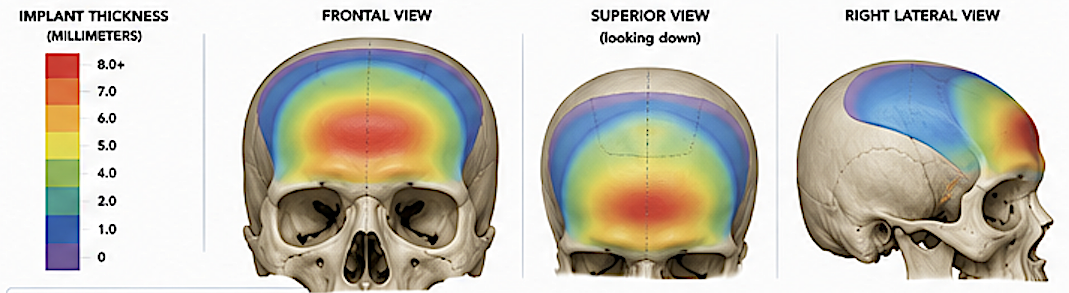
Unlike implants used elsewhere in the body, forehead implants frequently vary in thickness across nearly every point on their surface. The implant therefore functions as a three-dimensional topographic map rather than a uniform shell.
The design process typically begins by defining the desired sagittal profile. Once the appropriate forehead inclination has been established, frontal convexity is developed to create smooth profile continuity extending from the brow region toward the hairline. Width adjustments are then incorporated through modification of the lateral forehead and temporal transition zones. Finally, asymmetries are corrected through selective regional thickness adjustments rather than global increases in implant projection.
Because each parameter influences the others, implant design is inherently iterative. A seemingly minor increase in central projection may require simultaneous changes in lateral contour or superior extension to preserve surface continuity. Consequently, successful implant design depends on evaluating the forehead as a continuous three-dimensional surface rather than as a collection of isolated measurements.
The Seven Design Parameters
Although every implant is unique, most designs are based on seven fundamental architectural parameters:
Forehead Inclination establishes the overall profile and determines how far the upper forehead projects relative to the brow.
Frontal Convexity defines the curvature of the forehead between the hairline and supraorbital rims.
Brow Transition determines whether the forehead blends smoothly into the brow or develops a distinct brow break.
Forehead Width controls the transverse dimension of the upper face.
Temporal Transition creates a seamless contour between the forehead and temporal regions without visible implant borders.
Superior Extension determines how the augmentation blends into the anterior cranial vault, avoiding the appearance of an isolated forehead implant.
Regional Asymmetry Correction allows independent modification of individual regions to improve perceptual symmetry while preserving natural craniofacial variation.
These parameters should never be considered independently. The aesthetic success of the implant depends on balancing all seven simultaneously.
Implant Thickness
One of the most common misconceptions regarding custom forehead implants is that larger implants inevitably produce better aesthetic outcomes. Clinical experience demonstrates the opposite. Because the forehead occupies such a broad and visually uninterrupted surface, relatively small increases in implant thickness produce disproportionately large changes in facial appearance.
For this reason, implant projection is usually distributed over a broad surface area rather than concentrated within a localized region. A gradual transition extending over the entire forehead often creates a more natural appearance than greater projection confined to the central forehead.
When uncertainty exists regarding implant size, conservative design is generally preferable. Secondary augmentation for additional projection is technically straightforward, whereas correction of overaugmentation frequently requires implant redesign and replacement.
Beyond the Frontal Bone
One of the limitations of earlier forehead augmentation techniques was that augmentation effectively ended at the anterior temporal lines because bone cements could not be predictably extended onto the temporalis fascia. Patient-specific solid silicone implants largely eliminate this restriction.
Modern implant designs routinely extend beyond the anatomical borders of the frontal bone, allowing augmentation across the temporal transition and onto the superior cranial vault when indicated. These extended designs create more natural contour continuity while avoiding abrupt implant edges that historically contributed to an artificial appearance.
Rather than thinking of the implant as augmenting only the forehead, it is more accurate to view it as reshaping the entire upper craniofacial framework.
Surgeon-Directed Design Versus Artificial Intelligence
Artificial intelligence is increasingly incorporated into medical image processing, segmentation, and three-dimensional reconstruction. These technologies significantly accelerate the technical aspects of implant development by automating repetitive tasks and improving digital workflow efficiency.
However, AI cannot determine the most aesthetically appropriate forehead shape for an individual patient. Facial attractiveness remains highly individualized and depends on relationships among numerous craniofacial structures that extend beyond geometric measurements alone.
The surgeon therefore remains the principal designer of every custom implant. Artificial intelligence serves as an increasingly valuable assistant capable of generating surface models, identifying asymmetries, and facilitating implant fabrication, but the final implant geometry continues to reflect surgeon-directed aesthetic judgment rather than algorithmic decision-making.
Dr. Barry Eppley
Plastic Surgeon