
The Challenges of Custom Skull Implant Placement
While custom skull implants are conceptually straightforward—a patient-specific implant placed directly onto the skull—their surgical placement presents several unique technical challenges. Success depends not only on the accuracy of the implant design but also on careful handling of the scalp tissues, precise implant positioning, and meticulous soft tissue closure.
1. Limited Surgical Exposure
One of the greatest challenges is that the implant is often much larger than the incision used to place it. To minimize visible scarring, the incision is usually located low on the back of the scalp and is significantly shorter than the dimensions of the implant itself. As a result, the surgeon must work through a limited operative window while creating a pocket that extends over much of the skull.
This requires extensive subperiosteal dissection while preserving the integrity of the scalp and maintaining excellent hemostasis. The larger the implant, the more demanding this dissection becomes.
2. Scalp Elasticity Limits Implant Size
Unlike bone, the scalp has a finite ability to stretch. Every implant increases the amount of tissue that must cover it. Patients with tighter scalps or previous scalp surgery may not safely accommodate very thick implants without excessive wound tension.
For this reason, implant design must always consider the available soft tissue envelope rather than simply the amount of augmentation the patient desires. A technically perfect implant can still fail if the scalp cannot be closed without excessive tension.
3. Precise Three-Dimensional Positioning
Custom implants are designed to fit the skull with millimeter accuracy. Because of this precise fit, even slight rotational or translational errors during placement can create contour irregularities or prevent the implant from fully seating against the bone.
Large implants that extend from the occiput onto the vertex have only one ideal position. The surgeon must carefully manipulate the implant through a relatively small incision until it aligns perfectly with the underlying skull anatomy before fixation.
4. Maintaining Implant Stability
Once positioned, the implant must remain completely immobile throughout healing. Even minor movement can lead to discomfort, delayed tissue adherence, or subtle contour asymmetry.
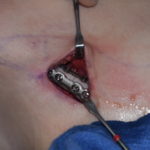
Small titanium screws are therefore routinely used to secure the implant directly to the skull. Proper fixation is particularly important for implants that span both the top and back of the head, where the curved skull surface provides multiple potential directions for displacement before fixation.
5. Achieving Smooth Edge Transitions
The edges of the implant must blend seamlessly into the surrounding skull. If the implant edge becomes elevated or is not fully seated, a visible or palpable step-off can develop.
Successful placement requires that the subperiosteal pocket exactly matches the implant dimensions and that the implant rests flush against the skull without soft tissue or periosteum trapped beneath it.
6. Hemostasis Throughout a Large Dissection
The scalp is one of the most vascular tissues in the body. Elevating the scalp over a large surface area inevitably creates numerous bleeding points.
Meticulous hemostasis is essential because even a small postoperative hematoma can place significant pressure on the scalp, increase patient discomfort, raise the risk of infection, and potentially compromise wound healing. Drains are commonly used for larger implants to reduce postoperative fluid accumulation.
7. Soft Tissue Closure Under Tension
Closing the scalp after inserting a large implant is often the most demanding part of the operation. The scalp must be reapproximated without excessive tension while maintaining adequate blood supply to the wound edges.
Careful layered closure is critical to prevent wound separation, delayed healing, or implant exposure. Implant thickness is frequently limited by what the scalp can safely accommodate rather than by what can be designed on the computer.
8. Avoiding Implant Rotation During Insertion
Medical-grade silicone implants are flexible enough to be inserted through relatively small incisions, but this flexibility also means they can temporarily fold, twist, or rotate during placement.
For very large implants, gradual manipulation is required to allow the implant to unfold naturally within the pocket while preserving its exact orientation. Once fully seated, the implant resumes its original three-dimensional shape and conforms precisely to the skull.
9. Protecting Neurovascular Structures
Although skull augmentation is performed on the bone surface beneath the periosteum, important sensory nerves and blood vessels traverse the scalp. Careful surgical technique minimizes the risk of temporary scalp numbness, preserves blood supply, and reduces the likelihood of postoperative discomfort.
10. Matching the Implant to the Surgical Pocket
The implant and the dissected pocket must function as a matched pair. If the pocket is too small, the implant may not seat completely. If it is too large, the implant can shift before fixation or leave unnecessary dead space.
This balance between implant design and surgical execution is one of the defining aspects of successful custom skull implant surgery.
The Importance of Surgical Experience
Custom skull augmentation is often perceived as simply inserting a patient-specific implant, but the operation is technically demanding. Large implants must be delivered through limited incisions, positioned with millimeter precision, securely fixed, and covered by a scalp that has limited elasticity. The best outcomes depend on the combination of advanced implant design and meticulous surgical technique. When these two elements work together, custom skull implants can produce dramatic yet natural improvements in the shape of the back and top of the head with excellent long-term stability.
Dr. Barry Eppley
Plastic Surgeon