
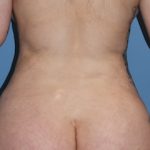
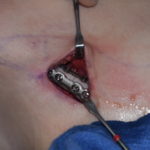
Hip implants for aesthetic body contouring are among the most technically demanding procedures in implant surgery. While the concept seems straightforward—adding projection to the lateral pelvis—the anatomy, biomechanics, implant design, and surgical access make them considerably more complex than breast, chin, or calf implants.
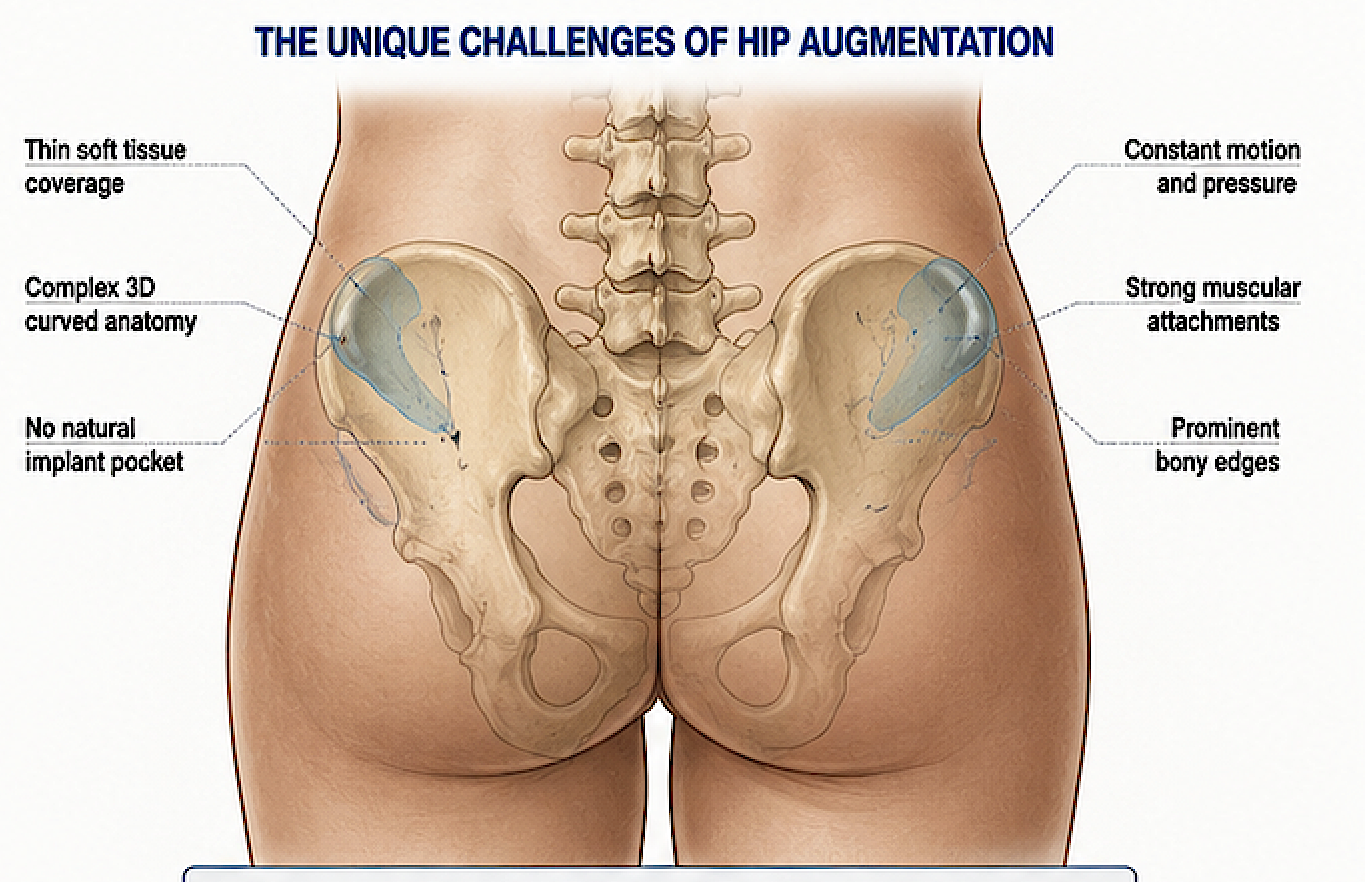
The main reasons include:
1. There is no natural implant pocket
Unlike the breast or gluteal region, the lateral hip has no natural anatomical space for an implant. It can not be placed under or in the muscle or even under the fascia. Instead it must be placed on top of the fascia in the deep subcutaneous tissues…never an ideal place for an implant.
The pocket must be:
- Large enough for implant insertion.
- Tight enough to prevent movement.
- Symmetrical on both sides.
- Stable over time.
Even a few millimeters of asymmetry can be noticeable.
2. Thin soft tissue coverage
Many patients requesting hip augmentation are naturally slender.
This means:
- Minimal fat
- Thin fascia
- Little muscle covering the implant
Consequently, implant edges may become visible or palpable if the implant is too thick or not perfectly contoured.
3. Constant motion
The hips experience continual movement during:
- Walking
- Running
- Sitting
- Sleeping on the side
- Twisting
- Climbing stairs
These repetitive forces increase the risk of:
- Implant migration
- Pocket enlargement
- Rotation
- Edge visibility
Few aesthetic implant locations experience this degree of repetitive loading.
4. Implant fixation is challenging
Unlike facial implants, which can be secured to bone with screws, aesthetic hip implants often rely primarily on pocket stability.
Without fixation, there is potential for:
- Migration
- Rotation
- Inferior settling
I have explored suture anchor fixation to the iliac crest or custom implant designs that encourage soft tissue ingrowth for engagement/stability but these techniques are not consistently reliable.
5. Standard implants rarely fit well
The pelvis varies substantially among individuals.
Differences include:
- Width of the iliac crest
- Flare angle
- Height of the crest
- Soft tissue thickness
- Existing asymmetries
Because of this, any stock implant creates compromises in fit and aesthetic outcomes, whereas custom implants can better match the patient’s anatomy and aesthetic goals..
6. Symmetry is difficult to achieve
No pelvis is perfectly symmetrical.
The surgeon must account for:
- Pelvic tilt
- Iliac crest asymmetry
- Leg length differences
- Muscle asymmetry
- Pre-existing skeletal differences
Also intraoperative positioning in the supine, prone or lateral decubitus positions make symmetry in hip implants difficult.
The goal is visual symmetry rather than identically placed implants.
7. Incisions are limited
Ideal incision placement should:
- Hide the scar.
- Allow insertion of a relatively large implant.
- Permit accurate positioning.
- Minimize contamination.
Because the incision is often remote from the final implant position, placement can be technically demanding.
8. Complication management is difficult
If problems occur, revision surgery is more challenging than the initial procedure.
Potential issues include:
- Implant malposition
- Seroma
- Edge visibility
- Infection
- Capsular contracture (less common than in breast implants but possible)
- Persistent asymmetry
Revision may require new implant designs or changes to the implant pocket.
9. Some patients need bone augmentation as well
Some hip deficiencies are skeletal as well and not just soft tissue volume deficient.:
- Need Lateral iliac crest expansion/projection
- Smooth transition into the greater trochanter
- Continuous waist-to-hip curve
Achieving this contour ca not be done with a simple oval implant. A titanium iliac crest implant is needed in addition to the traditional silicone hip implant in a a composite hip augmentation technique. (Pelvic Plasty)
Why custom hip implants are becoming more important
In my view, the greatest advance in aesthetic hip augmentation has been the application of patient-specific implant design. A CT-based custom implant can:
- Match the exact curvature of the iliac crest.
- Provide targeted projection where it is lacking.
- Blend smoothly into adjacent anatomy.
- Improve stability by maximizing bone contact.
- Better address pre-existing asymmetry.
Even with a custom design, however, surgery remains technically demanding because of the unique anatomy, limited soft tissue coverage, and constant biomechanical forces acting on the hips.
Overall, aesthetic hip implants are arguably among the most challenging custom implant procedures—comparable in complexity to custom skull and wraparound jawline implants, but with the added difficulty of weight-bearing motion and limited soft tissue concealment.
Dr. Barry Eppley
Plastic Surgeon