

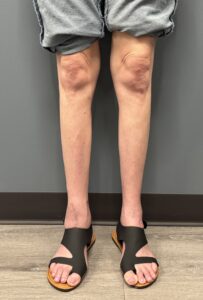
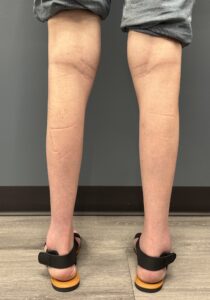
Implant sizing in Charcot–Marie–Tooth (CMT) patients is very different from standard cosmetic calf augmentation because the tissues are usually:
- thinner
- tighter
- more asymmetric
- neurologically compromised
- less forgiving of oversized implants
The aesthetic goal is usually:
“improvement of lower leg contour without causing medical or hraling problems ”
Core Principles of Sizing in CMT
1. Conservative sizing is critical
The most common mistake is choosing implants that are too large.
In CMT:
- skin and fascia are thin
- muscle bulk is absent
- there is little soft tissue camouflage
An oversized implant can lead to:
- palpable firmness
- shininess/stretching of skin
- compartment tightness
- chronic discomfort
- wound problems
The goal is not an athletic or muscular looking leg, rather it is about achieving less of an unnaturally thin leg with no shape.
2. Width matters more than projection
In standard cosmetic augmentation, projection often dominates selection.
In CMT reconstruction:
- restoring medial calf width is usually more important
- excessive posterior projection can look artificial
The best implant often:
- modestly restores medial fullness
- blends gradually into the ankle
- avoids a sharply convex posterior contour
3. Medial calf augmentation is usually primary
The medial gastrocnemius compartment contributes most visible calf contour.
In many CMT patients:
- the lateral compartment is extremely atrophic
- lateral soft tissue coverage is poor
Thus:
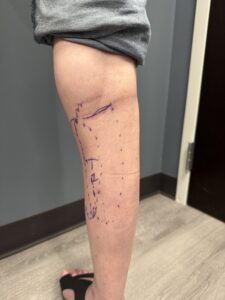
- isolated medial implants are common
- lateral implants are not \usually advised
- bilateral symmetry is often intentionally imperfect to match native anatomy
4. Soft tissue pinch thickness determines upper limit
A useful practical guide is posterior calf soft tissue thickness.
Very thin tissue (<1–1.5 cm pinch thickness):
- requires small/moderate implants
- may favor softer implants
- may require adjunctive fat grafting
Better tissue coverage:
- allows more projection safely
The tighter the skin envelope, the more conservative sizing should be.
5. Long implants often work better than highly projecting implants
In CMT, the calf deficiency is usually:
- diffuse
- elongated
- extends toward the ankle
Therefore:
- longer, lower-profile implants often create a more natural reconstruction
- short high-projecting implants can produce a “ball-shaped calf”
The reconstructed leg should taper naturally distally.
6. Asymmetry is extremely common
CMT frequently affects sides differently.
Common strategies:
- different implant volumes side-to-side
- different implant shapes
- unilateral lateral augmentation only
- custom carving/modification
Perfect symmetry is usually unrealistic.
Typical Sizing Philosophy
Mild Atrophy
Goal:
- subtle restoration
- avoid obvious augmentation
Typical approach:
- small-medium medial implant
- possible fat grafting adjunct
Moderate Atrophy
Goal:
- restore normal trouser silhouette
- improve lower leg proportion
Typical approach:
- medium medial implant
- possible small lateral implant
- careful intraoperative sizers
Severe “Stork Leg” Atrophy
Goal:
- reconstruct absent calf contour
- maintain soft tissue safety
Typical approach:
- staged or conservative augmentation
- elongated implants
- sometimes custom implants
- adjunctive fat grafting
- avoid maximal projection
These are the highest-risk patients for implant visibility.
Intraoperative Sizing Is Essential
Preoperative planning helps, but final choice is usually made intraoperatively using:
- temporary sizers
- patient tissue tension
- closure quality
- sitting/standing contour assessment
The surgeon should prioritize:
- tension-free closure
- soft contour transition
- implant invisibility
- long-term stability
over maximal size.
Fat Grafting Adjunct
Fat grafting is particularly valuable in CMT because it can:
- soften implant edges
- improve transition zones
- camouflage thin tissue
- reduce visibility
A common reconstructive strategy:
modest implant + fat grafting
often looks more natural than a very large implant alone.
Custom Implants
Custom implants become useful when:
- asymmetry is severe
- lower calf deficiency extends distally
- standard implants create contour mismatch
- tibial bowing/deformity exists
But custom implants also:
- cost more
- require more planning
- may increase revision complexity
Sizing Priorities Unique to CMT
Compared with cosmetic calf augmentation:
|
Standard Cosmetic |
CMT Reconstruction |
|
Larger size often desired |
Conservative size preferred |
|
Projection emphasized |
Width/transition emphasized |
|
Athletic appearance |
Natural restoration |
|
Symmetry goal |
Functional asymmetry accepted |
|
Thick muscle coverage |
Thin tissue challenge |
|
Cosmetic enhancement |
Reconstructive camouflage |
Practical Reconstructive Principle
The best CMT calf implant result usually looks:
- believable
- proportional
- understated
rather than obviously augmented.
Overcorrection is much harder to fix than undercorrection in neurologic atrophy patients.
Dr. Barry Eppley
Plastic Surgeon