EXPLORE
Plastic Surgery
Dr. Barry Eppley

Explore the worlds of cosmetic
and plastic surgery with Indianapolis
Double Board-Certified Plastic
Surgeon Dr. Barry Eppley

Archive for the ‘tracheal shave’ Category

Case Study: Tracheal Shave for Neck Feminization

Monday, April 1st, 2013

Background: The neck is generally a flat surface in youth that may have a bump or prominence in the middle about halfway between the jawline and the upper sternum of the chest. This laryngeal prominence, known more commonly as the Adam’s Apple, is formed by the size and angle of the thyroid cartilages that surround the larynx or voice box. This appears as a lump under the skin that is more prominent in men as the thyroid cartilages  form an acute angle where they meet in the middle. In women, this bump is much less visible, if at all, as the thyroid cartilage angle is more rounded rather than acute.

The laryngeal prominence has the name Adam’s apple for disputed reasons from a biblical  origin of an apple being stuck in Adam’s neck to a hebrew mistranslation of the words ‘man bump’. Regardless of what it is called, its purpose is to protect the larynx and the vocal cords which it contains. Its size also influences the depth of the voice. The bigger the laryngeal prominence the larger the voice box is creating a deeper toned voice.

Reducing the prominent Adam’s apple is a cosmetic neck surgery that has been done for decades. Know medically as a chondrolaryngoplasty, it is easier to call it by its more common name, a tracheal shave. While it is often thought as only being desired by transgender men to women conversions, that may be historically true but not accurate today. I done as many tracheal shaves in men who were merely bothered by its degree of prominence as that as part of facial femninization surgery.

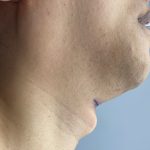
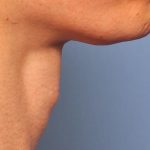
Case Study: This 35 year-old female had long been bothered by the size of her adam’s apple. She was a tall thin female with little subcutaneous fat. Her thyroid cartilages were very angular, coming to a sharp point that stuck out prominently.

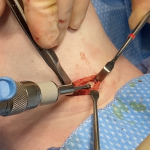
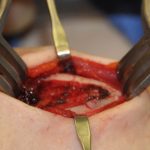
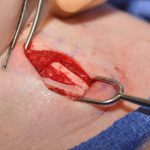
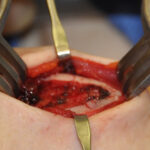
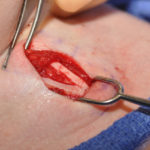
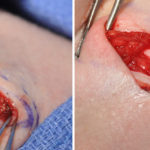
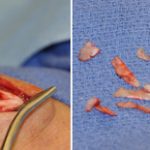
Under general anesthesia, her prominent thyroid cartilages were approached through a 3 cm long in a horizontal neck skin crease adjacent to the bump. The strap muscles were split and separated and the cartilages exposed. The front edges of the cartilages were shaved done enough to eliminate the thyroid prominence. The strap muscles were reapposed over the cartilage and the skin closed with dissolveable sutures. Only small tapes were applied for dressing.

She had minimal pain and no bruising afterwards. There was some moderate swelling and firmness over the area for a few weeks. the scar took several months to completely fade. The result shows the elimination of the thyroid bump and a much smoother and more feminine neckline.

Tracheal shaves for the prominent adam’s apple is not new. In reading its history, it has been associated with a wide range of complications including voice changes and laryngeal nerve injury. In my experience, I have seen only aesthetic issues with tracheal shaves which revolve around under- resection. It is important to get the best reduction possible but one should not over weaken the cartilages or violate the mucosal lining in so doing. It is always better to leave a  much reduced hump with no complications than a completely flat one with a complication.

Case Highlights:

1) The prominent adam’s apple in the neck is the result of large paired thyroid cartilages and thin neck tissues.

2) Reduction of the prominent adam’s apple is through a shaved reduction of the anterior or front portion of the thyroid cartilages. (tracheal shave)

3) The prominence of the adam’s apple can be significantly reduced but can not always be reduced enough to make the neck completely flat.

Dr. Barry Eppley

Indianapolis, Indiana

Postoperative Instructions for Tracheal Shave (Adam’s Apple Reduction) Surgery

Wednesday, February 20th, 2013


A tracheal shave or Adam’s Apple reduction is the removal of the protruding portions of the paired thyroid cartilages that cover the larynx. This is done through a small horizontal neck incision directly over them in a natural neck skin crease. The cartilages are reduced by shaving or burring them down but without making them unduly weak or disrupting the attachments of the underlying vocal cords. How much reduction of the neck bulge that can be achieved highly depends on the thickness of the cartilages.

The following are typical after surgery tracheal shave instructions:


1)  Most tracheal shave procedures have virtually no pain after surgery. Patients usually only feel the need to use Tylenol or Ibuprofen for just a few days after the procedure, if any medication at all.

2) There  will be a flesh-colored tapes glued on over the incision. That will stay on for a week or so. It will either be removed by Dr. Eppley at the first postoperative follow-up (in town patients) or you may peel it off after a week for out-of-town patients.

3) There may or may be some spotting of blood on the tapes. This is normal and not a cause for concern.

4. The sutures used in the small neck incision are all under the skin and will dissolve on their own. There is NO need for suture removal.

5. You may shower and wash your hair as normal the following day. There is no harm in getting the  neck tapes wet.

6) There may be some mild neck stiffness and soreness when you extend your neck backwards after surgery. Avoid excessively stretching your neck backwards for a few weeks after surgery once the tapes are removed.

7) Once the neck tapes are removed, you may begin to apply any topical scar treatments if you desire.

8) There are no limitations to any physical activities after tracheal shave surgery. You may feel free to run, workout and do any non-contact sporting activity as soon as you feel comfortable.

9) There are no restrictions on what you can eat or drink after surgery. Swallowing has no adverse effects on neck healing.

10. If any neck redness, increased tenderness or swelling, or drainage develops after the first week of surgery, call Dr. Eppley and have your pharmacy number ready.

Consent for Plastic Surgery – Tracheal Shave (Adam’s Apple Reduction)

Tuesday, February 19th, 2013


Every plastic surgery procedure has numerous issues that every patient who is undergoing a procedure should know. These explanations are always on a consent form that you should read in detail before surgery. This consent form, while many perceive as strictly a legal protection for the doctor, is actually more intended to improve the understanding of the tracheal shave procedure. The following is what Dr. Eppley discusses with his patients for this procedure. This list includes many, but not all,of the different outcomes from surgery. It should generate both a better understanding of the procedure and should answer any remaining questions that one would have.

ALTERNATIVES

There are no alternatives to reducing a prominent thyroid cartilage (adam’s apple) other than open surgical reduction.

GOALS

The goal of a tracheal shave is to reduce the prominence of the neck bulge over the thyroid cartilage.

LIMITATIONS

The limitations of  a tracheal are in how much reduction can be achieved. How much reduction of the neck bulge that will result depends on the thickness of the cartilage and the overlying soft tissues.

EXPECTED OUTCOME

Expected recipient site outcomes include the following: temporary swelling and bruising of the neck area, mild temporary soreness and neck tightness, a small permanent heck scar and up to 3 months for all swelling to go down to see the final result.

RISKS

Significant complications from tracheal shaves are very rare. More likely risks include infection, undercorrection with some residual neck bulging and adverse neck scarring. Permanent voice changes have been reported in the medical literature by not seen by Dr. Eppley. Any of these risks may require revisional surgery for improvement.

ADDITIONAL SURGERY

Should additional surgery be required for tracheal cartilage or scar revision, this will generate additional costs.

Options in Neck Contouring – 2. Hard Tissue Procedures

Saturday, August 25th, 2012


While the soft tissues dominate the surface area of the neck, they are not the only elements that give it its shape. Several hard tissue components comprised of bone and cartilage also make a contribution. The form of the jawline is on the upper edge of the neck and is the superior suspension point for most of the neck’s soft tissues. The thyroid cartilage sits in the midline of the lower neck and is barely noticeable unless it sticks out too far. The prominence of the thyroid cartilage also has gender significance in helping to define a male vs a female’s neck.

While manipulation of the hard tissues of the neck does not change the all-important cervicomental angle, it does help influence how that angle is seen. The stronger and more defined the jawline is, the greater is the perception of more youthful neck due to a longer upper limb of the cervicomental. If the thyroid cartilage is too prominent, the lower limb of the angle is disrupted creating an undesireable bump in the neckline. While for men this bump may be fine and even attractive, it is not so for women.

Chin Augmentation The jawline separates the neck from the face and is defined by both its length and it anterior projection. The chin is the most forward part of the jawline and its strength or weakness can help or hurt the appearance of the neck.  The horizontal projection of the chin can be easily increased using a variety of implant styles and sizes. Chin implants can be placed through either the mouth or from under the chin. For many patients, putting the implant in from under the chin assures proper positioning on the most forward part of the chin bone. Chin augmentation can be a very useful adjunctive procedure with any of the neck contouring procedures, particularly isolated liposuction and facelifts.

Tracheal Shave  The prominence of the thyroid cartilage often has little to do with one’s age. The size of the cartilages are genetically imprinted and not age-related. The one occasional exception is that seen after a facelift when the profile of the thyroid cartilage can become unmasked as the neck skin is tightened and pulled back. For those that have too strong of a neck bulge caused by the strength of the paired thyroid cartilages (more commonly known as an Adam’a apple), this can be reduced by shaving the prominence down. This is done through a small horizontal neck incision directly over the prominence. It is a virtually painless procedure with no recovery and a result that is immediate. Most patients obtain results where the size of the bulge is dramatically reduced and a few will get a completely smooth neckline in profile.

Tracheal Augmentation In rare cases, a more dominant or even an evident thyroid cartilage bulge is desired. This masculinizing neck procedure requires the placement of a specially-shaped implant on top of the thyroid cartilage to build out its projection where the paired cartilages meet in the midline. When combined with a submentoplasty above it, a more prominent tracheal bulge can be created.

Dr. Barry Eppley

Indianapolis, Indiana

Tracheal Shave (Adam’s Apple Reduction) for Neck Contouring

Tuesday, May 19th, 2009

A large or protruding thyroid cartilage (a.k.a. Adam’s Apple or pomus Adamus) can be a source of embarrassment to the male transsexual as well as to certain aesthetically-sensitive males. Reducing the size of the upper portion of the thyroid cartilage, known technically as a chondrolaryngoplasty, is often an essential procedure in appearing more feminine. A feminine-appearing face with a protruding thyroid cartilage  is a sure giveaway of one’s sexual origin.

Thyroid cartilage reduction, or a tracheal shave, is a fairly straightforward procedure both to do and to undergo. The cartilage is reduced by making a small horizontal incision directly overlying the most prominent portion of the cartilage in a natural skin crease. The cartilage is literally shaved down with a scalpel but not so far as to risk passing through the underside of the cartilage. The vocal cords lie on the inside of the cartilage. The incision is then closed with dissolveable sutures placed on the inside of the skin. There is very minimal pain and swelling afterwards.

Complications from a tracheal shave are few with hypertrophic (thick) scars being the most common.  Scars across the thyroid cartilage definitely have a tendency towards becoming thicker so scar treatments and massage are essential. Of some significance is that undesirable voice changes have been reported and can occur as the ‘box’ of the thyroid cartilage may become unstable if it is thinned too much, changing the tension or stretch of the vocal cords. Most voice changes are temporary however.

All tracheal shaves that I have performed have been done under general anesthesia, usually with other feminizing procedures such as rhinoplasty or forehead contouring. As a stand alone procedure, it may be able to be done under local anesthesia or IV sedation.

Tracheal shaves are a simple and effective procedure for reducing an unsightly neck bulge. In respecting the function of the thyroid cartilage, it may not be adviseable to try and make the neck completely neutral for fear of making a permanent voice change. Reduction of the bulge is always achieved but the neck may not be able to be made completely flat in this area.
Dr. Barry Eppley

Indianapolis, Indiana 


Dr. Barry EppleyDr. Barry Eppley

Dr. Barry Eppley is an extensively trained plastic and cosmetic surgeon with more than 20 years of surgical experience. He is both a licensed physician and dentist as well as double board-certified in both Plastic and Reconstructive Surgery and Oral and Maxillofacial Surgery. This training allows him to perform the most complex surgical procedures from cosmetic changes to the face and body to craniofacial surgery. Dr. Eppley has made extensive contributions to plastic surgery starting with the development of several advanced surgical techniques. He is a revered author, lecturer and educator in the field of plastic and cosmetic surgery.

Read More


Free Plastic Surgery Consultation

*required fields


Pricing

The cost of any type of elective plastic surgery plays a major role in the decision to undergo the procedure(s).

Get Your Quote Here


My Plastic Surgery Story

Military Discount

We offer discounts on plastic surgery to our United States Armed Forces.

Find Out Your Benefits


Categories